What is Depression?
Understanding the symptoms, mechanisms, and how to find your way out.
What depression actually is:
An illness on par with other medical conditions
A serious condition
Not just stress or feeling unwell
Not purely a psychological state
Involves biological processes in the nervous system
Something that can affect all of you, sleep, appetite, energy, thinking, not only mood
Not a weakness, and not something you chose
A common condition
A condition that can affect anyone
A condition that can be recurrent or chronic
Before any of the explanation, it can help to see it described from the inside. I had a black dog, his name was depression is a short animated film made by the World Health Organization, based on Matthew Johnstone’s book. It runs about four minutes. it puts pictures to what the days are like, and a great many people recognise themselves in it.
How normal are my feelings?
Some people can feel very down without being depressed. For others, it might mean they have depression. What is the difference?
Strong emotions and stress are natural reactions for everyone, especially youth. This can cause parents, teachers, and friends to overlook someone developing depression, interpreting signs of mental illness as just "part of growing up."
A bad grade, a misunderstanding with friends, or an argument with a partner or parents are common events that cause psychological stress. Reacting to adversity is part of a healthy process where we learn to master challenges.
Psychological stress, with symptoms like sleep difficulties, rumination, low self-esteem, poor appetite, and headaches, can last a few hours or a couple of days. It is when symptoms last for weeks or even months that the reactions become more serious and may indicate developing depression.
Have you been very sad, down, unable to sleep (or sleeping too much), lacking desire to do anything, lacking energy to be with friends, unable to eat, or unable to concentrate at school or work? Has it been like this almost all the time, for a few weeks?
If you have depression, you might feel oppressed and heavy-hearted, or sour and irritable. Some get concentration problems and remember less. This can also be a sign of other illnesses, so if you feel this way for longer periods, contact your doctor for further assessment. If it turns out you have depression, you can get well and feel better with the right treatment and your own effort. It is quite common to have anxiety in combination with depression.
Symptoms
Low mood, lack of initiative, despair, fear, or even anger are among the things you might feel if you are depressed. Physical symptoms like insomnia or sleeping too much, abnormally large or abnormally poor appetite can also be signs of depression. Symptoms can vary from person to person. Remember that all these feelings are sometimes common and do not necessarily mean you have a mental health issue that needs treatment. Often it will pass on its own, or after you have talked to a friend or someone else you have good contact with. It is if the difficult feelings do not go away or if they get worse, that it might be a good idea to talk to a doctor or other healthcare personnel.
Diagnosis
There is no specific test that will give you an answer to whether you have depression. The usual way is to talk to your doctor about how you are feeling, and possibly answer questions like: Have you felt down, depressed, and had negative thoughts about the future over the last couple of weeks? The doctor may also ask if you have changes in appetite and sleep patterns or other physical symptoms. If you conclude that this might be depression, it is important to talk about what kind of treatment might be suitable.
Treatment
For mild to moderate depression, guidelines usually suggest trying psychological treatment first. For severe depression, medication is often part of treatment from the start. There is no single right order, it depends on how severe it is, and on you. You and your doctor can assess whether there is a need for a referral to a psychologist or if the doctor themselves should follow you up.
It is normally best to be in work, education, or your usual activity even if you have depression. It may seem insurmountable, and research on behavioural activation points the same way: staying connected to activity tends to support recovery. Regular physical activity, good sleep quality, and a normal healthy diet are smart, and will also help prevent new depression.
What you can do yourself
You cannot always prevent depressive thoughts and feelings from returning, but you might be able to stop the depression in its early stages or at least make the symptoms smaller and the depression shorter.
Have a "contingency plan". It can contain advice to yourself about sleep and "rumination". If you sleep poorly and lose energy, the tendency to ruminate will increase. This can make you feel more depressed. If you learn to become aware of negative thoughts, you can avoid letting one negative thought drag another into the rumination mill. Then you prevent the depression from reinforcing itself.
Contact healthcare personnel if you cannot get rid of the negative thoughts on your own. Get help to help yourself.
Ask yourself: What triggered the depression now? Was it something I can influence? Then you can address it and prevent depression again.
Being active with other people strengthens self-esteem. Good self-esteem is important in the work to prevent depressions. The same applies to physical activity.
Mindfulness and the prevention of depression
Mindfulness-based cognitive therapy (MBCT) combines mindfulness practice with elements of cognitive therapy. Research suggests that it can help people who have experienced recurrent depression reduce their risk of relapse.
An individual patient data meta-analysis of nine randomised trials found that participants who received MBCT had a lower risk of depressive relapse over a 60-week period than those receiving usual care or other non-MBCT approaches. MBCT is a structured therapeutic programme, so these findings should not be interpreted as evidence that mindfulness exercises alone have the same effect.
Try a guided mindfulness practice
You do not need to clear your mind or make difficult feelings disappear. Mindfulness is about noticing thoughts, emotions and bodily sensations with greater awareness, without immediately judging them or getting caught up in them. You can explore the guided practices below and see whether one feels helpful for you.
Mindfulness is not a replacement for professional care when you need it. If focusing inward feels uncomfortable or overwhelming, you can stop and try a grounding exercise instead.
Research: Kuyken, W., et al. (2016). Efficacy of Mindfulness-Based Cognitive Therapy in Prevention of Depressive Relapse: An Individual Patient Data Meta-analysis From Randomized Trials. JAMA Psychiatry, 73(6), 565–574. Read the study.
The loop depression builds, and the way out of it
Depression is not only a feeling. It is a feeling that quietly reorganises your life around itself, and it is the reorganising that keeps it going. Drawn out, it looks like this.
Maybe your mood is low and there is no energy, so you do less, you cancel, you stay in, you let the small things slide. That is a completely reasonable response to having no energy. But doing less also means fewer of the moments that would have given you something back: no small win, no company, no daylight, nothing that says I can still do things. With fewer of those, the mood sinks a little further, the energy is lower still, and the next round starts from further down. Nothing in that loop means you are lazy or weak. It means the illness has a shape, and the shape is predictable.
The predictable part is also the useful part, because it shows you where to break in. The gold box under the loop has a name: behavioural activation. It asks you to do one small, planned thing, before you feel like doing it.
That order is the whole point, and it is the opposite of how we normally think. We are taught to wait until we feel motivated and then act. In depression that wait does not end, because motivation is one of the things the illness has taken. So you reverse it: you act first, and the motivation, or at least a little more of it, tends to turn up afterwards, as a result of having acted. Not always. Not immediately. But reliably enough that it is treated as a treatment in its own right, not just a piece of advice.
In practice it is far smaller than people expect. Not “start exercising”. More like: tomorrow at eleven I will walk to the postbox and back. Written down, at a set time. Then you notice what it was actually like, usually a little better than you predicted. Then you do the next one. A therapist will normally help you build the list and plan a week at a time, so it is not left to you to work out on a bad morning.
What the research says. Behavioural activation is recognised and studied as a therapy in its own right (Dimidjian et al., 2006; Ekers et al., 2014). In a well-known study that took cognitive behavioural therapy apart to see which pieces were doing the work, behavioural activation on its own was found to have comparable effect to the full package of behavioural activation plus cognitive restructuring (Jacobson et al., 1996). Read together, that suggests the active ingredient is less about which technique is used, and more about going towards what has been avoided, and acting before the motivation arrives.
External Resources & Videos
About that series. Magnus Nordmo is a Norwegian psychologist, and this is a free self-help series he has made and published himself, working through cognitive behavioural therapy for depression step by step, in Norwegian. It is his work, not ours, we are pointing you to it. It is a good companion to treatment, and a reasonable place to start while you are waiting for it, but it is not a substitute for working with someone.
INTERNATIONAL RESOURCES
NHS (UK), a plain-language overview of depression in adults, symptoms and treatment.
NIMH (US), the National Institute of Mental Health on depression: signs, treatment options and how to find help.
Mind (UK), information and support for anyone living with a mental health problem.
Samaritans (UK & Ireland), call 116 123, free, 24 hours a day.
988 Suicide & Crisis Lifeline (US), call or text 988, 24 hours a day.
findahelpline.com, free, confidential helplines listed by country, if you need to talk to someone today.
Depression is a treatable condition
Getting treatment can be useful for most people with depression because the depression will likely last longer or worsen if left untreated.
If you need help:
Contact your GP, or your local urgent care or out-of-hours medical service.
If you have strong suicidal thoughts or feel the urge to harm yourself, call your local emergency number or go to your nearest emergency room. To find a free, confidential helpline where you live, go to findahelpline.com.
If you are in school, talk to the school nurse, who can refer you further for treatment.
If you are studying, you can contact the student health service.
Is it difficult to take the first step to get help? Talk to a friend, or another person you trust. It could be a teacher, priest, youth club leader, or a school counselor.
When Grief Becomes Difficult to Carry - Depression, loss, and prolonged grief
Some losses change the way the world feels.
You may find it difficult to imagine a future that once seemed natural. Everyday activities can feel meaningless. You might withdraw from people, lose interest in things you used to enjoy, or find yourself returning to the same memories and questions again and again.
Perhaps you have lost someone you love. Perhaps a relationship has ended, or the life you expected to have is no longer possible.
Whatever the loss, you may be trying to understand why something that happened in the past can still affect almost every part of your present.
Grief is not a weakness, and there is no single correct way to grieve. Healing does not mean forgetting someone, deciding that the loss was acceptable, or leaving an important part of your life behind. It means gradually finding ways to carry what happened while making room for life as it is now.
When grief and depression overlap
Grief and depression can share many experiences: sadness, exhaustion, difficulty concentrating, withdrawal, and a loss of interest in everyday life.
But they are not the same.
Grief often centres on the person, relationship, or future that has been lost. Depression can affect a person's sense of self, their expectations for the future, and their ability to experience pleasure or connection more broadly. The two can also occur together.
If you are struggling, you do not need to work out which label fits before seeking support. What matters is understanding what you are experiencing, how it affects your life, and what kind of help might make a difference.
A closer look: Why can grief become stuck?
Grief can involve more than missing someone. It can also affect how we remember, what we believe about ourselves, and how we approach life after a loss.
Psychologists Paul Boelen and colleagues proposed a cognitive behavioural model in 2006 to explain why grief becomes persistent and distressing for some people. Their model identifies three interconnected processes.
1. The loss has not yet become part of your understanding of life
You may know that someone has died, yet part of you still expects them to walk through the door, answer the phone, or be there for an ordinary moment.
A familiar place, a song, or the sound of a key in the door can bring the person vividly to mind. Some memories may feel comforting; others may make the loss feel painfully immediate.
This does not mean that you are deliberately refusing to accept what happened. The mind needs time to connect the knowledge of a loss with memories, daily routines, and expectations about the future.
Gradually, the loss may become part of your life story rather than something that feels unreal or continually present.
2. The loss changes what you believe about yourself and the future
After a major loss, thoughts such as these can arise:
“I will never be happy again.”
“Nothing matters without them.”
“I should have done more.”
“If I begin to enjoy life again, it means I am leaving them behind.”
These thoughts can feel completely convincing when you are in pain. Some reflect genuine questions that deserve time and compassion. Others may turn a painful moment into a permanent conclusion about your life.
When the future seems closed, it can become difficult to imagine new relationships, meaningful activities, or even small moments of enjoyment.
You do not have to force yourself to feel hopeful. Sometimes the first step is simply to recognise that a thought is an expression of how things feel right now, rather than proof of how they will always be.
3. You begin to avoid the pain, or withdraw from life
When grief feels overwhelming, avoiding reminders can bring short-term relief. You might avoid certain places, conversations, photographs, or memories.
You might also withdraw from friends, work, hobbies, and routines because everything takes too much energy.
Sometimes people feel that moving forward would be disloyal to the person they lost. Others fear that allowing themselves to feel the full pain will make it impossible to cope.
These responses are understandable. Avoidance can offer temporary protection when emotions feel too intense. But if it gradually narrows your life, it can also leave you with fewer opportunities to discover that painful feelings can be experienced without completely overwhelming you.
The goal is not to force yourself to face everything at once. It is to find a pace at which you can begin reconnecting with life while respecting what you have been through.
How these patterns can reinforce one another
The three processes can become connected.
When reminders of the loss feel overwhelming, you may avoid them. Avoidance can prevent you from gradually adjusting to the reality of the loss. At the same time, thoughts such as “I will never cope” can make avoidance feel necessary.
As you withdraw from everyday life, you may lose some of the routines, relationships, and experiences that once gave your days meaning. This can deepen feelings of emptiness and make the future seem even more hopeless.
This is not a personal failure. It is a pattern that can be understood and, with support, gradually changed.
You do not need to resolve every memory, belief, or feeling at the same time. Change can begin with one part of the pattern.
What is prolonged grief disorder?
Most people experience intense grief after losing someone important. Over time, the experience often changes, although grief can return around anniversaries, significant events, or unexpected reminders.
For some people, however, grief remains persistently intense and significantly interferes with everyday life.
Prolonged grief disorder (PGD) is a recognised mental health condition involving persistent longing for, or preoccupation with, someone who has died, alongside significant emotional pain and difficulty adapting to the loss.
Other experiences may include:
Feeling that a part of your identity has disappeared.
Finding it difficult to accept the death.
Avoiding reminders because they are too painful.
Feeling that life has lost its meaning.
Struggling to reconnect with relationships, responsibilities, or activities.
The time required before a diagnosis can be considered differs between diagnostic systems: the ICD-11 uses a minimum of six months after the death, while the DSM-5-TR uses twelve months for adults and six months for children and adolescents. These timeframes are not deadlines for grief, and the passage of time alone does not establish a diagnosis. The intensity of distress, its persistence, cultural context, and its impact on daily functioning also matter.
Prolonged grief disorder is distinct from depression and post-traumatic stress disorder, although they can occur together. It is estimated to affect a small minority of bereaved people, with prevalence varying according to the diagnostic criteria used.
Having intense grief does not automatically mean you have a disorder. You deserve compassion and support whether or not a diagnosis applies.
What can help when grief remains overwhelming?
Research reviewed by LaPlante and colleagues in 2024 suggests that grief-focused cognitive behavioural therapies have some of the strongest evidence for treating prolonged grief disorder. These approaches are adapted to the person's needs and may include several complementary elements.
Making room for the reality of the loss
With appropriate support, gradually approaching painful memories and reminders can help some people process what happened. This is not about forgetting the person or forcing yourself to move on. It is about making the loss more possible to live with.
Understanding painful beliefs
Therapy can help you explore beliefs about guilt, identity, loyalty, and the future. The aim is not to argue you out of your grief, but to understand how these beliefs affect you and whether they leave room for other ways of living.
Reconnecting with everyday life
Small, meaningful activities can help restore structure, connection, and a sense of possibility. This might mean contacting a trusted friend, returning to a familiar activity, or taking one manageable step towards a responsibility you have been avoiding.
Finding a pace that feels manageable
There is no universal timetable for grieving. Helpful support takes your circumstances, culture, relationships, and readiness into account. Some people benefit from individual therapy; others may find additional support through trusted people or a carefully facilitated group.
Not every intervention works for everyone, and the evidence is still developing. Grief-focused therapy can help, but recovery is not always straightforward and further support may be needed.
You can carry the loss without giving up your future
Perhaps part of you worries that feeling better would mean caring less. Perhaps you are afraid that if you stop thinking about the person, you will lose something important about them.
But remembering someone and continuing to live are not opposites.
You can preserve the relationship's meaning while allowing your own life to change. You can have moments of joy without denying your sadness. You can begin to make plans without pretending that the loss no longer matters.
You do not have to rush towards acceptance, and you do not have to face everything alone.
If grief, low mood, or withdrawal has made everyday life difficult for a prolonged period, consider speaking with a qualified mental health professional. If you are struggling to stay safe or are experiencing thoughts of suicide, seek urgent support through your local emergency or crisis services.
You are not being asked to leave the past behind. You are allowed to find a way to live with it.
Further reading
Boelen, P. A., van den Hout, M. A., & van den Bout, J. (2006). A cognitive-behavioral conceptualization of complicated grief. Clinical Psychology: Science and Practice, 13(2), 109–128. https://doi.org/10.1111/j.1468-2850.2006.00013.x
LaPlante, C. D., Hardt, M. M., Maciejewski, P. K., & Prigerson, H. G. (2024). State of the science: Psychotherapeutic interventions for prolonged grief disorder. Behavior Therapy, 55(6), 1303–1317. https://doi.org/10.1016/j.beth.2024.07.002
IF READING THIS FELT FAMILIAR
When nothing feels worth the effort, "just do it" is not advice, it is the thing you cannot reach
Low mood is not laziness and it is not a character flaw: when mood drops, the brain narrows what it predicts is worth the effort, so fewer things get started and fewer things go well, and the narrowing then comes back to you as proof that nothing helps, which is how the loop keeps itself running. Depression needs proper assessment and treatment, and a course is not that, and nothing here replaces it. But you are the person who keeps functioning anyway, the one who still answers, still turns up, still gets through the day, and you are also the only one who knows what it costs to be that person. The Emotion Regulation Course is where the mechanism is laid out plainly, what a feeling is actually doing, why a wave that takes about 90 seconds can feel like it will never end, and what to do with it while it is here, one small step at a time, written out of 8 years and 4,500 clinical hours.
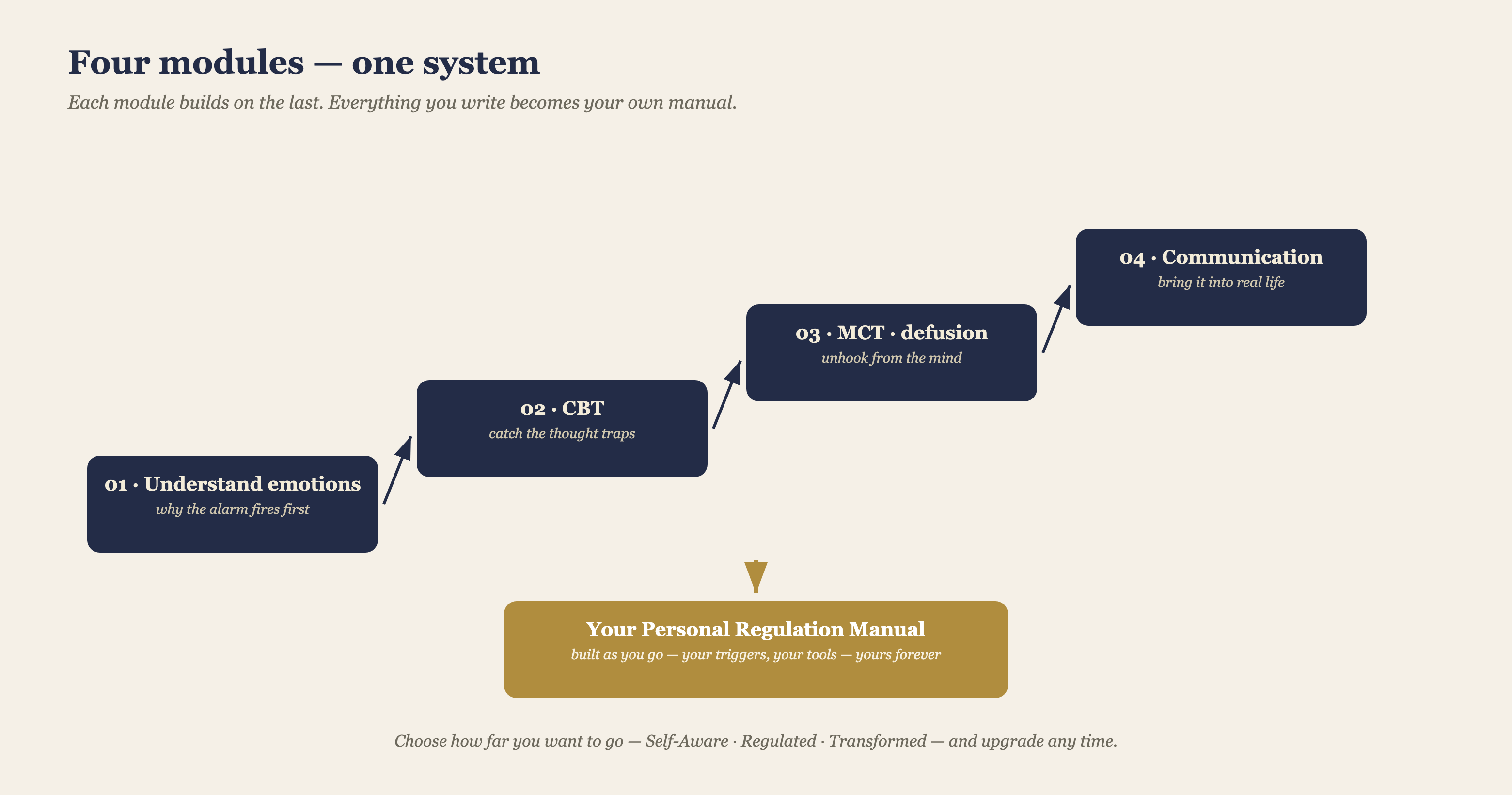
WHAT IS INSIDE
Module 1: Understanding Emotions, 59 lessons · 5 parts
Module 2: CBT Thought Patterns, 28 lessons
Module 3: MCT Thought Defusion Techniques, 32 lessons
Module 4: Communication in Real Life, 44 lessons
From $297 · one-time payment · instant access. This is education, not treatment for depression, please speak to your GP as well.
If you want something to hold onto
Depression narrows what feels possible. These are free, and small enough to actually use on a low day.
Free · workbook
The Self-Worth Reset
Where the sense of not being enough comes from, and how it is answered.
The inner critic as a one-sided prosecutor, and an evidence audit that answers it
Free · workbook
The Overthinking Off-Ramp
Why the mind loops, and why it is loudest at night.
Sort the thought, take an exit, interrupt the loop
Free · article
Good Reasons for Bad Emotions
Why low mood is not a sign of a broken brain.
What sadness is for, and what it asks of you
Understand why you feel this way:
Start with the 15-minute test ($27). It names your pattern and shows you exactly where to begin.