What Is Anxiety?
A clinical overview of anxiety disorders, what they are, how they work, why they persist, and what actually helps.
Anxiety is not a character flaw, a sign of weakness, or an overreaction. It is the brain's threat-detection system doing exactly what it was designed to do, just in the wrong context, or at the wrong intensity.
The anxiety response evolved to protect us from physical danger. When the amygdala detects a threat, it triggers the sympathetic nervous system: heart rate increases, breathing quickens, muscles tense, digestion slows. The body is preparing to fight, flee, or freeze. This response is extraordinarily effective against a predator. It is considerably less useful in a meeting, on a plane, or in a supermarket queue.
The problem is not the alarm system itself, it is that the alarm has become miscalibrated. It fires in response to perceived threats (social judgment, uncertainty, physical sensations) as if they were life-threatening. And once it fires, the avoidance behavior that follows prevents the nervous system from learning that the threat was not actually dangerous.
The Amygdala
The brain's smoke detector. It processes threat signals before the rational brain (prefrontal cortex) can evaluate them. This is why anxiety feels automatic, because it is. The amygdala acts first and asks questions later.
The Maintenance Cycle
Anxiety is maintained by avoidance. Every time you avoid a feared situation, you get short-term relief, which reinforces the avoidance. The feared situation never gets the chance to be disconfirmed as dangerous. The anxiety grows.
The Way Out
Exposure, approaching feared situations rather than avoiding them, is the core mechanism of change. Not because it eliminates anxiety, but because it teaches the nervous system that the feared outcome is survivable, or does not occur.
An important distinction:
Anxiety and fear are related but different. Fear is a response to a present, identifiable threat. Anxiety is anticipatory, it is about what might happen. Most anxiety disorders involve the overestimation of threat probability and/or the underestimation of one's ability to cope.
What anxiety feels like in the body
Anxiety is a full-body experience. Understanding the physiology behind each symptom reduces their power, they are not signs that something is wrong with you. They are signs that your nervous system is working.
- Racing heart / palpitations
The heart pumps harder to deliver oxygen to muscles preparing for action. Not dangerous, though it often feels it.
- Shortness of breath / chest tightness
Breathing becomes faster and shallower to increase oxygen intake. This can cause hyperventilation, which paradoxically increases feelings of breathlessness.
- Dizziness / lightheadedness
Hyperventilation lowers CO2 levels, causing blood vessels to constrict slightly. Not dangerous, but deeply uncomfortable.
- Nausea / stomach upset
Digestion is deprioritized during threat response. Blood flow is redirected to muscles. The gut-brain axis is highly sensitive to stress.
- Sweating / trembling
Sweating cools the body in preparation for physical exertion. Trembling is muscle activation, the body ready to move.
- Numbness / tingling
Hyperventilation and blood flow changes can cause temporary numbness, particularly in hands and face. Alarming but harmless.
- Feeling of unreality (derealization)
The brain enters a state of heightened alertness that can make the environment feel dreamlike or distant. A protective response, not a sign of losing one's mind.
- Muscle tension / headaches
Muscles tense in preparation for action. Chronic anxiety leads to chronic muscle tension, particularly in the neck, shoulders, and jaw.
Types of anxiety disorders
Click each type to expand the clinical description, mechanism, and treatment approach.
Core presentation
Persistent, excessive worry about multiple areas of life, work, health, family, finances, that is difficult to control.
Physical symptoms
Muscle tension, fatigue, difficulty concentrating, irritability, sleep disturbance.
How it works
The brain's threat-detection system (amygdala) is chronically activated, interpreting ambiguous situations as dangerous. The prefrontal cortex, which normally regulates this response, becomes less effective over time under chronic stress.
Treatment
CBT (particularly worry postponement and cognitive restructuring), ACT, and in some cases medication. GAD responds well to psychological treatment.
Core presentation
Intense fear of social situations where one might be observed, judged, or humiliated. Often misunderstood as shyness.
Physical symptoms
Blushing, sweating, trembling, racing heart, nausea, particularly in anticipation of social situations.
How it works
Heightened self-focused attention combined with a distorted sense of how one appears to others. Safety behaviors (avoiding eye contact, preparing scripts) maintain the anxiety by preventing disconfirmation of feared outcomes.
Treatment
CBT with exposure and behavioral experiments is the gold standard. Video feedback can be particularly effective in correcting distorted self-perception.
Core presentation
Recurrent unexpected panic attacks, sudden surges of intense fear with physical symptoms, combined with persistent worry about future attacks.
Physical symptoms
Palpitations, chest pain, shortness of breath, dizziness, numbness, feeling of unreality, fear of dying or losing control.
How it works
A misinterpretation of normal bodily sensations as catastrophically dangerous. The panic attack itself is not dangerous, it is the body's alarm system misfiring. Avoidance of situations associated with panic maintains and expands the disorder.
Treatment
Interoceptive exposure (deliberately inducing feared sensations to learn they are survivable), CBT, breathing retraining. Well researched, with effective treatments.
Core presentation
Intense, irrational fear of a specific object or situation (spiders, flying, blood, heights, vomiting) that is out of proportion to actual danger.
Physical symptoms
Immediate anxiety response upon exposure or anticipation of exposure. May include fainting response with blood-injection-injury type.
How it works
Classical conditioning, a neutral stimulus becomes associated with fear through direct experience, observation, or information. The fear is maintained through avoidance.
Treatment
Graduated exposure therapy is highly effective, often achievable in a small number of sessions.
Core presentation
Fear of situations where escape might be difficult or help unavailable in the event of a panic attack, public transport, open spaces, crowds, being outside alone.
Physical symptoms
Panic symptoms in feared situations. Progressive restriction of movement and activity.
How it works
Often develops following panic disorder. The world gradually shrinks as more and more situations are associated with the possibility of panic.
Treatment
Exposure therapy with gradual expansion of the avoided situations. Often combined with panic disorder treatment.
Core presentation
Intrusive, unwanted thoughts (obsessions) combined with repetitive behaviors or mental acts (compulsions) performed to reduce distress.
Physical symptoms
High anxiety and distress triggered by obsessive thoughts. Temporary relief from compulsions, followed by return of obsessions.
How it works
Compulsions provide short-term relief but reinforce the belief that the obsessive thought is dangerous and must be neutralized. ERP (Exposure and Response Prevention) breaks this cycle.
Treatment
ERP is the gold standard. The goal is not to eliminate intrusive thoughts, everyone has them, but to change the relationship with them.
Core presentation
A response to experiencing or witnessing a traumatic event. The memory is not processed in the usual way, so it can feel as if the danger is still happening now.
Physical symptoms
Flashbacks, nightmares, hypervigilance, startle response, emotional numbing, avoidance of trauma reminders.
How it works
During trauma, memories can be stored in a fragmented way, without a clear sense of time and place (Ehlers & Clark, 2000). This produces fragmented trauma memories that are re-experienced as if happening now.
Treatment
Trauma-focused CBT, EMDR, and Prolonged Exposure are all evidence-based. Trauma is treatable, recovery is possible.
Core presentation
Persistent preoccupation with having or developing a serious illness, despite medical reassurance.
Physical symptoms
Heightened awareness of bodily sensations, which are interpreted as signs of illness. Reassurance-seeking provides only brief relief.
How it works
Attention bias toward bodily sensations combined with catastrophic interpretation. Reassurance-seeking and body-checking maintain the anxiety by preventing natural habituation.
Treatment
CBT targeting the reassurance-seeking and checking behaviors. Reducing reassurance is counterintuitive but essential.
6 Evidence-Based Tools
These are not cures. They are skills, and like all skills, they improve with practice.
Name 5 things you can see. 4 things you can touch. 3 things you can hear. 2 things you can smell. 1 thing you can taste. This activates the sensory cortex and interrupts the anxiety spiral by anchoring attention in the present moment.
Double inhale through the nose (short sniff followed immediately by a second sniff to fully inflate the lungs), then a long, slow exhale through the mouth. Repeat 3, 5 times. In one study, about five minutes of this a day improved mood more than mindfulness meditation did (Balban et al., 2023).
Designate a 15-minute 'worry window' each day. When a worry thought arises outside that window, note it briefly and consciously postpone it: 'I will think about this at 5pm.' This interrupts the all-day rumination loop without suppression, and often the worry feels less urgent when the window arrives.
Instead of 'I am going to fail,' try: 'I am having the thought that I am going to fail.' Add distance: 'I notice I am having the thought that I am going to fail.' The thought is not a fact. You are not your thoughts. This technique, from Acceptance and Commitment Therapy, reduces the power of anxious cognitions without requiring you to challenge their content.
Identify a prediction ('If I go to the party, I will embarrass myself and everyone will notice'). Design a small experiment to test it. Go to the party. Observe what actually happens. Write down the result. Repeated behavioral experiments gradually update the threat-assessment system with accurate data.
Stop. Take a breath. Observe (what am I thinking and feeling?). Pull back (is this a fact or an interpretation?). Proceed (what is the most helpful response right now?). This creates a pause between stimulus and response, the space where choice lives.
A note on medication:
SSRIs and SNRIs can play a role in anxiety treatment. Benzodiazepines are generally only recommended for short-term use in a crisis, if at all (NICE CG113). Medication is not a sign of failure, for some people, it creates the neurological stability necessary for psychological work to take hold. The decision about medication is best made with a GP or psychiatrist, taking into account the type and severity of anxiety, personal history, and preferences.
How anxiety is treated, and why it works
Anxiety disorders are among the most researched conditions in mental health, and effective treatments exist. Cognitive behavioural therapy with exposure is recommended as a first-line treatment in international guidelines, meaning it is what you should normally be offered first.
Exposure does not mean forcing yourself through the worst thing you can imagine. It means listing the situations you avoid, putting them in order from mildly uncomfortable to almost unthinkable, and starting near the bottom, one agreed step at a time, at a pace you set together with a therapist. You stay long enough for something to happen, and what happens is that the alarm quietens by itself. That settling is called habituation: the nervous system stops treating a familiar signal as an emergency. With repeated exposures the fear usually comes down sooner, and less steeply, each time.
Something else is going on underneath, and it may be the more important half. Cognitive therapy sets exposure up as an experiment rather than an endurance test. Before you go in, you say what you expect to happen, I’ll panic, I’ll lose control, I’ll have to leave, and afterwards you compare that prediction with what actually happened. Finding out that the feared outcome did not arrive is called expectation disconfirmation, and it is understood to be a main reason exposure works. The point is not to prove you can suffer. It is to discover, in your own body, that the prediction was not 100% true.
Many believe that if you do not escape, the anxiety will simply keep climbing until something terrible happens. It climbs, it reaches a peak, and it comes down, and it comes down whether or not you do anything to make it. Leaving the situation feels like the thing that saved you, which is exactly why the belief survives.
Safety behaviours are the quiet version of leaving. Sitting near the exit. Carrying water, or medication you never actually take. Keeping your phone in your hand. Bringing someone with you. They are understandable and they are not shameful. The problem is what they do to the learning: when it goes fine, you don’t get to conclude it went fine, you conclude it went fine because I had the water. In treatment you will often be asked to try the same situation both with and without them, and compare what you find.
What the research says. In studies of anxiety disorders, exposure worked about as well as cognitive therapy for panic, PTSD and OCD, while cognitive therapy did better for social anxiety (Ougrin, 2011). What many people have been avoiding may be the active ingredient, rather than any one clever technique.
Sleep. Anxiety and sleeplessness feed each other in both directions. A sleepless night lowers the threshold at which the threat system fires the next day; a day spent anxious leaves a body too switched on to settle at night. That is one of the reasons a week can get steadily worse without anything obvious having happened. Sleep is treatable too, with its own form of cognitive behavioural therapy, CBT for insomnia, which is why we have put a series on it in the resources below.
External Resources & Videos
About those two series. Magnus Nordmo is a Norwegian psychologist, and these are free self-help series he has made and published himself, one on panic disorder, one on sleep, both working through cognitive behavioural therapy step by step, in Norwegian. They are his work, not ours; we are pointing you to them. The sleep series is here on purpose: anxiety and sleep problems make each other worse, and treating the sleep often makes the days easier too. Useful alongside treatment, and a reasonable place to start while you are waiting for it, but not a substitute for working with someone.
INTERNATIONAL RESOURCES
NHS (UK), a plain-language overview of generalised anxiety disorder, symptoms and treatment.
NIMH (US), the National Institute of Mental Health on anxiety disorders: signs, treatment options and how to find help.
Anxiety & Depression Association of America, find a therapist, free webinars and support groups.
Samaritans (UK & Ireland), call 116 123, free, 24 hours a day.
988 Suicide & Crisis Lifeline (US), call or text 988, 24 hours a day.
findahelpline.com, free, confidential helplines listed by country, if you need to talk to someone today.
WHEN THE ALARM KEEPS GOING OFF
You can know it is a false alarm and still feel it in your chest
Anxiety is a prediction, not a verdict, and understanding that rarely quiets it on its own. What changes it is practising the response often enough that your body learns the alarm was wrong. The Emotion Regulation Course walks you through that, step by step, on real situations rather than examples.
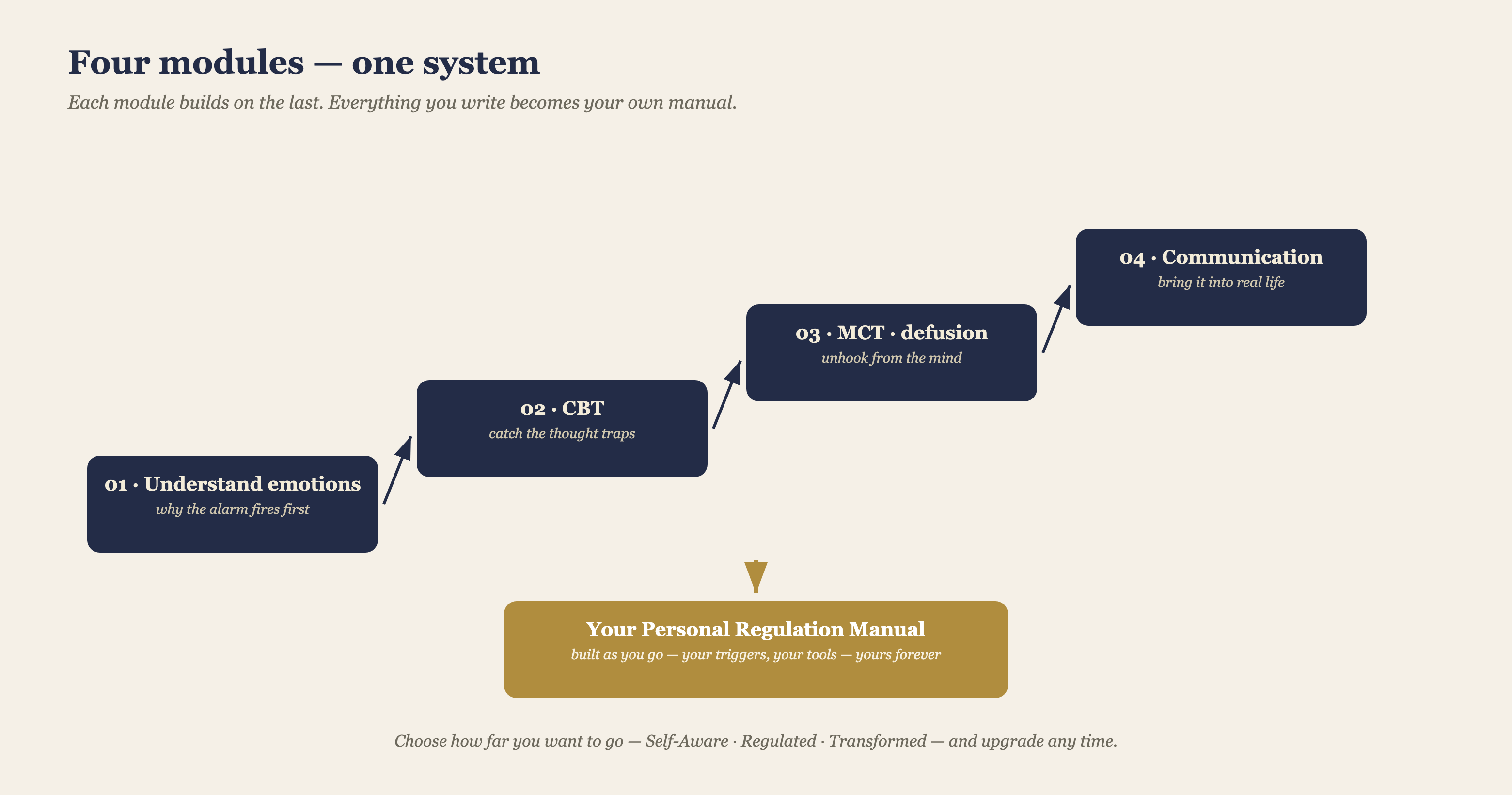
WHAT IS INSIDE
Module 1: Understanding Emotions, 59 lessons · 5 parts
Module 2: CBT Thought Patterns, 28 lessons
Module 3: MCT Thought Defusion Techniques, 32 lessons
Module 4: Communication in Real Life, 44 lessons
From $297 · one-time payment · instant access. The course is education, not treatment for an anxiety disorder.