Perfectionism, explained. Free to read.
Perfectionism is not a quest for the best.
It is a pursuit of the worst in ourselves: the part that says nothing we do will ever be good enough. Here is how it works, where it comes from, and why “just lower your standards” has never helped anyone.
About a ten-minute read. No sign-up.
From the first page of the course
You became the person everyone relies on.
And somewhere along the way, you disappeared from your own life.
You are disciplined. Responsible. High-functioning. You get things done even when you are exhausted. But underneath the structure, routines, goals, optimization and constant self-monitoring, something no longer feels alive.
Built for the people nobody talks about: the ones who are “too functional” to look like they are struggling.

Not ready to buy? The free preview is the first pages of the course, so you can feel whether it fits.
What kind of perfectionism is this?
Four patterns. Most people carry more than one.

Not all perfectionism works the same way, and the tools that help depend on what is driving yours. You do not need to see yourself as a perfectionist for this to apply to you.
Self-oriented: “I must be flawless.”
“If this isn’t perfect, I’ve failed myself.” “Good enough is never really good enough.”
Socially prescribed: “Others expect me to be perfect.”
“If they see me fail, they’ll withdraw.” “I have to be impressive, or they won’t accept me.”
Other-oriented: “Everyone must meet my standard.”
“Why can’t people just do it properly?” “I’d rather do it myself.”
Worth-contingent: “I must prove I deserve my place.”
“I haven’t really earned my place yet.” “I’m only as good as my last performance.”
High personal standards are not the problem. The problem is when they decide whether you are allowed to rest, to connect, and to be okay as you are. The aim is not to lower the bar. It is to stop letting the bar decide your value as a person.
Before the costs
What do you believe it gives you?
Perfectionism does not feel like a burden from the inside. It feels like it is working. That is why it is so hard to change. Most people recognise at least one of these:
A competitive edge. “If I loosen the standards, I’ll fall behind.”
Respect from others. “People trust me because I never cut corners.”
A sense of identity. “Without the high standards, I don’t know who I am.”
Safety from failure. “If I let go of it, I might actually fail at the things that matter most.”
These are real beliefs, and many are partly true. The question the course asks is a smaller one: if you loosened the pattern by just ten percent, would you actually lose that thing?
Two voices
Meet Scar and Sun

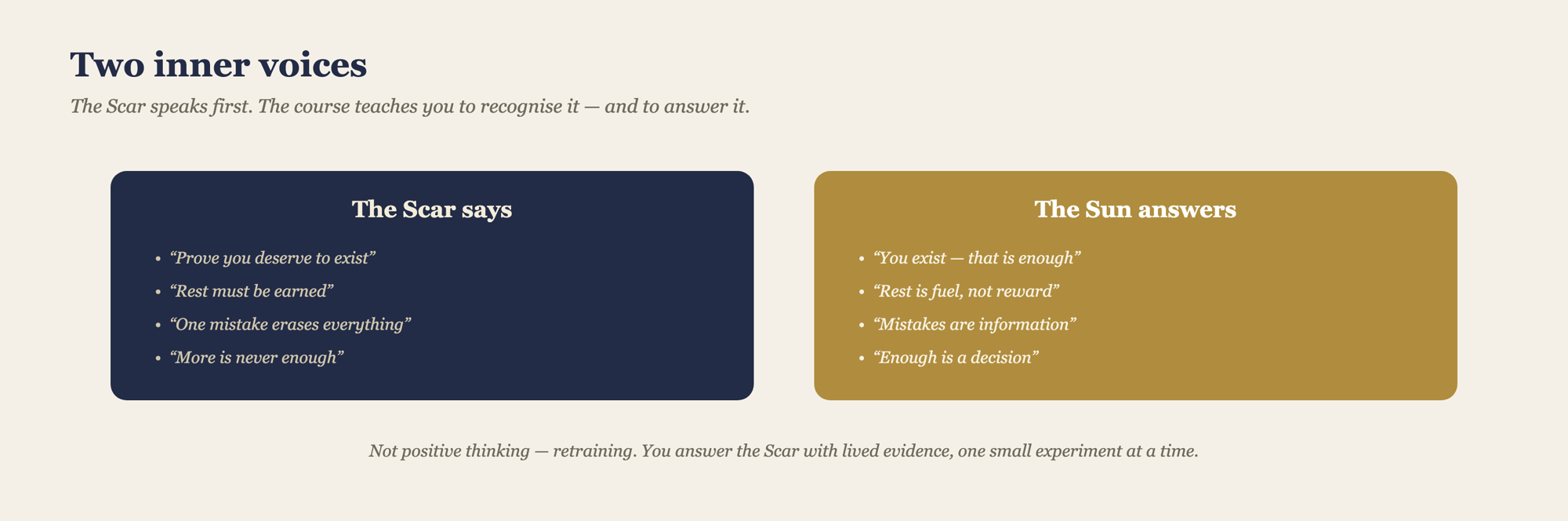
Scar is the inner critic. He sounds like a sergeant. Like the parent who was never quite satisfied. Like the part of you that keeps an invisible record of every mistake.
Scar believes he is protecting you, and in a way, he once was. He emerged when performing was how you earned love, safety or belonging. You may know him in thoughts like “You’re not doing this right” and “What if you’re just not good enough?”
Sun is the voice the course builds toward. Not naive or cheerfully positive. She responds to difficulty with curiosity instead of judgment.
Scar is not the enemy. But he is not the truth either. He is a pattern, and patterns can change.
How the course is meant to be taken
The mind will try to do this course perfectly too.

Given any challenge, including a course about perfectionism, the mind will often try to approach it perfectionistically. “How do I do this correctly?” is the first move.
So the course says it plainly: you do not have to complete every field, do every exercise, or do any of it “right.” One imperfect run-through beats the perfect version you never start.
You do not have to earn self-compassion. Kindness tied to achievement is not self-compassion. It is perfectionism wearing a more palatable outfit.
Burnout rarely feels dramatic at first
You notice you become a little more tired than usual. Things you used to handle easily take more effort.
You think a little more. Sleep a little worse. Get irritated faster, or a little more empty.
And then you do what most people do: you continue.
I see this often: the person who achieves a lot but never allows themselves to enjoy it, because the next item on the list is always waiting. And the next one after that.
When you loosen the standards, a strange emptiness can appear. If your worth has been fused to output for years, doing less can feel like becoming no one.
Conscientiousness: strength and burden
Conscientiousness is one of the most studied personality traits in psychology, and one of the strongest predictors of achievement. Being structured and self-disciplined genuinely works. The world rewards it.
But there is a shadow side that is rarely named. When the list, the standard and the routine stop being tools you use and become rules you fear breaking, something shifts.
The same traits that built your competence start to cost you your energy, your relationships and your sense of self.
When you plan every minute of your day to make life perfect, you stop listening to yourself. You listen to the fear of what happens if you don’t. Life becomes very clean. Almost sterile.
But not coping, not managing, not wanting to, a day in bed, a skipped workout: that is part of being human. It can be a source of rest, not something to run from.
Striving versus concern
Psychologists separate two parts of perfectionism. Perfectionistic strivings are the high standards themselves. Perfectionistic concerns are the fear of mistakes, the harsh self-criticism, and the feeling that others expect perfection.
The strivings are mostly fine. The concerns are what do the damage, and they are the part you can work on while keeping your standards.
The maintenance cycle
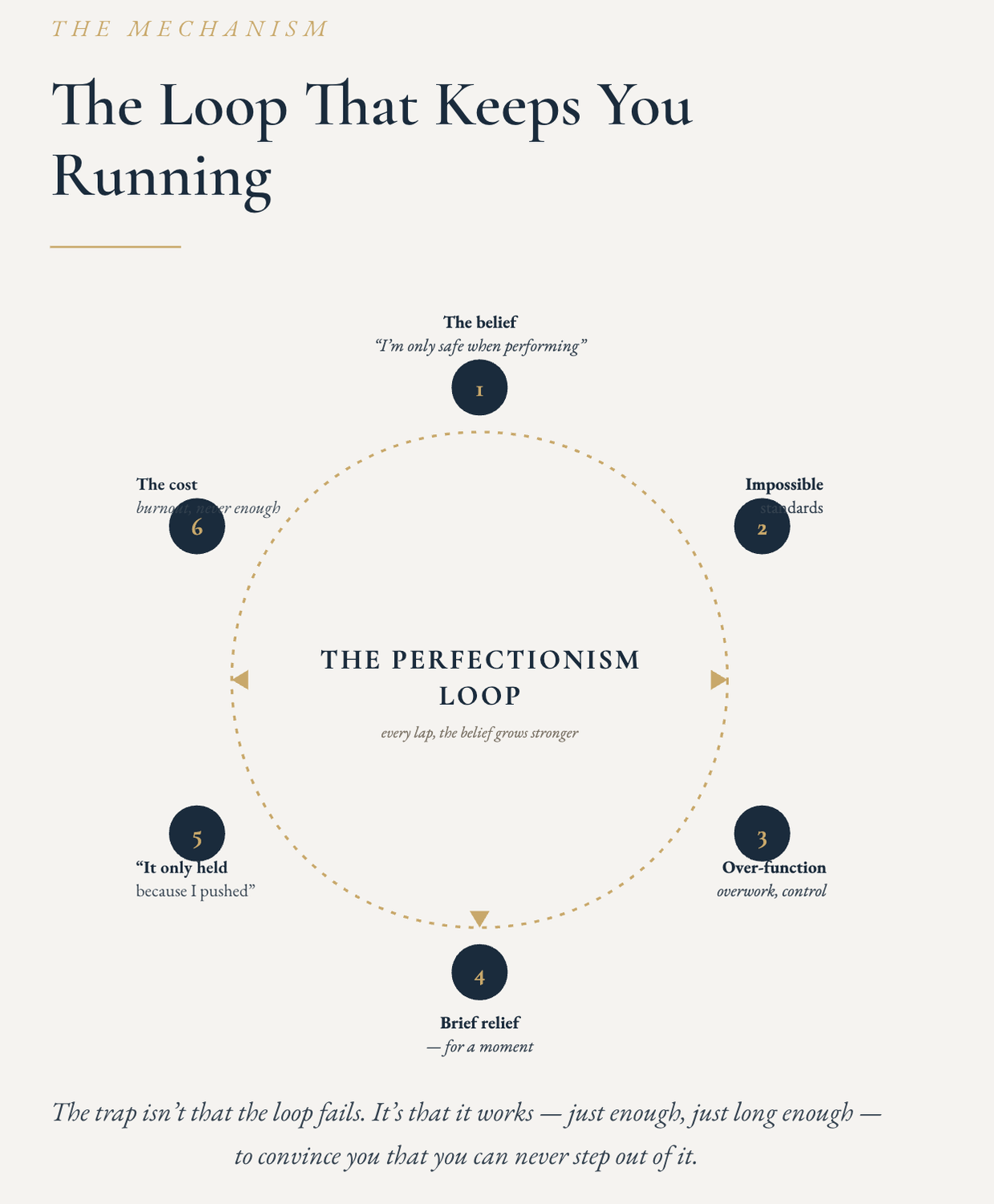
Impossible standard, then inevitable failure, then harsh self-criticism, then trying even harder, then raising the standard again.
And the reason it never feels like it is working: on the days you hit the bar, you move the bar.
Why “just lower your standards” never worked
Easing up does not feel like relief. It feels like danger.
Nobody is born believing they have to earn their place. It is learned, usually early, and the body remembers it as a rule. Rules come with shame: break one, and it feels like you failed.
From “I must” to “I choose”
“You know, so you do” can gradually become: “You know, you see that you have a choice, and you can choose to do it, if you want.”
What I have seen repeat itself, again and again: the change does not happen in the moment someone decides to change. It happens the first time they actually choose differently, and survive it.
In my own words
What it looked like in me

I score near maximum on conscientiousness, where all the facets are far above the norm. I can see how this has helped me in life. And I can see how, at 21, I locked myself in a mental prison, the result of an extremely strong sense of duty combined with intense self-discipline.
When I know what I should be working on, it is incredibly difficult not to trap myself in an optimised routine that shuts out spontaneity, creativity and freedom.
Many people ask: “Who wouldn’t want that?” The problem comes when you discard everything that isn’t on the list. You end up with haste, stress and a motivation that comes from deep fear, not from genuine desire.
And worst of all, I learned how to fear my emotions, how to run so fast and fill my days so full that they never get to me, so that I never have to face them, and so that nobody can question if I am okay.
This course is what I wish someone had handed me then. Kristina
The questions people bring me
Why do I collapse the moment I finally have a free weekend?
Why does resting feel like cheating?
Why am I still holding a standard nobody else is asking for?
Why does “good enough” feel like giving up?
Why does one piece of criticism erase ten good days?
Why does slowing down make me feel like I am disappearing?
What do I actually do when the pressure starts, not hours after?
Where to go from here
If you want to work through this with structure, the course takes it one module at a time.
Not therapy. Psychoeducation. If you are in crisis: findahelpline.com