Practical Tools We Might Need
Free, structured, and evidence-based information for you who are waiting for a course, need support now, or want concrete tools in daily life.
Part 1: Your Nervous System and Resistance to Change
The Nervous System and Homeostatic Resistance
Your body has a nervous system that seeks stability. When you try to change behavior or thoughts, your nervous system interprets it as danger. It is not irrational. It is a protective mechanism. Your nervous system knows the old pattern as safe, even though it hurts you.
Why Change Creates Inner Resistance
When you start doing something differently, you may experience anxiety, irritability, or a strong desire to return to the old ways. It is not a sign that it is not working. It is a sign that your nervous system is fighting to preserve what is known.
Four Stress Responses
When you are triggered, your body can react in four ways:
Freeze: You become stiff, numb, or cannot move. Thoughts become heavy.
Fight: You become angry, irritable, or aggressive. You want to fight the problem.
Flight: You want to escape. You become restless, anxious, or seek distractions.
Submission: You give up. You become passive or hopeless.
All four are normal nervous system responses. None are wrong. But you can learn to recognize which one you use, and choose a different response.
Part 2: When Strong Emotions Activate
Common Thought Patterns
With hopelessness: "It will never get better. I am hopeless. Nothing helps."
With anger: "It is their fault. They should know better. I have the right to be angry."
With low mood: "I am not good enough. I should be different. I am a failure."
Distinguish Between Thoughts and Facts
A thought is a thought. It is not a fact. Your brain produces thoughts all the time, especially when you are stressed or tired. A thought like "It will never get better" is an interpretation, not reality.
Affect and Impulse
When you are triggered, a feeling (affect) arises that wants to be acted upon (impulse). You can feel strongly without acting on it. The feeling and the action are not the same. You can let the feeling be there and choose a different action.
Part 3: Concrete Regulation Tools
Stop and Register
When you notice you are being triggered: Stop. Notice where in your body you feel it. Your heart? Your stomach? Your throat? Simply registering the physical sensation causes your nervous system to begin calming down. You have given it attention.
Observe Thoughts
When a thought arises, tell yourself: "I have a thought that..." instead of "It is true that..." Example: "I have a thought that I am a failure" instead of "I am a failure." This creates distance between you and the thought.
Use Your Senses
When your nervous system is activated, use your senses to calm it. Cold water on your face. Strong smell (lemon, peppermint). Music. Tactile stimulation (touching something soft). These signals tell your brain that you are safe now.
Breathe and Regulate
Breathe in through your nose for four counts. Hold for four counts. Breathe out through your mouth for six counts. Repeat five times. The longer exhale activates the parasympathetic nervous system, which calms your body.
Delay the Impulse
You do not need to act on the impulse right away. Tell yourself: "I can do this in 15 minutes if I still want to." Often the impulse will fade. If it does not, you have given yourself time to think.
Write Down an Alternative Thought
When you have a negative thought, write it down. Then write down three alternative interpretations of the situation. Example: Thought: "He did not look at me, so he does not like me." Alternatives: "He was focused on something else." "He saw me, but I did not notice." "He has poor eyesight."
READY TO UNDERSTAND WHY YOU FEEL THIS WAY?
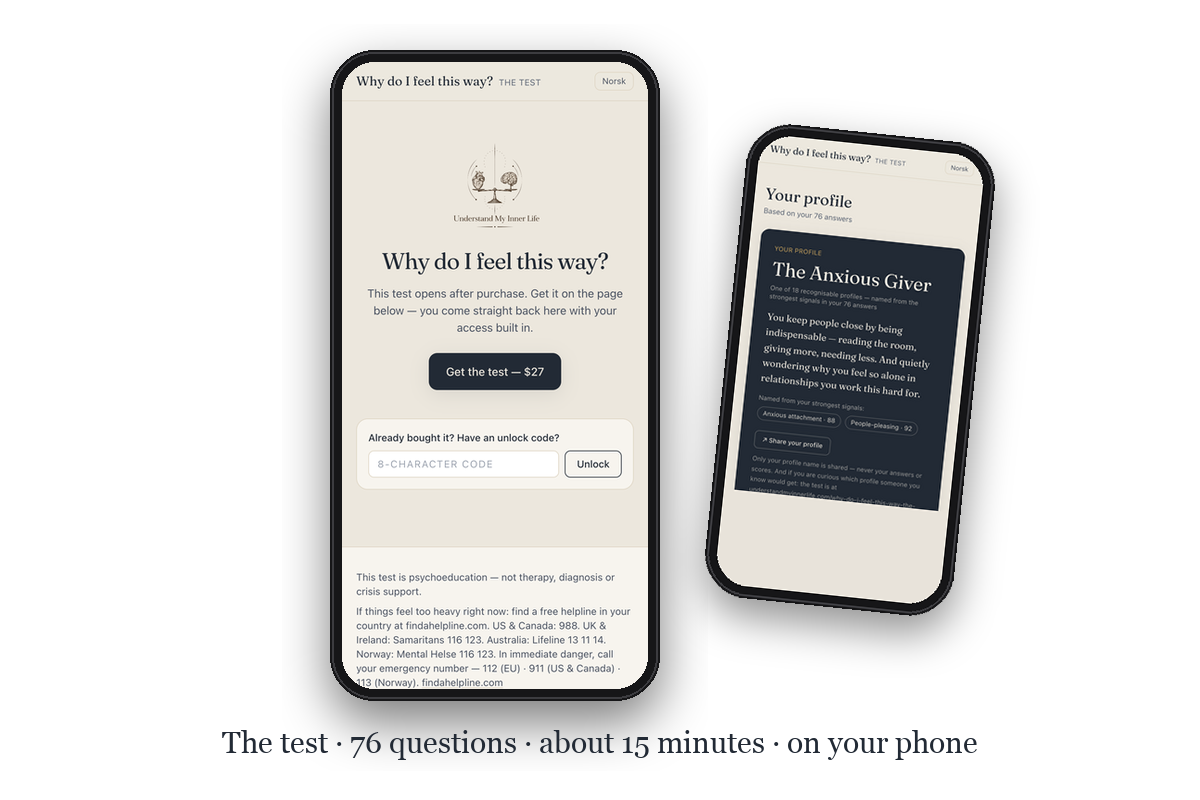
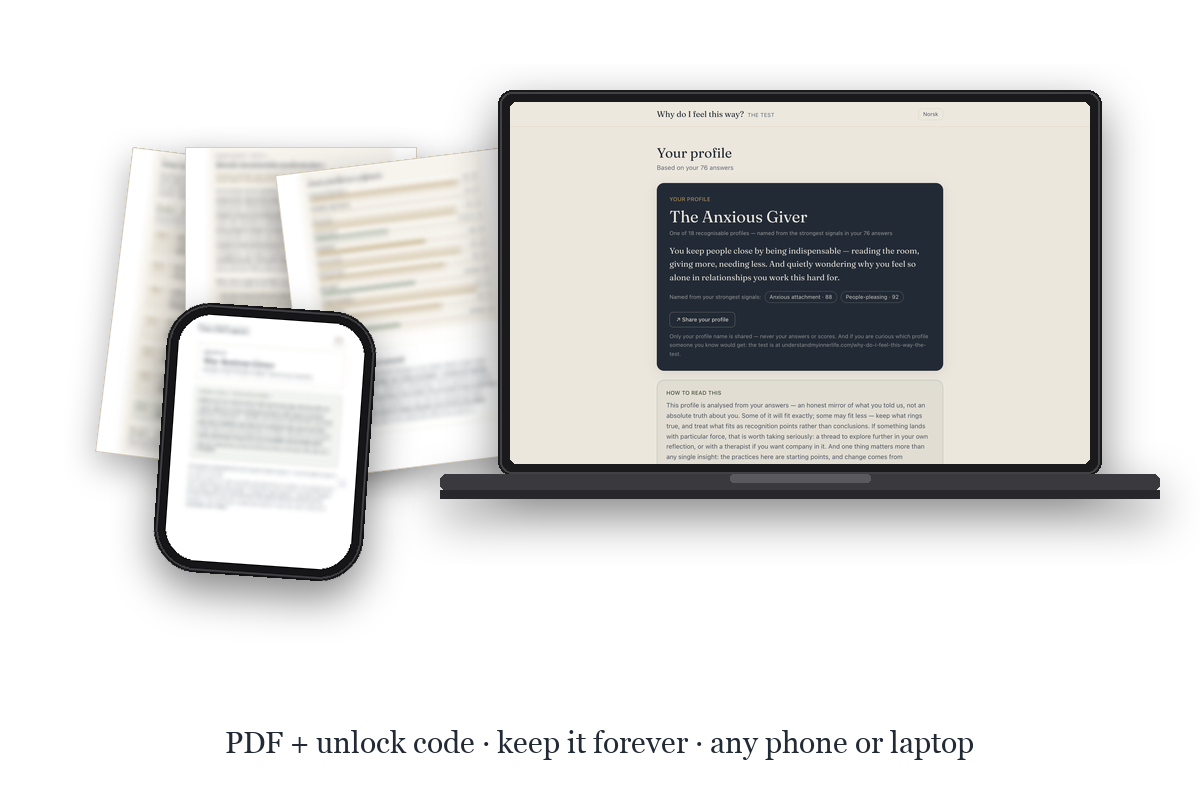
The 15-minute assessment is $27, paid up front. It names your pattern and shows you exactly where to begin.
Part 4: Values and Direction
Values are directions you want to go in life, not goals you need to reach. Examples: Being a good friend. Living authentically. Learning. Being present.
Exercise: Name Three Values
Think of people you admire. What do they do? What is important to them? Write down three values that resonate with you.
One Concrete Action per Value
Take each of your three values and name one small, concrete thing you could do this week that moves in that direction. If the value is friendship, it might be sending one message. Keep it small enough that you will actually do it.
Part 5: The Small Steps Principle
Your brain is programmed to seek efficiency. Large changes require a lot of energy and meet resistance. Small steps require less energy and meet less resistance. Small steps build self-confidence because you actually complete them.
How to Build Habits Gradually
Choose a habit. Start so small that it seems trivial. Example: "I will stretch for two minutes every morning" instead of "I will exercise for an hour." Do the same thing every day for a week. Then you can increase.
Example of a Weekly Plan
Monday, Thursday: Two minutes of stretching. Friday, Saturday: Three minutes. Sunday: Rest. Next week: Four minutes. You build momentum without overwhelming yourself.
Part 6: When You Feel Triggered
Distinguish Between Feeling and Action
You can feel strongly without acting on it. You can be angry without hitting. You can be afraid without running. The feeling and the action are not the same.
Self-Support Mantra
"I am triggered now. It is normal. I can handle this. I do not need to act on what I feel."
HALFWAY THROUGH
Reading a tool once rarely makes it available when you are actually activated. If you want to practise these rather than only understand them, that is what the course is for.
Part 7: Document Progress
Your brain is wired to notice problems, not progress. If you do not record the small steps forward, your brain will keep telling you that nothing is changing.
Write down three small steps forward each day
Each evening, write down three small things that went well today. Not big things. Small things. "I drank water." "I said hello to someone." "I did my breathing exercise." Over time you will start to see patterns, and to see that you are changing.
Part 8: Understanding Self-Sabotage
Your nervous system has a range it treats as familiar, a level of visibility, success and even wellbeing that feels "like you". When you move beyond that range, the unfamiliarity itself can register as unsafe, and old protective patterns switch on to pull you back to what it knows. This is not self-sabotage in the sense of wanting to fail. It is a system doing what it was built to do.
Four Ways Your Nervous System Sabotages You
Freeze Response: Lack of clarity, sudden exhaustion, or feeling paralyzed despite having a to-do list.
Fawn Response (Submission): Prioritizing others' needs over your own, giving away resources, rushing to please others instead of pursuing your goals.
Flight Response: Appearing productive but actually hiding, revising the same document repeatedly without publishing, endless learning without implementation.
Fight Response: Excessive busyness, working harder and longer while avoiding the specific step that would actually move things, because that step is the exposing one.
These responses are not character flaws. They are your nervous system trying to protect you by keeping you in the familiar.
Part 9: The Homeostatic Impulse
The homeostatic impulse is your body's drive to return to what is familiar and predictable. Evolutionarily, we are built to conserve energy and prefer the predictable, which is why change costs more than it looks like it should. When you try to push yourself out of autopilot, you meet resistance from both mind and body.
Common Examples in Daily Life
Exercise: You want to start a new routine, but your body resists. You feel physical discomfort, lack of motivation, and mental resistance.
Diet Changes: You try to eat healthier, but cravings for old foods intensify. Your body is used to a certain type of nutrition and fights the change.
Work Habits: You want to stop checking email first thing in the morning, but the old habit feels automatic and hard to break.
Social Patterns: If you have always been shy or withdrawn, stepping into more active social situations feels deeply uncomfortable.
The Solution: Small, Gradual Steps
To overcome the homeostatic impulse, start with tiny, incremental changes. If you want to exercise, start with five minutes twice a week. If you want to change your diet, replace one unhealthy food at a time. Your nervous system will gradually accept these small changes as the new normal.
From the same foundation
Explore more tools
Part 10: Congruence Living Authentically
E. Tory Higgins' theory describes three versions of yourself:
Your Actual Self
Who you are right now, your current reality, with all your strengths and weaknesses, achievements and failures.
Your "Should" Self
The standards and obligations you feel you must meet. These come from society, family, and cultural expectations, things you feel you should do or be to be accepted or valued.
Your Ideal Self
The best version of yourself you dream of becoming. Your hopes, dreams, and goals, the person you strive to be.
The Gap Between Actual and Ideal: When there is a large distance between your actual self and your ideal self, you feel disappointment, frustration, and sadness. You want more but do not feel capable of reaching it.
The Gap Between Actual and "Should": When there is a large distance between your actual self and your "should" self, you feel anxiety, fear, and guilt. You fear not living up to external expectations.
The Key: Move Toward Your Ideal Self, Not Your "Should" Self
Focusing on your ideal self is more personally motivating and authentic. It reflects your own values and desires, not others' expectations. When you pursue your ideal self, you experience genuine fulfillment.
Part 11: The Two Circles Exercise
This exercise helps you visualize how you currently spend your time versus how you would like to spend it. It reveals whether your daily life reflects your true values and interests.
Step 1: Draw Circle 1 (Your Current Reality)
Draw a circle and divide it into sections based on how much time you currently spend on different activities: work, sleep, social life, hobbies, relaxation, exercise, family time, etc.
Questions to Ask Yourself:
• Are any sections surprisingly large or small?
• Do these activities make me happy and fulfilled?
• Am I spending time on things that matter to me?
• What am I neglecting?
Step 2: Draw Circle 2 (Your Ideal Life)
Draw another circle and divide it according to how you would like to spend your time. Include work, personal development, hobbies, exercise, meaningful relationships, rest, and spiritual or creative pursuits.
Questions to Guide You:
• What is truly important to me?
• What gives my life meaning?
• What reflects my deepest values and desires?
• What would make me feel alive and engaged?
Step 3: Identify the Gaps
Compare the two circles. Where are the differences? Which areas need more time? Which need less?
Key Areas to Assess:
• Economic stability and career fulfillment
• Happiness and satisfaction
• Personal growth and learning
• Physical health and exercise
• Healthy family relationships
Step 4: Create a Transition Plan
Make a list of small changes you can make each week to move from Circle 1 to Circle 2. Start with one change per area.
Examples of Small Changes:
• Wake up 30 minutes earlier to meditate
• Set aside one hour per week to learn a new skill
• Schedule one meaningful conversation with a friend
• Reduce social media by 15 minutes daily
Step 5: Track and Adjust
Keep a log of how you actually spend your time. Reflect on whether these activities feel satisfying. Be willing to adjust Circle 2 as you learn more about yourself.
Remember:
Balance is key. Work is important, but so is your personal life, health, and relationships. Do not sacrifice one area for another.
Part 12: Flexibility and Habituation
When you start something new, it often feels uncomfortable or wrong. This is normal. Your brain and body need time to adjust to new circumstances or activities. This process is called habituation.
Why New Things Feel Hard
In the beginning, new situations or activities often lead to resistance or discomfort. This is because you are comfortable with your established habits and routines. Any change feels challenging. This is not a sign that the change is wrong, it is a sign that you need time to adjust.
The Habituation Process
Give new activities time to become familiar. It can take weeks or even months for your brain and body to accept new circumstances as safe.
Week 1 and 2: High discomfort. You question if this is right for you.
Week 3 and 4: Discomfort decreases slightly. You notice small positive changes.
Week 5 to 8: The new activity begins to feel more natural. You see real benefits.
Week 9+: The new habit becomes part of your routine. It feels less effortful.
When to Persist and When to Adjust
Persist if: You feel discomfort but also notice small positive changes. The discomfort is normal resistance, not a sign that something is wrong.
Reconsider if: After a significant period (8+ weeks), you still feel deeply unhappy or uncomfortable. This might be a sign that the change is not aligned with your true needs and desires.
Remember: Even if something feels uncomfortable at first, it can often be a source of learning and personal growth. Many valuable changes require us to tolerate discomfort temporarily.
Practical Example: Starting a New Exercise Routine
Week 1: "This is hard. I do not want to do this. My body hurts."
Week 3: "It is still uncomfortable, but I notice I sleep better. Maybe this is working."
Week 6: "I actually look forward to this now. I feel stronger and more energized."
Week 10: "This is now part of who I am. I cannot imagine not doing this."
YOU HAVE READ THE TOOLS
Knowing a tool and being able to use it are two different things
A tool you have read about and a tool you have practised behave very differently in the moment you actually need it. The Emotion Regulation Course is built around repetition on real situations, so the tools on this page become something your body reaches for on its own.
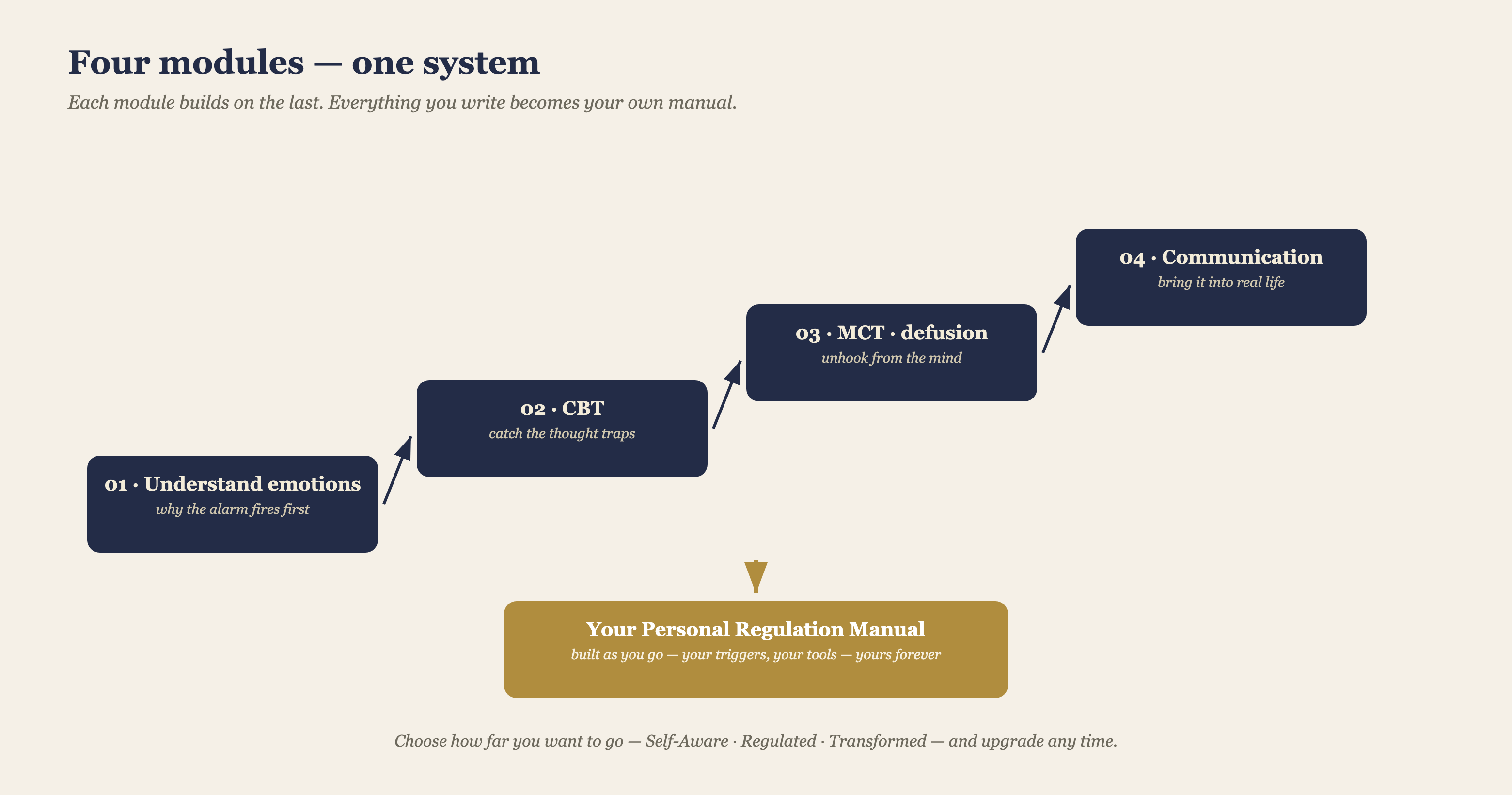
WHAT IS INSIDE
Module 1: Understanding Emotions, 59 lessons · 5 parts
Module 2: CBT Thought Patterns, 28 lessons
Module 3: MCT Thought Defusion Techniques, 32 lessons
Module 4: Communication in Real Life, 44 lessons
Four modules. 164 lessons. Guided teaching, written exercises and knowledge checks throughout.
From $297 · one-time payment · instant access.