
Self-guided toolkit · one-time download
Catch a pattern early, before it becomes a full reset
The work does not end when the course does. This is the toolkit that helps you catch a pattern early, before it becomes a full reset.
Based on Marlatt & Gordon's Relapse Prevention Model, adapted for emotional regulation. A self-guided kit you keep and return to whenever you need it.
One-time payment · Lifetime access · Instant PDF download · Yours to keep
This Is For You If
You completed the emotion regulation course and want to protect your progress
You want a structured tool without ongoing costs or commitments
You value Prevention over crisis management
You notice old patterns returning after periods of stress
You finished an accountability program and want a maintenance safety net
You want something to return to, Not something to keep up with
Who is Kristina?

Kristina. 8 years in mental health care · 4,500+ clinical hours · MSc in clinical psychology (in progress)
Inside the toolkit
How the early-warning system works
At the heart of the toolkit is a two-minute self-scan. Here is the structure you use each time you check in.
1. The Early-Warning Self-Scan
Rate each line 0, 10. A rise of 3 above your own baseline is the warning sign.
Rumination
"Am I replaying things and unable to switch off?"
0 · not at all
10 · very much
Inner critic
"Is the inner critic louder than it usually is?"
0 · not at all
10 · very much
Avoidance
"Am I avoiding things I'd normally face?"
0 · not at all
10 · very much
Pulling away
"Am I pulling away from people?"
0 · not at all
10 · very much
Excerpt from the Relapse Prevention Toolkit, the full toolkit also includes your relapse cycle map, high-risk situation plans, matched refreshers and a pocket card.
What's Inside the Toolkit
A complete maintenance system: relapse cycle map, green flags, high-risk mapping, urge-surfing, behavioural experiments, and a pocket card.
The Relapse Cycle (Per-Link Map)
Visual relapse cycle: stress, then avoidance, then less self-care, then isolation, then old coping, then relapse. With a 'what this looks like for me' map for each link, so you can spot your exact pattern.
Personalized early-warning system
Green Flags (Signs You're Doing Well)
Not just danger signs, a list of green flags that tell you you're on track. Self-scan with both danger signals and wellness indicators.
Balanced, not fear-based
Test the Wobble (Behavioural Experiment)
Predict a feared outcome, then test it in real life, then log what actually happened. Turn uncertainty into evidence in your own handwriting.
From insight to evidence
High-Risk Mapping + Urge-Surfing
Map your high-risk situations. Learn to sit with the urge without acting on it, the core skill of relapse prevention.
Includes a mapping of the Self-Critical & the Self-Supporting voice, plus 'write your own' practice
Everything in the Toolkit
Early-Warning Self-Scan (0, 10, with your personal baselines + thresholds)
11 matched maintenance Library refreshers (one Page each)
Repeatable check-in Page (use anytime)
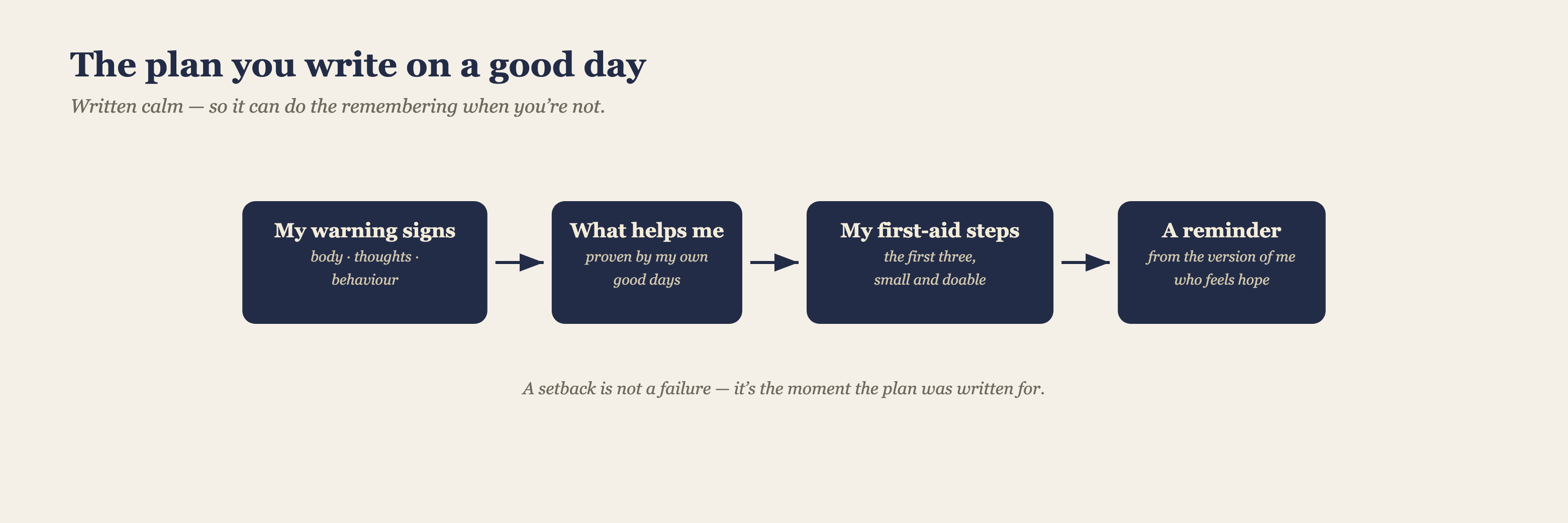
Early-action plan with built-in escalation
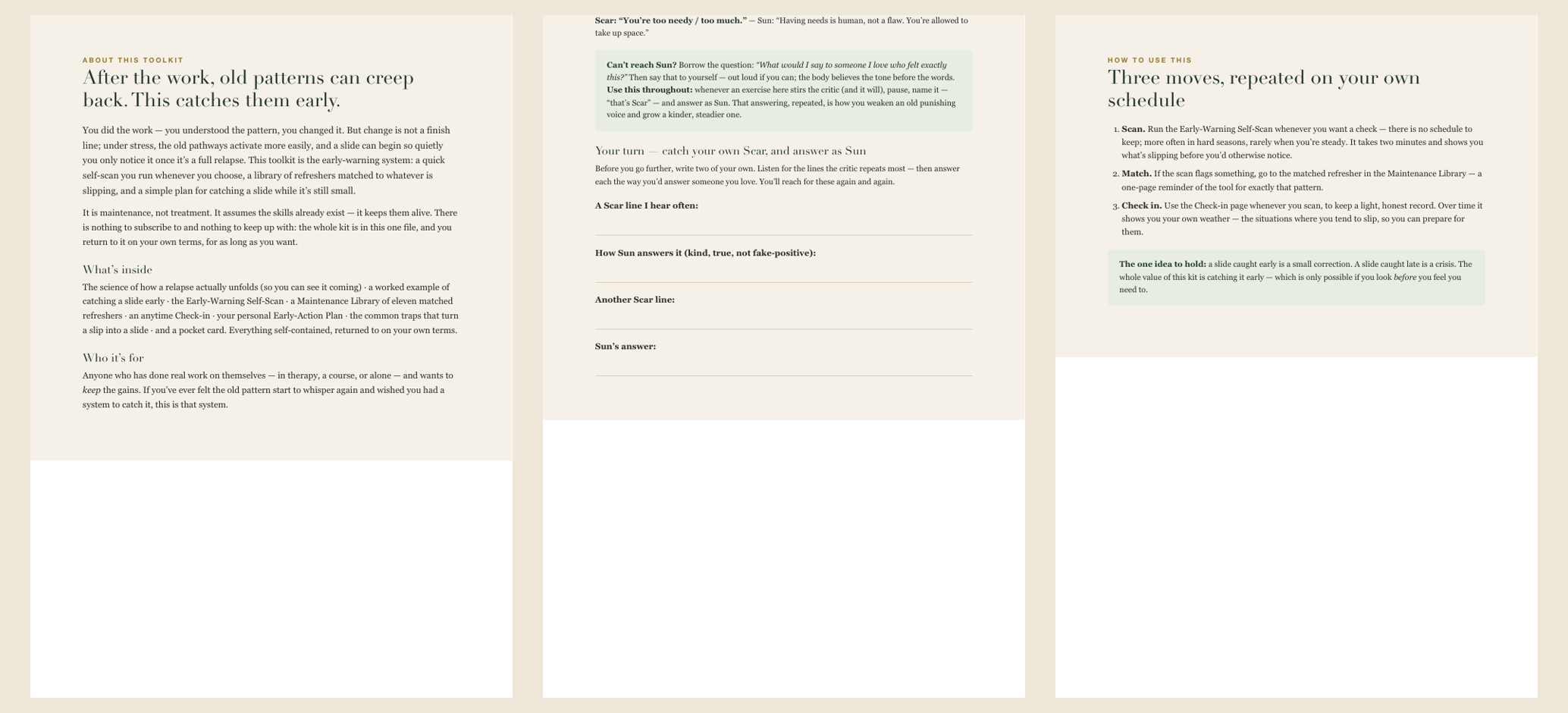
28 pages, comprehensive and practical
Instant PDF download · yours to keep · lifetime access
See inside the toolkit
Twenty-eight pages: your early-warning self-scan, the relapse-cycle map, first-aid steps and the plan you write on a good day.
No app. No subscription. The toolkit is a PDF you own, and once a month for the first year, a short letter lands in your inbox and walks you through the check-in page. Unsubscribe anytime.
The Relapse Prevention Toolkit
$19
One-time · Lifetime access · Instant PDF download
Early-Warning Self-Scan
11 Maintenance Library refreshers
Repeatable Check-in (use anytime)
Early-action plan with escalation
12 monthly check-in letters, one short email a month for a year, included
28 pages · yours to keep
Because this is instant digital content, by completing your purchase you agree to immediate access and waive the 14-day withdrawal right. Not a substitute for therapy.
Common questions
Honest answers.
Not just the emotional toll. The time lost, the relationships affected, the momentum you have to rebuild. What specifically would a relapse cost you right now?
There is always a warning signal. A thought pattern. A skipped meal. A moment you stopped checking in with yourself. This toolkit teaches you to catch it.
The toolkit is designed to work best after structured emotional regulation work. But if you recognise the patterns described and want a maintenance system, it will still be useful.
Yes. Pay once, download immediately, keep forever. No subscription, no expiry.
Monthly is the rhythm it is built for, plus any day a warning sign shows up. The Early-Warning Self-Scan takes about two minutes, and the toolkit is built to be reused for years, not read once.
You finished the course. You felt different. You had new tools, new awareness, new patterns forming. And then, slowly, almost imperceptibly, the old patterns crept back. This is not failure. This is the forgetting curve in action . Without structured maintenance, the brain defaults to its most practiced pathways. The new thinking patterns you carved start to fade and you revert back to the known easier path. Research on relapse prevention (Marlatt & Gordon, 1985) shows that the critical factor is not the initial learning, it is what happens in the 3 to 6 months after . This toolkit gives you a structure to catch a slide before it becomes a reset.
Early Warning Signs of Sliding Back
• You stop noticing your body signals before reacting • The if-then plans feel "too effortful" to use • The self-critical voice starts feeling like "just being realistic" • You catch yourself mid-reaction instead of before it • The old thought patterns feel comfortable again
One-time payment · Lifetime access · Instant PDF download · Yours to keep
The difference between people who hold their progress and people who slide back is rarely motivation. It is structure.
Without a maintenance system
Old patterns return quietly, weeks after the course ends You catch yourself mid-reaction instead of before it The if-then plans feel like too much effort The inner critical voice starts sounding like 'just being realistic' Progress feels fragile, one stressful week undoes months
With the Relapse Prevention Toolkit
You spot a slide in week one, not month three You have a written plan for your highest-risk situations Monthly check-ins keep the new patterns active Behavioural experiments turn uncertainty into evidence Progress becomes structural, not dependent on motivation
No. This is a structured self-guided maintenance tool. It complements therapy but does not replace it.
Because this is instant digital content, by completing your purchase you agree to immediate access and waive the 14-day withdrawal right.
Important
This toolkit is designed for people who have already completed structured emotional regulation work and want to maintain their progress. It is not a substitute for professional treatment
The complete toolkit, yours to keep
The complete toolkit, yours to keep. One-time purchase, no subscription, no expiry.
How it works: the toolkit is a 28-page PDF you keep. You pay $19 once, and you land straight on a download page. A receipt arrives by email. No app, no login, no subscription.
Included: for the next twelve months, one short letter a month lands in your inbox and walks you through the check-in. You can unsubscribe anytime. The toolkit stays yours. You can also run the check-in on your own, whenever you like. The letters are just a nudge.
If the download fails or you ever lose the file, email contact@understandmyinnerlife.com.