
A 90-minute weekly reset
Your week spirals from the moment you wake up.
By Saturday morning, you feel fractured. Reactive. Like you are running on fumes. This 90-minute ritual gives you a deliberate space to slow down, take stock, and begin the week from a more grounded place.
This Is For You If
You have done the reading but want a structured weekly practice to anchor it
You notice the same Emotional patterns repeating Week after Week
You prefer working alone, at your own pace, without accountability pressure
You want structure without rigidity, A framework, not a cage
You are between therapy sessions and want something to anchor the work
Who is Kristina?

Kristina. 8 years in mental health care · 4,500+ clinical hours · MSc in clinical psychology (in progress)
The 90-Minute Structure
Each Saturday, you follow the same sequence. The structure stays constant, the content adapts to your week.
0 to 15 min
The Arrival
Body scan + Week Review. You arrive in your body before you arrive in your thoughts.
Then: What happened this week? What activated me? What did I avoid?
Interoceptive awareness (Craig, 2009)
15 to 35 min
The Pattern Recognition
Identify your top 2 emotional triggers from the past week. Map them: What was the trigger? What was the automatic response? What did my self-critical part say? What would my self-supporting part say instead?
Interoceptive awareness (Craig, 2009)
35 to 55 min
The If-Then Planning
For each trigger identified: write one specific if-then plan. 'If [trigger situation], then I will [specific action].' This is the single most evidence-based behavior change technique.
Implementation intentions, a medium-to-large effect across many studies (Gollwitzer & Sheeran, 2006)
55 to 75 min
The Compassion Practice
Write a letter from the self-supporting part of you to yourself about this week. Not affirmations. Not toxic positivity. Honest acknowledgment of what was hard, and what you did despite it.
Self-compassion (Neff, 2003) + Expressive writing (Pennebaker, 1997)
- 75 to 90 min
The Week Ahead
Preview the coming week. Where are the likely triggers? What if-then plans do you already have? What is one thing you want to practice noticing, not fixing, just noticing?
Prospective memory + Desirable difficulty (Bjork, 1994)
What's inside the PDF
The Rogers Congruence Exercise (draw your week now vs your values-aligned week, the most visual, shareable hook)
The Scar & Sun Two-Voice Method (structured self-compassion practice)
If-Then Planning System (reusable, with 30+ example scenarios, implementation intentions for the week)
Weekly Behavioural Experiment (predict a feared outcome, then test it in real life, then log what actually happened)
'Before Monday Arrives' Implementation Page (turn insights into concrete actions before the week starts)
12-Week Tracker (spaced repetition, the science of turning knowledge into automatic behavior)
'Make It Stick' Page (a maintenance System, not just a worksheet)
See inside the protocol
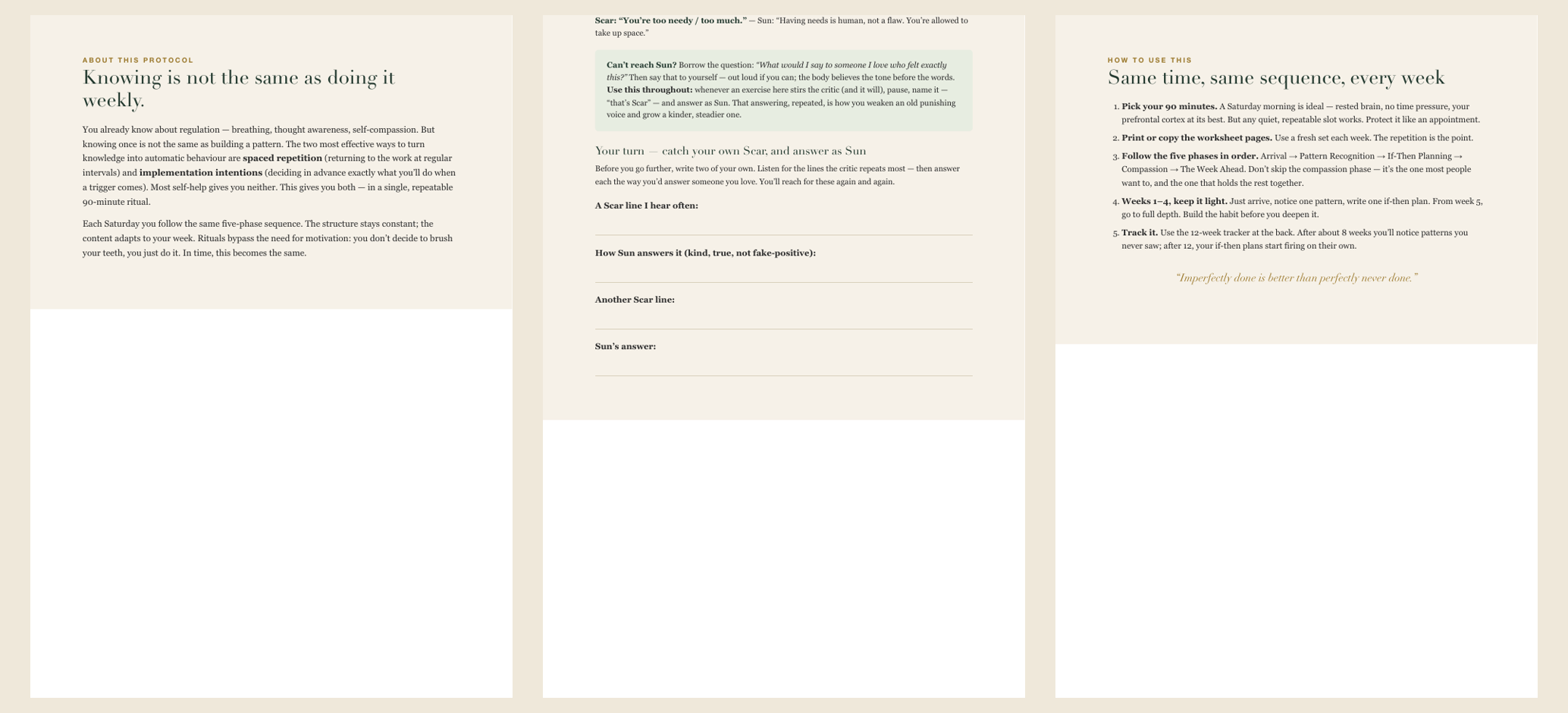
Thirty-two pages: the Saturday sequence step by step, the Scar & Sun two-voice method, if, then planning pages, and a 12-week tracker, written to be used, not just read.
$29
One-time payment, no subscription
Instant digital delivery. No account required.
Because this is instant digital content, by completing your purchase you agree to immediate access and waive the 14-day withdrawal right.
Want the complete system?
Common questions
Honest answers.
Yes. Pay once, use every Saturday for as long as you need. Lifetime access, no subscription.
No. The protocol is self-contained. It works as a standalone practice, and also deepens the course if you have done it.
You pick it up the next one. There is no streak to protect. The structure is always there when you come back to it.
No. This is a structured psychoeducational self-regulation tool. It complements therapy but does not replace it.
Because this is instant digital content, by completing your purchase you agree to immediate access and waive the 14-day withdrawal right. The page describes exactly what you get, if you are unsure, read it carefully before purchasing.
You understand the concepts. But understanding doesn't change the pattern.
You know you could regulate your emotions. You know about breathing techniques, thought awareness, self-compassion. You have read the articles. Maybe you have even taken a course. But knowing is not the same as doing . And doing once is not the same as building a pattern. The research is clear: spaced repetition (Cepeda et al., 2008) and implementation intentions (Gollwitzer, 1999) are the two most effective strategies for turning knowledge into automatic behavior. But most self-help gives you neither. The Saturday Morning Protocol gives you both, in a single, repeatable ritual.
One 90-minute ritual per week - > After 8 weeks, you will notice patterns you never saw before. -> After 12, your if-then plans will fire automatically. -> 52 sessions per year.
Meet Scar & Sun
Every exercise in the protocol is built around two inner voices. Learning to tell them apart, and answer one with the other, is the quiet engine underneath every section.
Scar, the critical voice
Harsh, absolute, certain
"You always ruin this." "You should be over this by now." "Everyone else has it together." "If you can't do it perfectly, don't bother."
Scar learned, long ago, that keeping you in line through fear and shame would keep you safe. It means well. It is also exhausting, and usually wrong about your worth.
Sun, the steady, self supporting and kind voice
Warm, steady, honest
"You always ruin this.", then "You're human, and this was hard. What do you need right now?" "You should be over this.", then "Healing isn't linear. You're exactly where you are, and that's allowed." "If you can't do it perfectly...", then "Done imperfectly beats perfect-never-started."
You don't silence Scar, you learn to answer it with Sun. That answering, repeated, is how you weaken an old punishing voice and grow a kinder, steadier one.
Excerpt from the Saturday Morning Protocol, the full exercise guides you through catching your own Scar lines and writing Sun's answers.
Spaced repetition builds automaticity
Skills become automatic through return at regular intervals. Coming back every week moves regulation from 'something I know' to 'something I do without deciding.' The calendar does half the work.
Implementation intentions change behaviour
Gollwitzer's research: turning a goal into a specific if-then plan raises follow-through substantially, a medium-to-large effect across many studies. Phase 3 builds one for each of your real triggers, every week.
Self-compassion outperforms self-criticism
Kristin Neff's work shows that meeting yourself kindly, the Sun voice, lowers the fear and shame that drive avoidance, and predicts more resilience and follow-through, not less.
Rituals bypass motivation
A fixed time and a fixed sequence remove the daily negotiation with yourself. You don't decide to brush your teeth, you just do it. By anchoring the work to a set Saturday slot, you stop relying on feeling like it.
Not a transformation promise. A realistic picture of what consistent weekly practice produces.
Without a weekly practice
The same triggers catch you off guard every week You understand your patterns but can't interrupt them in the moment Sunday anxiety about the week ahead Knowledge without behavior change Emotional reactivity that costs you energy and relationships
After 8, 12 Saturdays
Triggers become recognisable before they escalate If-then plans fire automatically in real situations You enter the week with a plan, not a hope Patterns you couldn't see become visible Emotional regulation becomes a skill, not a concept
Start This Saturday
One purchase. Lifetime access. Use it every Saturday for as long as you need.
How this works: pay $29 once at the secure checkout, and you land straight on a download page, one click saves the complete 32-page PDF to your device. A receipt arrives by email. There is no app, no login, and nothing is sent on a schedule, it is a file you own and return to.
If the download fails or you ever lose the file, email contact@understandmyinnerlife.com and it will be re-sent at no charge.