
The Spotlight Effect, Shame, and Self-Reinforcing Activation
How one comment becomes an identity, and how you can break the pattern.
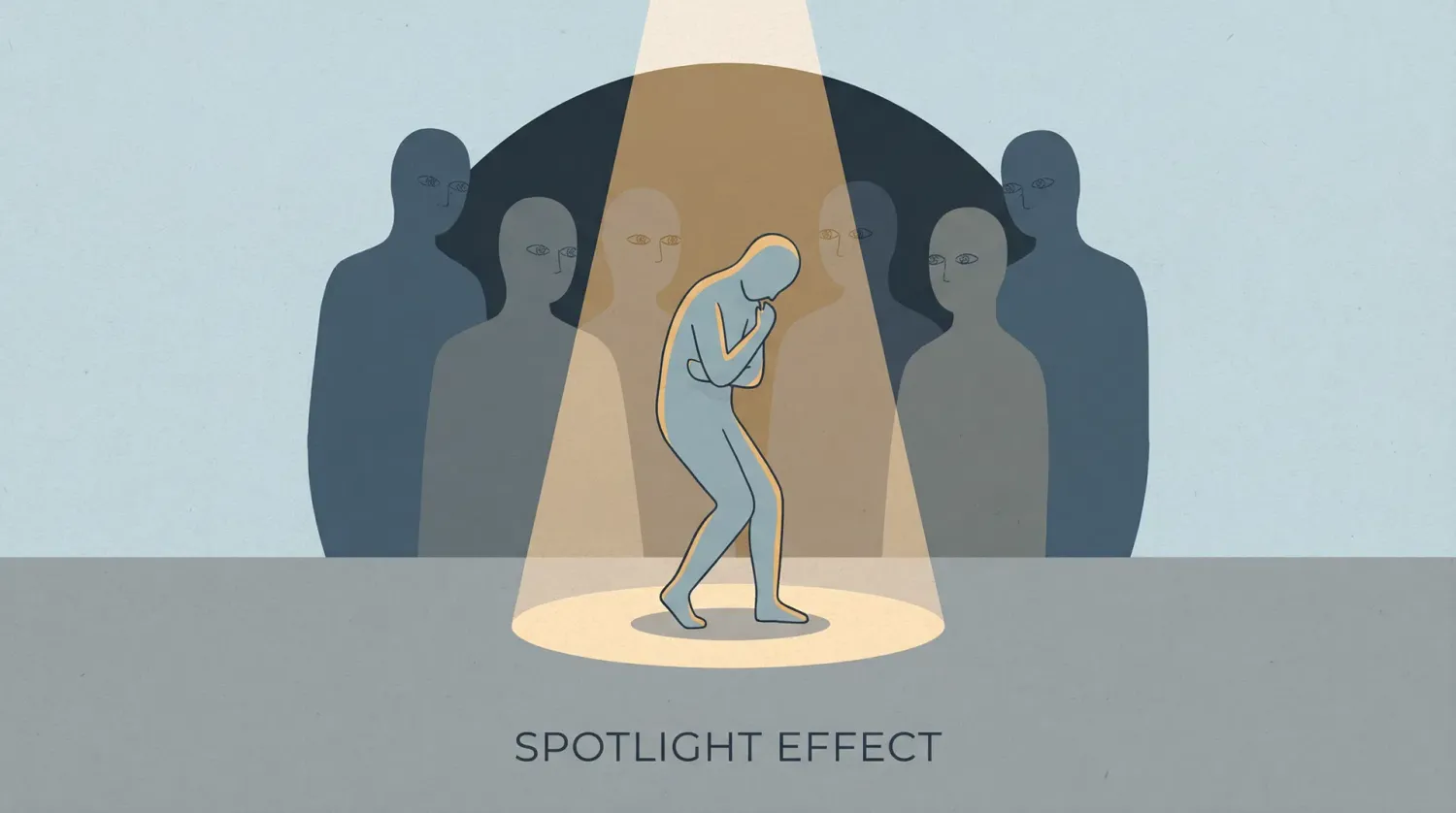
What Is the Spotlight Effect?
People systematically overestimate how much others notice about them. This is called the spotlight effect.
Why does this happen? Your own attention is stronger than others'. Your brain prioritizes social evaluation as a survival mechanism. When you focus on yourself, it intensifies the experience of being seen.
Two cognitive distortions often occur:
Overgeneralization: If one person noticed it, everyone must have noticed it.
Mind reading: I know what they are thinking.
Concrete Example:
A teenager believes everyone sees a pimple on their forehead. In reality, most people don't notice it. Those who do might think about it for two seconds before moving on. But the teenager carries the thought all day.
The Evolutionary Roots: Why We Fear Social Exclusion
To understand why the spotlight effect feels so intense, we need to go back to our evolutionary past. For most of human history, being excluded from the group was a death sentence.
Built for the Group: Humans are a deeply social species. For most of our history, survival depended on staying with the group. A lone human in the wilderness was vulnerable to predators, starvation, and exposure. Being cast out meant death.
The Biological Fear: This is why social rejection triggers the same alarm system as physical danger. Your nervous system doesn't distinguish between "the group is judging me" and "I am in mortal danger." Both activate the fight-flight-freeze response.
The Shame Mechanism: Shame evolved as a social regulator. It made us conform, follow the rules, and avoid behaviors that would get us expelled. A child who felt shame for being loud or different learned to be quiet and fit in. This kept them safe within the tribe.
The Problem Today: We still carry this ancient wiring. But today, social exclusion is rarely fatal. Yet your body reacts as if it is. A critical comment, a perceived judgment, a moment of embarrassment, all trigger the same biological alarm that once meant survival or death.
Why This Matters:
Understanding this evolutionary context helps you see that your fear is not irrational. It's ancient. It's wired into your nervous system. But it's also outdated. You are not going to die from social judgment. Your body just doesn't know that yet.
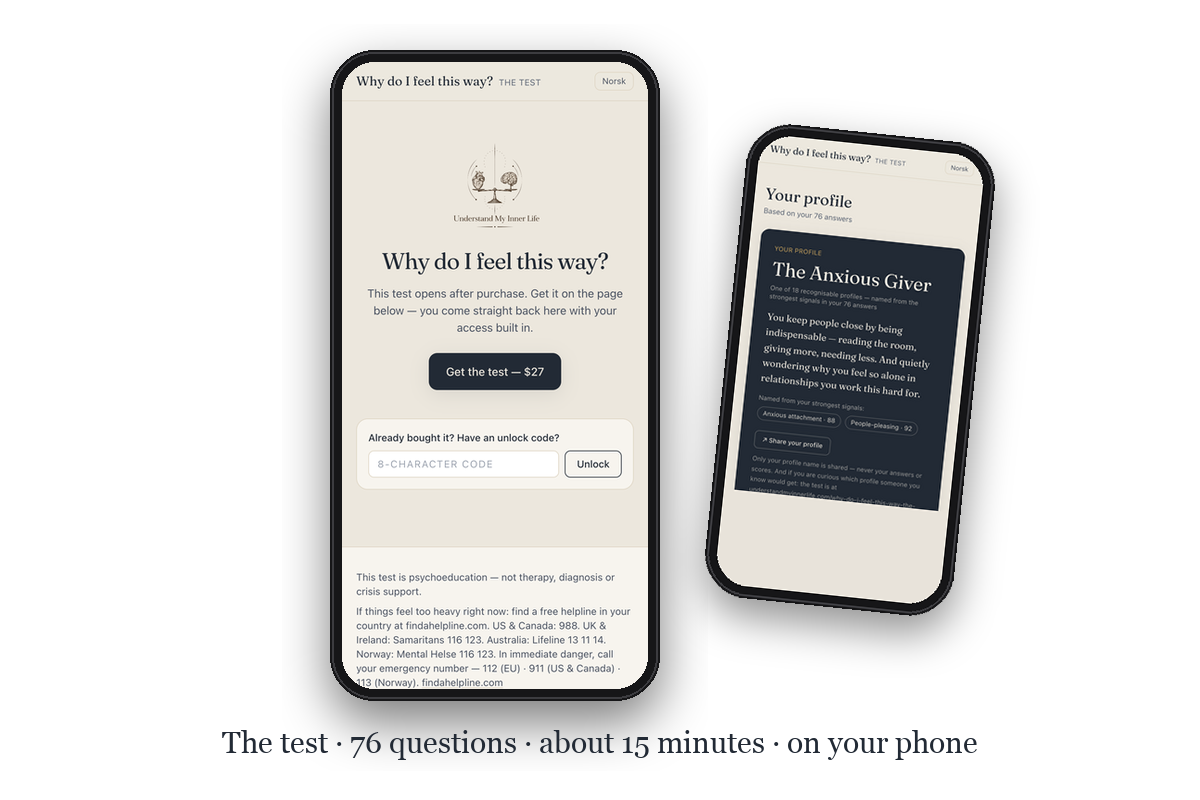
Ready to understand what's really happening?
The 15-minute assessment is $27, paid up front. It names your pattern and shows you exactly where to begin.
When One Comment Becomes an Identity
An impulsive comment from a peer can become an internal truth. Here is the mechanism:
The Comment: Someone says something direct about a trait.
Emotional Activation: You feel shame, fear, or discomfort.
Repeated Rumination: You think about the comment again and again.
Internal Label: The comment becomes part of how you see yourself.
The fear of confirmation keeps you from sharing it with others. You hold it to yourself. And when you hold it to yourself, it grows.
Related Examples: How Context Shapes Shame
A thought is a thought. It is not a fact. Your brain produces thoughts all the time, especially when you are stressed or tired. A thought like "It will never get better" is an interpretation, not reality.
Example 1: The Quiet Person
A child is told: "You're so quiet. Why don't you talk more?" Over time, they internalize this as: "I am boring. I have nothing interesting to say. I should hide." Years later, they avoid social situations, interpret silence as rejection, and assume others find them dull.
Example 2: The Emotional Person
A child cries and is told: "Stop being so emotional. You're too sensitive." They learn that their feelings are wrong, that expressing emotion is weakness, that they should hide their inner world. As an adult, they struggle to connect with others because vulnerability feels dangerous.
Example 3: The Ambitious Person
A teenager shares a big dream and someone laughs: "That's unrealistic. You're not smart enough for that." They internalize this as: "I'm not capable. I should dream smaller. If I try and fail, I'll confirm what they said." They spend years playing small, not because they lack ability, but because shame prevents them from trying.
A THOUGHT WHILE YOU READ
If the spotlight feeling turns up in most rooms rather than one, it is usually attached to a standard you are holding yourself to. That is a pattern you can map.
The Self-Reinforcing Cycle
When you meet other people and fear that they will notice this trait, a process begins:
1. Self-Consciousness: You focus on the trait.
2. Physiological Activation: Your nervous system becomes activated.
3. Monitoring: You begin to monitor yourself.
4. Interpretation: You interpret the activation as confirmation.
5. Increased Activation: Stress increases, and the trait becomes more visible.
This is a regulation problem, not an identity problem.
How Stress Worsens Symptoms:
When you are stressed, physical signs become more visible. Blushing becomes more intense. Trembling becomes more noticeable. Your voice can change. Your face can tense up. This is physiology, not proof that something is wrong with you.
Flexibility as a Skill
There is a big difference between rigid and flexible thinking.
Rigid Thinking: The world must go exactly as planned or it's a catastrophe. I must be perfect. If this trait shows, everything is ruined.
Flexible Thinking: That was uncomfortable, but it doesn't mean everything is ruined. I can show up even if I'm not at my best. I'm not fully myself today, and that's okay.
Therapy often involves increasing flexibility. This is done through:
Tolerating Discomfort: Being able to be with discomfort without it meaning something is wrong.
Delaying Reaction: Not reacting immediately to thoughts or feelings.
Changing Language: Saying "I feel" instead of "I am."
Giving Yourself Temporary Descriptions: "I'm not fully myself right now" instead of "I'm always like this."
Closing Regulation Perspective
What we don't allow ourselves, we judge in others. When you don't allow yourself to be imperfect, you begin to judge others for their imperfection. The sense of injustice is regulated by criticizing them.
Inner rigidity reinforces outer judgment. When you become more flexible with yourself, you automatically become more flexible with others.
Flexibility can be trained. It is a skill. It is one of the strongest protective factors for mental health.
The spotlight effect is not something to eliminate. It's something to understand. Your fear of judgment is not a flaw, it's a feature of being human. But you can learn to live with it without letting it control you.
IF THIS IS A PATTERN, NOT A MOMENT
Knowing people notice less is not the same as being able to stop bracing
People notice far less about us than we fear, and you can know that and still replay the sentence at two in the morning. What keeps the bracing going is usually not the comment, but a rule underneath it about what you have to be in order to be alright. The Perfectionism Map takes you to that rule on paper, in your own handwriting.
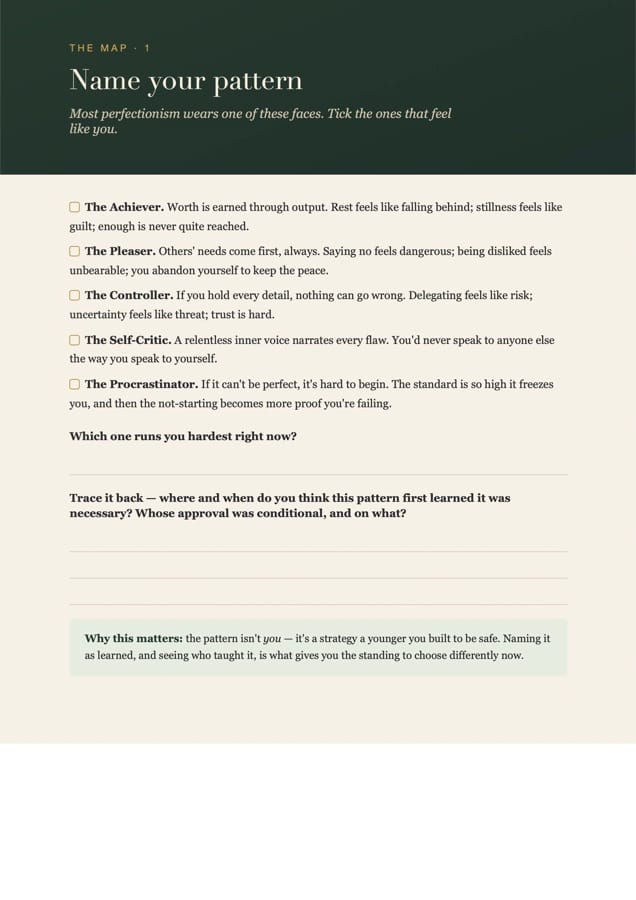
WHAT IS INSIDE
20 pages you write yourself, in one evening.
Your loop, drawn out: the trigger, the rule, the push, the crash.
Your weak point and one move for this week, not someday.
The Overthinking Off-Ramp, included.
PDF. Print it, or fill it in on your phone.
The Perfectionism Map · $27 · one-time payment · yours for life.