
Add-on · Course graduates & active learners
You already know what to do. This is what makes you do it.
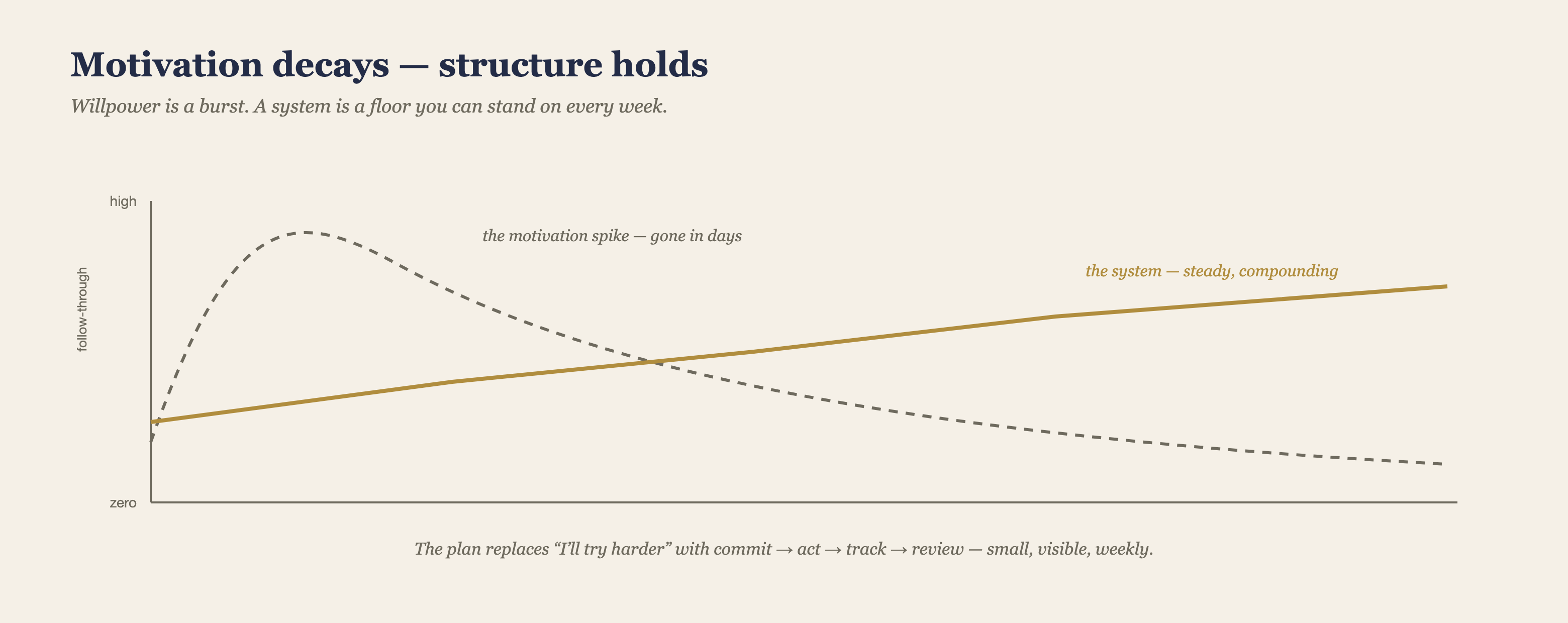
Most people who learn about emotion regulation already know what they should do. The gap between knowing and doing is closed by one thing: structure and repetition. This is that structure.
The knowing-doing gap is real
Most people who take a course on emotion regulation, CBT, or self-awareness already know what they should do. They have read the books, watched the videos, taken the course. And then, life happens, the habit doesn't stick, and six months later they are back where they started.
This is not a character flaw. It is how change works. Insight is the beginning, not the end. The gap between knowing and doing is closed by structure, repetition, and a place to be honest about what is actually happening.
That is what this system is for.
Who is Kristina?

Kristina. 8 years in mental health care · 4,500+ clinical hours · MSc in clinical psychology (in progress)
How you use it
Work through it at your own pace. No clock, no expiry, no schedule to keep.

Step 1·Set up your Implementation Map
Fill in your baseline: the one pattern you are working on, your 1, 10 starting score, your top triggers, and the two tools you will practice. This takes 10 to 15 minutes and anchors everything that follows.

Step 2·Use the Weekly Practice page
Return to the repeatable weekly page as often as you need, daily, weekly, or whenever you want to check in with yourself. Two to five minutes. Simple enough to do, specific enough to matter.

Step 3·Complete a Progress Review
Whenever it feels right, after a hard week, after a win, or when something shifts, fill in the Progress Review. Re-rate your scale. Notice what has changed. Record what is still hard.

Step 4·Mark your milestones
Whenever you feel ready to mark your progress, record your milestones. Compare where you are to where you started. Choose the next pattern to work on.

Step 5·Use the re-entry plan when you fall off
If you go quiet for weeks or months, the re-entry plan is there. Not a reset, a return. You pick up where you left off.
What's inside the PDF
A complete self-guided implementation system, not generic accountability, but built around the specific tools and patterns from the course.
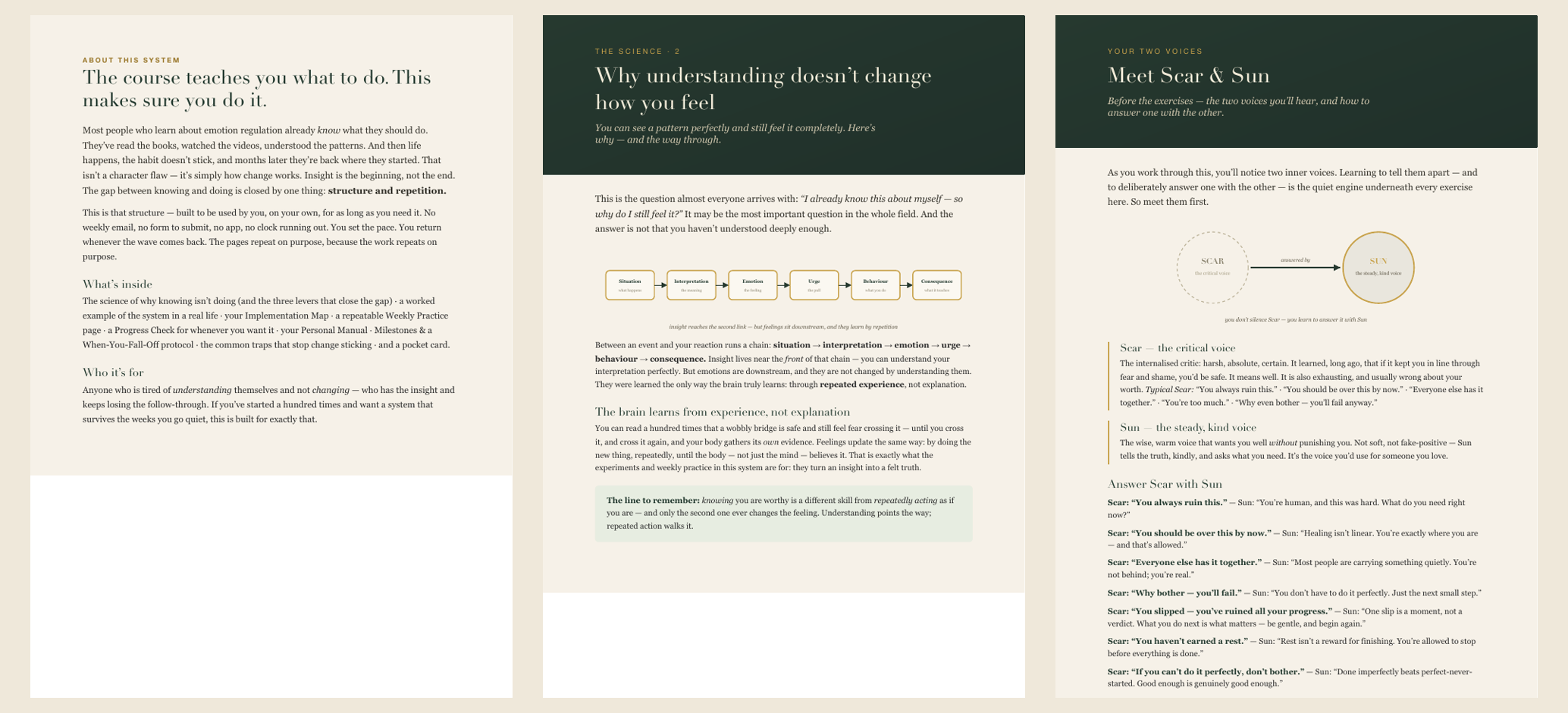
Why Understanding Doesn't Change How You Feel (CBT Chain)
The foundation: situation, then interpretation, then emotion, then urge, then behaviour, then consequence. Understanding this chain is the first step to working with it.
What Your Pattern Protects You From (Implementation Map)
Every pattern has a function. This map names what your pattern is protecting you from, the thing underneath that keeps the pattern in place.
Weekly Behavioural Experiment (Prediction vs Actual)
Predict a feared outcome, then test it in real life, then log what actually happened. Turn uncertainty into evidence in your own handwriting.
Scar & Sun Method (Self-Compassion Practice)
A two-voice practice you build as you go. The self-critical voice (what you are carrying) and the self-supporting voice (what you are learning). Your own words, your own pace.
'Make It Stick' Page (Personal Manual)
A maintenance system, not a worksheet. Build your personal manual as you go, the patterns you've shifted, the tools that work, the insights that matter. Yours to keep.
What's included
Fillable sections that build your Personal Manual over time, one file, yours to keep forever.
- The science of why knowing isn't doing
- A worked example in a real life
- Implementation map (set up once) + a repeatable weekly Practice Page
- Progress check + when-you-fall-off Protocol
- Personal manual + milestones
- Common traps that stop change sticking, And a pocket card
See inside the system
Twenty-five pages: the weekly engine (commit, then act, then track, then review), implementation maps and the honest tracker.
The Accountability System
one-time $39
Lifetime access · No subscription · Instant PDF download
The science of why knowing isn't doing
A worked example in a real life
Implementation Map (set up once) + a repeatable Weekly Practice page
Progress Check + When-You-Fall-Off protocol
Personal Manual + Milestones
Common traps that stop change sticking, and a pocket card
Requires the Emotion Regulation Course. Not a substitute for therapy. Because this is instant digital content, by completing your purchase you agree to immediate access and waive the 14-day withdrawal right.
How this works: pay $39 once at the secure checkout, and you land straight on a download page, one click saves the complete PDF to your device. A receipt arrives by email. There is no app, no login, and nothing is sent on a schedule, it is a file you own and return to.
If the download fails or you ever lose the file, email contact@understandmyinnerlife.com and it will be re-sent at no charge.
Questions
Yes. The Accountability System is built around the course content, it uses the tools, the frameworks, and the language from the course. It is designed for people who have the course (or are taking it) and want a structured system to actually implement what they are learning.
The system is designed for that. There is a dedicated 'When You Fall Off' re-entry plan inside the PDF, a short, honest process for getting back on track without guilt or starting over from scratch.
The Weekly Practice page takes about 2 to 5 minutes. The Progress Review takes 10 to 15 minutes. Marking your milestones takes 5 to 10 minutes. The system is designed to be sustainable, not another thing to fail at.
A fill-in section you build over time. As you complete your practice pages, you record what works, what your patterns are, and what you are learning about yourself. By the time you have worked through the system, you have a document written in your own words, yours to keep.
Yes. There is no clock, no expiry, no schedule you have to keep. You work through it when you are ready. The structure is there when you need it, not a deadline.
No. This is a structured self-guided implementation system for people who have already learned the tools and want support using them consistently. It is not therapy, not crisis support, and not a substitute for professional help. If you are in crisis, please use the resources at the bottom of this page.
Most people who don't follow through aren't lacking motivation. They're lacking a system.
Without a structure
You understand the tools but don't use them consistently Good weeks followed by weeks where you forget entirely Progress feels like it depends on how you feel that day The same patterns keep returning despite your best intentions No record of what has actually changed
With The Accountability System
A written plan you return to, not a memory you rely on Weekly practice that takes 2 to 5 minutes, sustainable by design Progress Reviews that show you how far you've actually come A re-entry plan for when you fall off (not if) A Personal Manual in your own words, yours to keep
You complete this once, in about fifteen minutes. Everything else in the system builds on what you write here.
One pattern
Name one specific behaviour you want to change. Not a trait, a behaviour. 'I withdraw and go silent when I feel criticised.'
Your baseline
Rate it 1, 10 right now. You will return to this number in 8 weeks. The number is not a judgment, it is a starting point.
Your top trigger
What is the single situation most likely to activate this pattern? Be specific: not 'stress' but 'feeling judged by my partner.'
A worked example from the system: Marcus, 45, has known for years that he shuts down and goes cold when he feels hurt. He could explain it perfectly. Explaining it never once changed it. His Implementation Map: Pattern, 'I withdraw and go silent when I feel criticised.' Baseline: 8/10. Top trigger: feeling judged by his partner. Two tools: name the feeling; one long exhale before responding. That is the whole setup. The Weekly Practice page does the rest.
Excerpt from The Accountability System, the full system includes the Weekly Practice page, Progress Review, and When You Fall Off re-entry plan.
Start this week.
You already know what to do. This is the structure that makes you do it.