Free resources
Everything here is free, before you decide anything
Written from 8+ years in mental health care, including acute psychiatry. Read what is relevant to you. No commitment, no pressure.
Clinical psychology
Evidence-based
Written for real people
Not sure where to begin? Read and visit:
I struggle with relationships and attachment
I overthink and cannot switch off my mind
I feel burned out, empty, or exhausted
I want to understand what I am experiencing
I struggle with food, body image, or control
I want practical tools I can use today
Start with these
These are the most-read guides, each one grounded in clinical practice and written to be genuinely useful, not just informative.

Clinically grounded
Every guide is written from experience in acute psychiatry, inpatient wards, and outpatient clinical work, not from textbooks alone.

Written for real people
These resources are written for the person sitting with the experience, not for professionals.

A starting point, not a solution
Understanding is the first step. These guides give you language for what you are experiencing. Practice and support come next.
Your First Three Tools
- The starting point, and the three moves the whole method rests on. Why feelings hijack you, and why understanding yourself was never the thing that changed it. The Golden Second, the 5-Minute Reset, and "Why do I feel this way?", one skill through three doors. Ends with a seven-day experiment and a pocket version to carry.
The Anxiety Decoder
- Anxiety as an alarm you can learn to read instead of obey. What is happening in your body, the trap that makes anxiety grow, and why you cannot think your way out of it. Built around one sort, real alarm, or prediction, with a separate response for each.
The Overthinking Off-Ramp
- Why the mind loops, why it pays you a little every lap, and how your beliefs about worry keep it running. Why it is loudest at night, and what to do when it will not let you sleep. Sort the thought, take an exit, interrupt the loop.
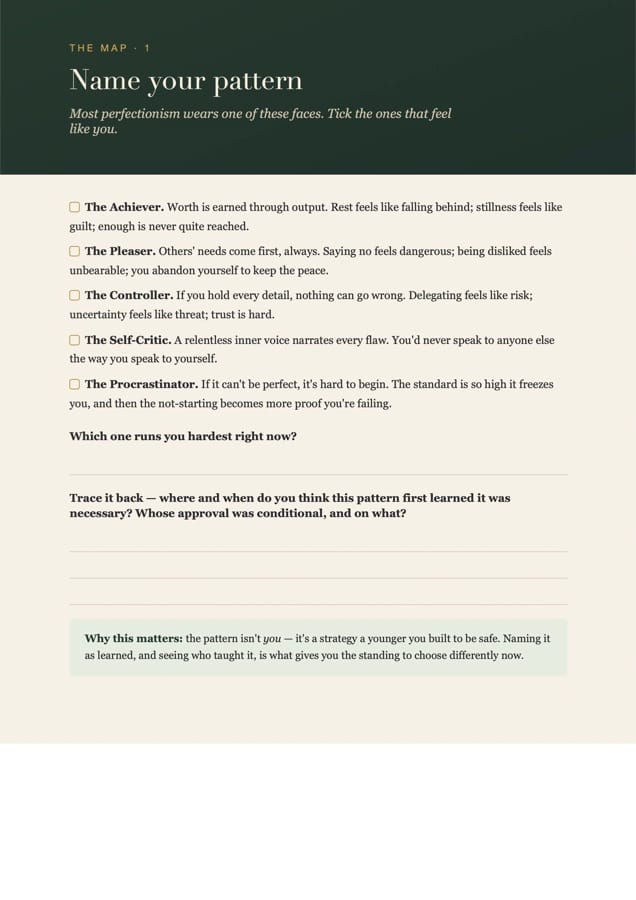
The Perfectionism Map
- Perfectionism as fear wearing a suit, not high standards. The maintenance cycle and why it is self-sealing, the cost and the paradox, and why "just lower your standards" never works. Ends in the 80% experiment.
The Self-Worth Reset
- Where conditional worth comes from and why it persists. The inner critic as a one-sided prosecutor, and an evidence audit that answers it. Worth is rebuilt in the body by repetition, not by deciding you are enough, so this one ends in a daily practice.
- The Anger Compass
- Anger as a signal, not a problem. What sits underneath it, and the three doors anger walks through, including the one most people never use. Build the clean sentence that says it without shouting it.
The Boundary Blueprint
- How the pressure actually works, why you comply, and why guilt lies. The shape of a clean no, how to hold the line when it spikes, and five real lines to practise holding.
The Armour Audit
- The defences you built to survive, named, and where they came from. What the armour costs you, the inner dictator that keeps it on, and how to lower it an inch at a time, safely, rather than all at once.
The Decision Untangler
- Why more choice makes it harder, and why overthinking a decision feels productive without being productive. "Good enough" as a strategy rather than a compromise, and a ten-minute method to decide and close the loop.
The True-Self Map
- The exhaustion that comes from being far from yourself, not from doing too much. You are not one self but parts, map the gap, meet the protector, and practise seven small acts of you, with a daily congruence check.
The Resilience Field Guide
- Resilience as the capacity to bend, not toughness, not staying positive. The levers you can actually pull, benefit-finding without toxic positivity, and fourteen days of bending.
THE FULL COURSE · FROM $297
When free is not enough
The free material is meant to be genuinely useful on its own, and for a lot of people it is enough. If you would rather have the whole method in order than in pieces, that is what the course is.