
The neuroscience
Hooked on Hope Workbook
A self-guided workbook on limerence: why you cannot stop thinking about them, and how to interrupt the loop.
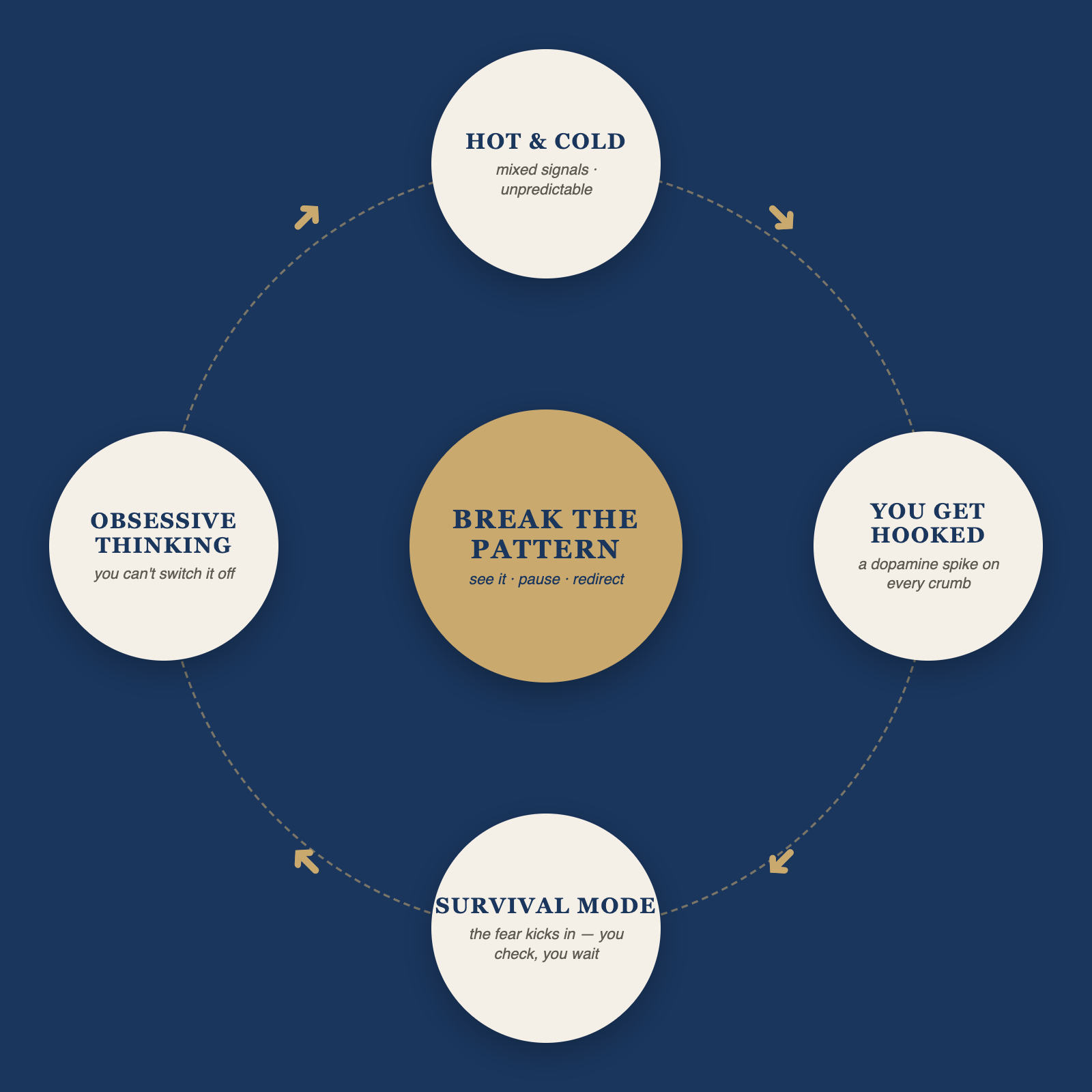
You might recognise this
The pattern has a shape.
You are not imagining it. And you are not alone in it.
Right now
You check their profile before you check on yourself.
You replay the last conversation, looking for the moment it went wrong.
You feel high when they answer, and crushed when they don't.
You know this is not good for you, and you still can't stop.
You are tired, and you are still waiting for them to choose you.
After working through this
You understand why your nervous system got hooked, and that it was not weakness.
You can stop a spiral before it takes your whole day.
You know the difference between love and the need to be chosen.
You can feel the pull without following it.
These are not promises. They are what becomes possible when you have words for what is happening, and tools to meet it.
What is limerence?
Limerence is an intense, often obsessive pull toward one person. Your thoughts circle around them without you choosing it, and your mood rises and falls with their attention. It can feel like love, but it is mostly about what their attention does to you.
Self-Assessment: Are You Experiencing Limerence?
Limerence Self-Assessment Quiz
Take this brief interactive quiz to assess whether you may be experiencing limerence. This is a tool for self-reflection and awareness, not a clinical diagnosis. Your honest responses will help you understand your current emotional state and attachment patterns.
The quiz contains 10 questions. For each statement, you'll indicate your level of agreement on a scale of 1 (Strongly Disagree) to 5 (Strongly Agree). It takes about 2-3 minutes to complete.
How it works
The more unpredictable the signals, the more your brain treats this person as critical to your survival.
Why hot & cold is addictive
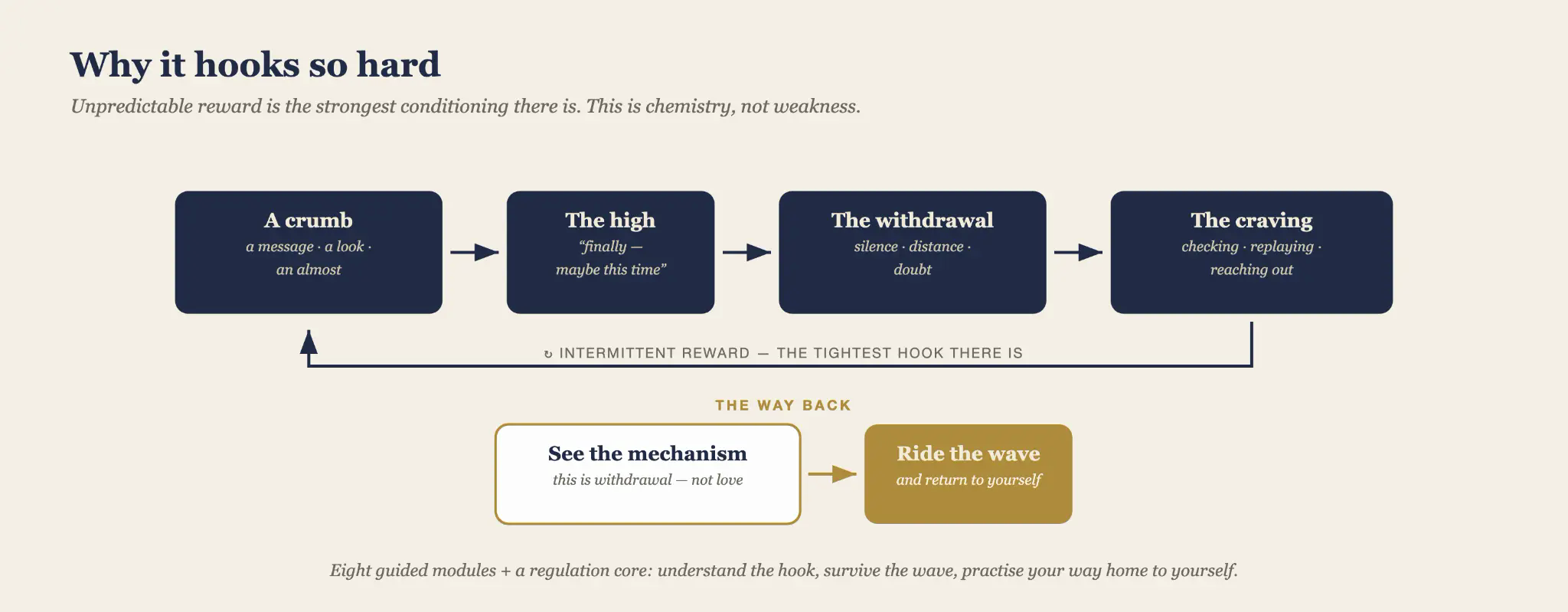
Intermittent reinforcement, the same mechanism behind slot machines, creates stronger attachment than consistent kindness. Your brain thinks: the reward is coming. Just wait.
Why you cannot think your way out
When your nervous system flags someone as survival-critical, the prefrontal cortex goes offline. Logic stops working.
What actually breaks the loop
Understanding the pattern, interrupting the thought cycle, and rebuilding a nervous system that no longer needs their validation to feel safe.
Self-Guided Workbook
Limerence
You cannot stop thinking about them.
Eight guided modules and 30+ exercises on limerence, attachment, and the neuroscience of why you cannot stop, even when you know you should.
PDF workbook. Practical tools. Clinically grounded. One payment, yours forever.
CBT · MCT · DBT · ACT
Private, nothing uploaded
No subscription, ever
8 guided modules · instant PDF download
From limerence basics to full recovery
Private Journal
Reflection prompts saved on your device only
Practical Tools
Three-Thought Rule, breathing, grounding
Lifetime Access
One payment, no expiry, no account needed
What's inside the workbook
Eight guided modules, plus the science section, a personal mood audit, “How to Sit With the Feeling” and the Experiment Engine. Each module includes evidence-based content, reflection prompts ("What would letting go mean?", "Why am I still checking?"), and practical tools. You keep the workbook forever.
See inside the workbook
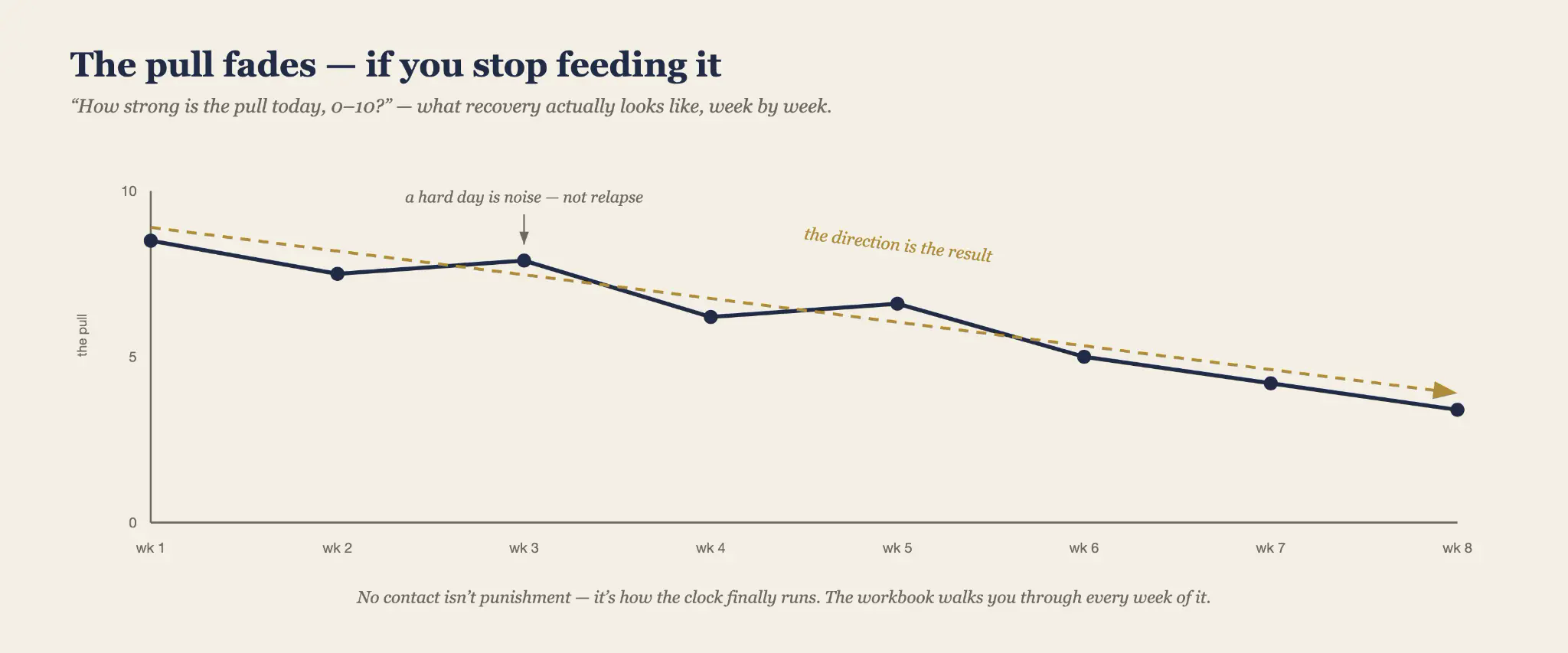
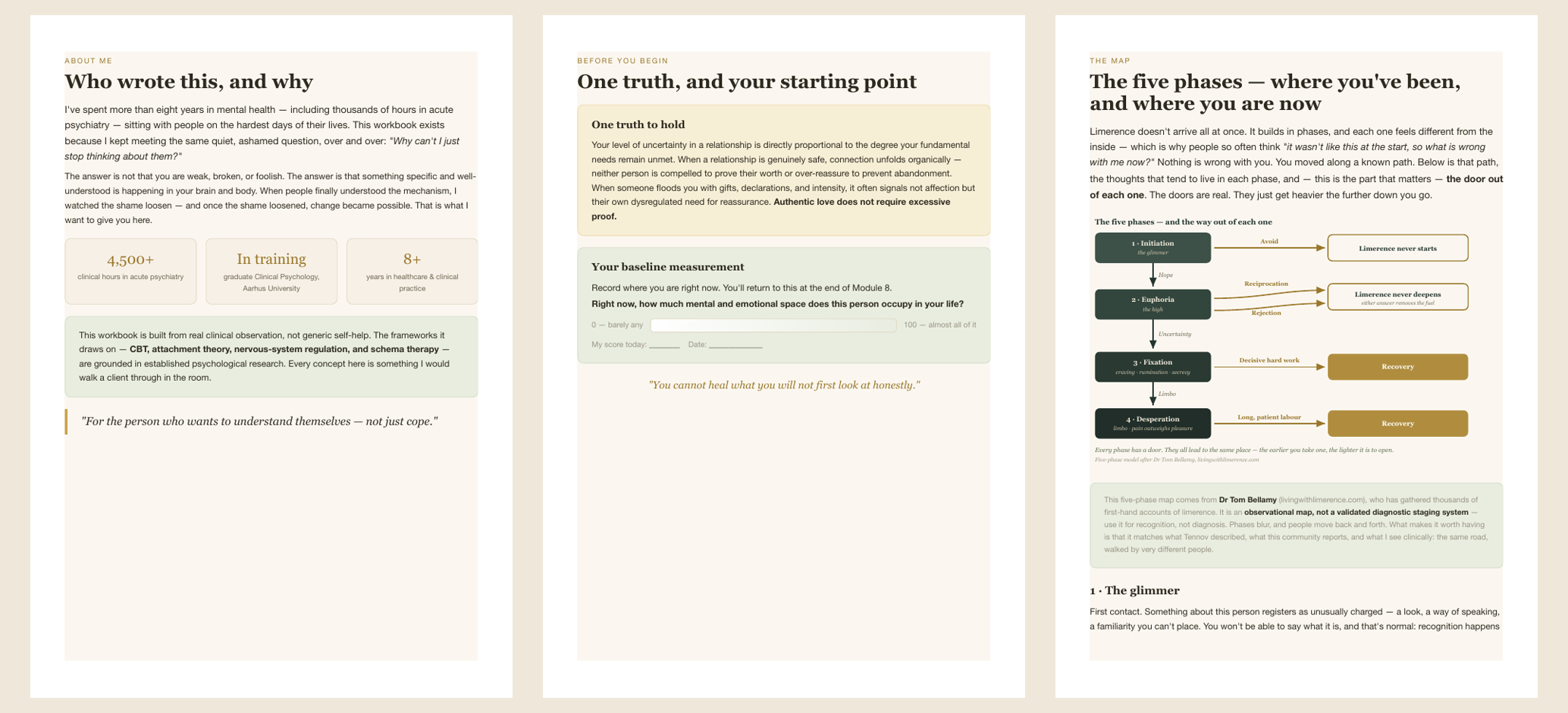
Eight guided modules: the neurobiology of the hook, the checking loop, no-contact week by week, and the regulation core.
Who made this

I am Kristina. I have sat with many people on their worst nights. I made this workbook so you can understand the pull, and find your way out of it, step by step.
8 years in mental health care · 4,500+ clinical hours · Master in clinical psychology
In their own words
✶
“She doesn’t let anything out of her hands before it feels right to her. I think this can mean a lot to anyone who struggles to put words to their own feelings.”
INGRID
“She is the person I call at 3:30 in the morning when everything feels like it is falling apart and the words are hard to find. She does not try to solve it or rush past the hard part. She stays.”
FRIEND
✶
“She taught me to see the world differently, not in a way that felt forced or naive, but in a way that made genuine sense to me. I understand myself more clearly now. I feel less trapped by the patterns I used to move through automatically.”
ANONYMISED REFLECTION
“She doesn’t just offer comfort, she helps you understand why you feel what you feel. She puts words to things I hadn’t been able to express myself.”
NIKA
“Kristina is fearless in the face of strong emotions. She dares to stand in it together with the patient. That creates a safety that is rare to see.”
COLLEAGUE
Common questions
Recognizing where you are. Understanding the pattern. Your attachment blueprint. The neurobiology of the hook. Breaking the cycle. Rebuilding yourself. What love actually looks like. Your personal action plan.
Yes. The exercises draw on attachment theory (Bowlby, Ainsworth), variable ratio reinforcement (Skinner), metacognitive therapy (Wells), DBT skills (Linehan), acceptance and commitment therapy (Hayes) and self-complexity theory (Linville).
This workbook is a self-help resource, not a replacement for individual therapy, psychiatric treatment, or crisis intervention. If you are in acute distress, please contact a qualified mental health professional or your local crisis service.
Crisis resources: Norway: Mental Helse 116 123 · UK: 116 123 · US: 988 · Australia: 13 11 14 · findahelpline.com
How this works: pay $17 once at the secure checkout, and you land straight on a download page, one click saves the complete PDF to your device. A receipt arrives by email. There is no app, no login, and nothing is sent on a schedule, it is a file you own and return to.
If the download fails or you ever lose the file, email contact@understandmyinnerlife.com and it will be re-sent at no charge.
$17 · one-time purchase · instant PDF download after payment. Questions? contact@understandmyinnerlife.com
Kristina Zaikina. 8 years in mental health care · 4,500+ clinical hours · MSc in clinical psychology (in progress).
Yes. The free article Hooked on Hope for love explains the pattern before you buy anything.
It is possible to survive this.
It is possible to feel better.
You can love someone and still need to leave. You can understand their pain and still protect your own. You can recognise their humanity and still refuse to be their emotional regulator. These are not contradictions, they are acts of wisdom.
Your nervous system is asking for rest. Your body is asking for safety. Your soul is asking to come home to yourself.