Imposter Syndrome
When you feel you don't deserve your success and are afraid of being "exposed".
Perfectionism and Low Self-Esteem
Psychologists Suzanne Imes and Pauline Rose Clance were the first to describe imposter syndrome in 1978. At the time, they used it to describe high-achieving career women. More recently, it has been found to affect both women and men in many different professions.
Perfectionism, low self-esteem, and neuroticism are common traits in people with imposter syndrome. You believe that every task must be solved perfectly, rarely ask for help, and are very afraid of making mistakes. This can lead to procrastinating tasks - for fear of not being able to complete them, or spending much more time than necessary on the task.
It is not uncommon for people who struggle with such thoughts to have experienced a lot of pressure to perform from their parents while growing up.
It appears to be common: surveys across many professions find that a large share of people recognise these thoughts at some point, and they turn up especially often among high achievers. Figures vary widely between studies, because imposter feelings are measured in different ways and are not a diagnosis, so treat any single percentage with caution.
If this maps onto perfectionism
Imposter feelings and perfectionism feed each other, the higher the standard, the stronger the fear of being found out.
Course · $179
Perfectionism & Burnout
For when the standard has become the problem.
Recognise perfectionism while it is driving
Rebuild rest without guilt
Reconnect with the parts you suppressed
What imposter syndrome actually is
It is not a diagnosis. You will not find it in a diagnostic manual, and there is no test that makes it official. It is a pattern, a particular way of explaining your own success to yourself.
The pattern goes like this. Something goes well, and you hand the credit to something outside you. Luck. Timing. Good colleagues. An easy year. The fact that you worked twice as hard as the job actually required. Anything except the plain possibility that you were able to do it.
And because your ability never gets the credit, a second thought follows close behind: sooner or later, someone is going to notice. That is the fear underneath the feeling, not failing, but being found out.
It is very common, and it tends to land on people who are genuinely competent. That is not a kind line added to make you feel better. It is what the pattern requires in order to exist at all: you have to be doing well enough to have something to lose.
The imposter loop, why succeeding never fixes it
This is the part that is almost never explained, and it is the part that changes things.
Watch what happens around one single task.
1. The task arrives. And with it, immediately: this is the one where they find out.
2. The anxiety has to go somewhere. So you overwork, check it eleven times, rehearse it, stay up with it, or you put it off until the deadline forces your hand. These look like opposites. They are the same move: managing the fear of exposure.
3. It goes well. It usually does.
4. Relief. Short, and enormous. Got away with it again.
5. The credit is misfiled. The result is explained by the overwork, or the luck, or a low bar, never by the fact that you are good at this.
6. So the evidence is spent. Nothing is added to the account. The next task begins from zero, exactly like the last one.
Read steps five and six together, because that is the entire mechanism: success cannot cure imposter feelings, because the proof is refused at the moment it arrives.
This is why "achieve a bit more and then you will feel secure" never works, and why the most decorated person in the room can still be the one lying awake. The loop is not waiting to be fed. It runs on refusing the food.
Why the proof never sticks
Two ordinary mental habits keep the loop sealed.
The first is how you file cause. When something goes well, you look outward for the reason, it was easy, they were generous, you got lucky. When something goes badly, you look inward, that was me, that was the real me showing. Success is treated as circumstance. Failure is treated as character. With that filing system no amount of success can ever accumulate, and a single mistake counts for everything.
The second is treating a feeling as information. I feel like a fraud, so I probably am one. Feelings are real and worth listening to, but they are not measurements. Feeling like a fraud tells you something true about how exposed you feel. It tells you nothing whatsoever about whether you can do the work.
Notice what those two habits do together. One throws the evidence away. The other puts the feeling in its place. No wonder it holds.
THE FULL COURSE · $179
Want to work on the standard itself, not just the feeling?
Perfectionism & Burnout is a full course on that, perfectionism as fear wearing a suit rather than high standards, the cycle that keeps it self-sealing, and what to do instead of lowering the bar.
The shapes it takes
The same pattern wears different clothes. Most people recognise themselves in one or two of these, not all of them, and this is meant to help you notice your own move, not to hand yourself a label.
The perfectionist. The standard is flawless, so anything short of it reads as proof. Ninety-five per cent is not ninety-five per cent. It is the five that got away.
The expert. You feel you must know everything before you are entitled to speak. So you take one more course, read one more paper, and stay quiet in the meeting where you actually had the answer.
The soloist. Asking for help would show the seam, so you carry it alone. It costs more, takes longer, and leaves no witnesses to what you actually managed.
The natural. If you were really good at this it would come easily, so effort itself becomes the evidence against you. This one falls hardest on people who were praised as children for being clever rather than for working at something.
The superhuman. You compensate by carrying more than anyone asked for: more hours, more roles, more responsibility. Being indispensable feels safer than being found out. It is also the shortest road to burnout.
None of these is a type of person, and none of them is something to diagnose yourself with. They are strategies, sensible ones, for staying ahead of a fear. Each is an attempt to protect yourself, and each works just well enough to keep you doing it.
Did Not Feel Belonging
Recent research suggests that this is not an individual phenomenon, but can be attributed to the environment. For example, research on ethnic-minority students in the United States has found that those who had experienced more discrimination reported imposter feelings to a greater extent (Cokley and colleagues).
Other work in academic settings has found that a stronger sense of being an imposter goes together with a weaker sense of belonging - they did not feel as connected to others in the academic environment they were in.
Some situations turn the volume up, and it is worth naming them.
Being the first. The first in your family at university, in that profession, in that kind of room. There is no one at home who can say yes, this is what it feels like, keep going. Without that, unfamiliarity gets read as unsuitability.
Being the only one. The only woman at the table, the only one with your background, your accent, your class. When nobody in the room shares your starting point, belonging has to be argued for rather than assumed, and arguing for it all day is tiring in a way that is easy to mistake for not coping.
Being somewhere selective. In places where everyone is able, ordinary competence stops registering as competence at all. The comparison group has moved. The internal scoring has not.
Naming this is not about handing out an excuse. It is about accuracy. If the room is part of what is producing the feeling, then the feeling is not simply a flaw in your personality, and the work is not yours alone to do.
What actually helps
One thing at a time. This is not a list to get through, reading all of it and doing none of it is the pattern repeating itself. Pick the one that made you wince and start there.
Write the evidence down, and go back and read it. This sounds small and it is the most important one here. Memory filters out what does not fit the story, so evidence you only hold in your head will not survive the next bad day. Keep the message where someone thanked you, the review, the thing that went well, the hard conversation you handled. Then read it when the feeling arrives, not when you are calm and reasonable, but precisely when you are not.
Separate the feeling from the fact. Two sentences, not one. I feel like a fraud is the feeling. Here is what I did, and here is what happened is the fact. Say both. You do not have to argue yourself out of the feeling. You only have to stop letting it be the only thing on the page.
Say it out loud to one person. Shame lives in silence and shrinks in company. One person you trust is enough. Most people are quietly astonished to discover how many of the capable people around them are having the identical private conversation.
Trade "I should already know this" for "I am learning this now." The first is a verdict. The second is a description. Both describe not knowing something yet, but only one of them leaves you able to ask the question.
Treat competence as something built, not something you either have or do not. If ability is a fixed amount you were handed at birth, then every struggle is a test of whether you were given enough. If it is something that accumulates by doing the work, struggle is simply what building looks like from the inside.
Let one thing be good enough on purpose. Deliberately, with the uncomfortable feeling included and nothing done about it. Every time something turns out fine at eighty per cent, the standard gets corrected by experience rather than by argument, and experience is the only thing that actually moves it.
When it is more than a pattern
Imposter feelings are common, and for most people they come and go with new roles and unfamiliar rooms. Sometimes something heavier is sitting underneath, and that deserves proper attention rather than more self-help.
It is worth talking to your doctor or a psychologist if the feeling has settled in rather than passed, weeks of low mood, or worry that will not switch off. If it is making your life smaller, so that you are turning down work, chances or people in order not to be exposed. If you are sleeping badly most nights, or using alcohol or anything else to take the edge off before you perform. Or if the thought has arrived that people would be better off without you.
If that last one is here, do not wait for a better moment: findahelpline.com
Asking for help is not the opposite of being competent. It is the same move you already know how to make at work, bringing in someone with a different skill set when the problem sits outside your own.
Podcasts and Links (Norwegian)
A WORKBOOK · $27
If this is a pattern, not a moment
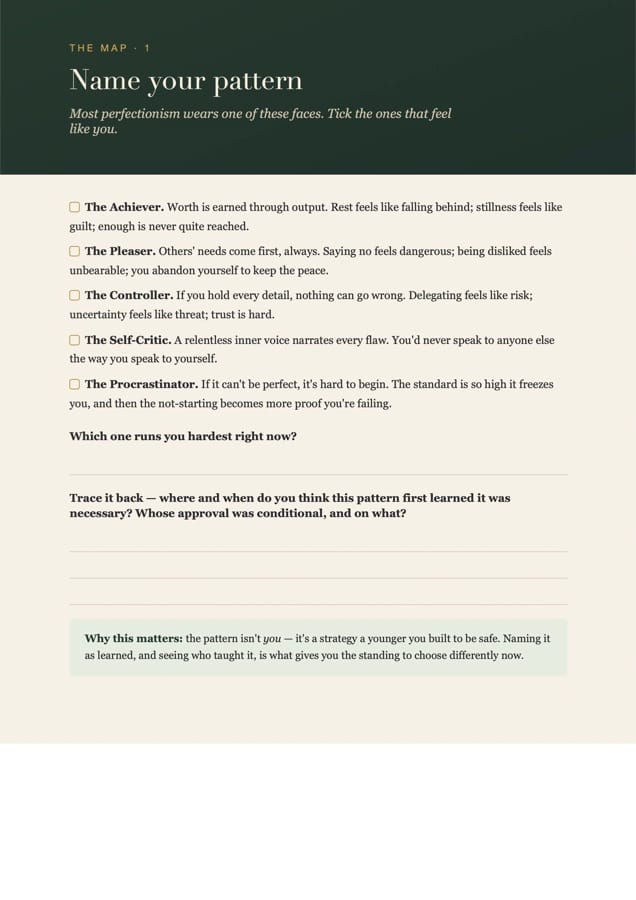
Feeling like a fraud tracks with how high the internal standard is set, not with how competent you actually are, which is exactly why evidence never settles it: every success gets filed as luck, or as effort that only just covered the gap, so the proof goes in, the standard quietly rises to meet it, and the gap sits precisely where it always sat. You are the person who always delivers, the one everybody counts on, and you are also the only one who knows what it costs to be that person. The Perfectionism Map is a short workbook for finding where that standard was set, what it has been costing you, and what the first way out of it looks like, written out of 8 years and 4,500 clinical hours.