Good Reasons for Bad Emotions
Why sadness, anxiety, and low mood are not signs of a broken brain, but evolved mechanisms trying to protect you.
What is Behind Our Emotions?
You are a survivor, not developed for happiness, but for survival. We are not built to feel good all the time. Emotions exist to influence your behavior; they are transient to get you out of situations your brain believes might threaten your survival. Anxiety and depression are often the body's defense mechanisms, a normal part of human nature.
However, be aware that lack of sleep, prolonged stress, passivity, and overexposure to others' potentially fake lifestyles on social media send signals that the brain interprets as you being in a dangerous world where you are not good enough. So the brain responds by signaling you to withdraw so you don't feel bad. You are built to move; physical activity and community can protect you against this.
The best thing you can do when there's no real danger is to recognize that the brain made a mistake. It thought you were in danger, but there's nothing harmful present.
Remember that thoughts and feelings are temporary. They rise, peak and pass on their own, you do not have to make them go away. If you try to control your uncomfortable symptoms and make them go away, you may unintentionally keep them going through your thoughts. The brain then believes you still need help and releases more stress hormones into your body.
A Helpful Strategy for Anxiety:
When you experience anxiety or physical discomfort because you're worrying or having distressing thoughts, stop and notice what's happening. Tell yourself: "My brain thinks I'm in danger because I started focusing on unpleasant thoughts."
Instead of trying to make them go away, remind yourself: "It's okay. I know there's no real danger. The brain just thought I needed help."
Use your control over your attention and shift your focus from the internal to the external. Observe what's actually around you, solve a task, have a conversation, or enjoy an activity you like. You do not have to fight the symptoms. When you stop struggling against them, they tend to settle on their own.
Why We Have Anxiety
Anxiety can be useful. In fact, most people have more anxiety than they actually need, because having too little anxiety in our evolutionary past would have ended in disaster.
Through natural selection, organisms are shaped to behave in ways that maximize their survival. Our brains were shaped to be advantageous for our genes, not necessarily for our comfort. Anxiety and low mood exist for the same reason as physical pain and nausea: because they are useful in certain situations. Just as a cough is a useful response indicating a problem in the lungs, anxiety is a response indicating a perceived threat.
The Smoke Detector Principle
Think of your anxiety like a smoke detector. The psychiatrist Randolph Nesse calls this the smoke-detector principle: a false alarm is cheap, a burst of fear and a wasted sprint, while a missed real alarm can cost you your life. When the two costs are that lopsided, natural selection settles on a system that would rather be wrong many times over than miss once. The symptoms of panic are incredibly useful for escaping danger, but sometimes the alarm goes off just because you burned the toast.
Sickness Behavior and Conservation
Have you ever woken up with a cold and felt like there is absolutely no reason to do anything that day? This is called "sickness behavior." It has an evolutionary advantage: it forces you to conserve energy, avoid predators, and stay out of conflicts when you are not at your best and would likely lose.
Sometimes, the brain interprets exhaustion or chronic stress as an infection, triggering feelings of low mood, hopelessness, and withdrawal to force you to rest.
The Advantage of Sadness
Interestingly, research on mood and thinking suggests that a low mood can sharpen attention to detail, while a good mood tends to favour the broad picture. When we are happy, we tend to absorb overarching information and may overlook details, making us less critical and potentially more naive. In contrast, we take in information more detailed and critically when we feel down, which can be an advantage in situations that require troubleshooting or careful analysis.
The Depressed Brain (Deppahjerne) & Inflammation
Depression can be seen as a response to the fact that we live longer than our ancestors. Our bodies and brains are developed to survive threats that historically killed people at a young age. Stress can signal an increased risk of being harmed by an infection, as our immune system uses about 20% of our energy. Prolonged stress can therefore be energy-consuming and lead to the immune system being overactivated.
Research shows that situations that threaten our self-image, like a job interview, can mobilize the immune system because the body interprets the stress from the situation as an increased risk of injury or infection. This can lead us to withdraw and isolate ourselves to avoid contagion or save energy, which could help us overcome a potential infection. This is why prolonged stress is interpreted as a persistent risk, and the brain responds by creating feelings that make us withdraw, a state we call depression.
The Cycle of Stress and Inflammation
Every time you stress, the body sends signals to the brain that SOMETHING IS WRONG. This causes the brain to send the body and mind signals in the form of negative emotions. You stay in ego perception, you focus only on yourself and your life, what you need to feel well again.
This reinforces a cycle: stressed, then inflamed, then less effective and healthy brain, then creating your "depressed brain" (deppahjerne), which tells you everything that is negative from the moment you wake up. Because the cells in your body hold onto the stress. Until you calm down for a longer period, your emotions will consist predominantly of negative ones, rather than positive. Because you are clearly stressed, and then something must be wrong, so your brain tries desperately to figure out what by reminding you of everything that is not good.
Real-World Examples: How Modern Life Triggers Inflammation
Consider a typical Monday morning. You wake up after a poor night's sleep, you scrolled through social media until midnight, comparing your life to others' highlight reels. Your cortisol (stress hormone) is already elevated. You skip breakfast and rush to work, your nervous system in a state of mild panic. At work, you face back-to-back meetings, constant notifications, and the pressure to respond immediately to emails. Your brain is flooded with information, your attention fragmented. By noon, you grab a processed lunch, high in sugar and refined carbohydrates, which your immune system recognizes as inflammatory. Your body interprets this as a threat, releasing more inflammatory markers. By afternoon, you feel exhausted, unmotivated, and notice yourself spiraling into negative thoughts: "I'm not good enough. I can't keep up. Everyone else seems to manage better than me." This is not weakness. This is your inflamed brain doing exactly what it's designed to do.
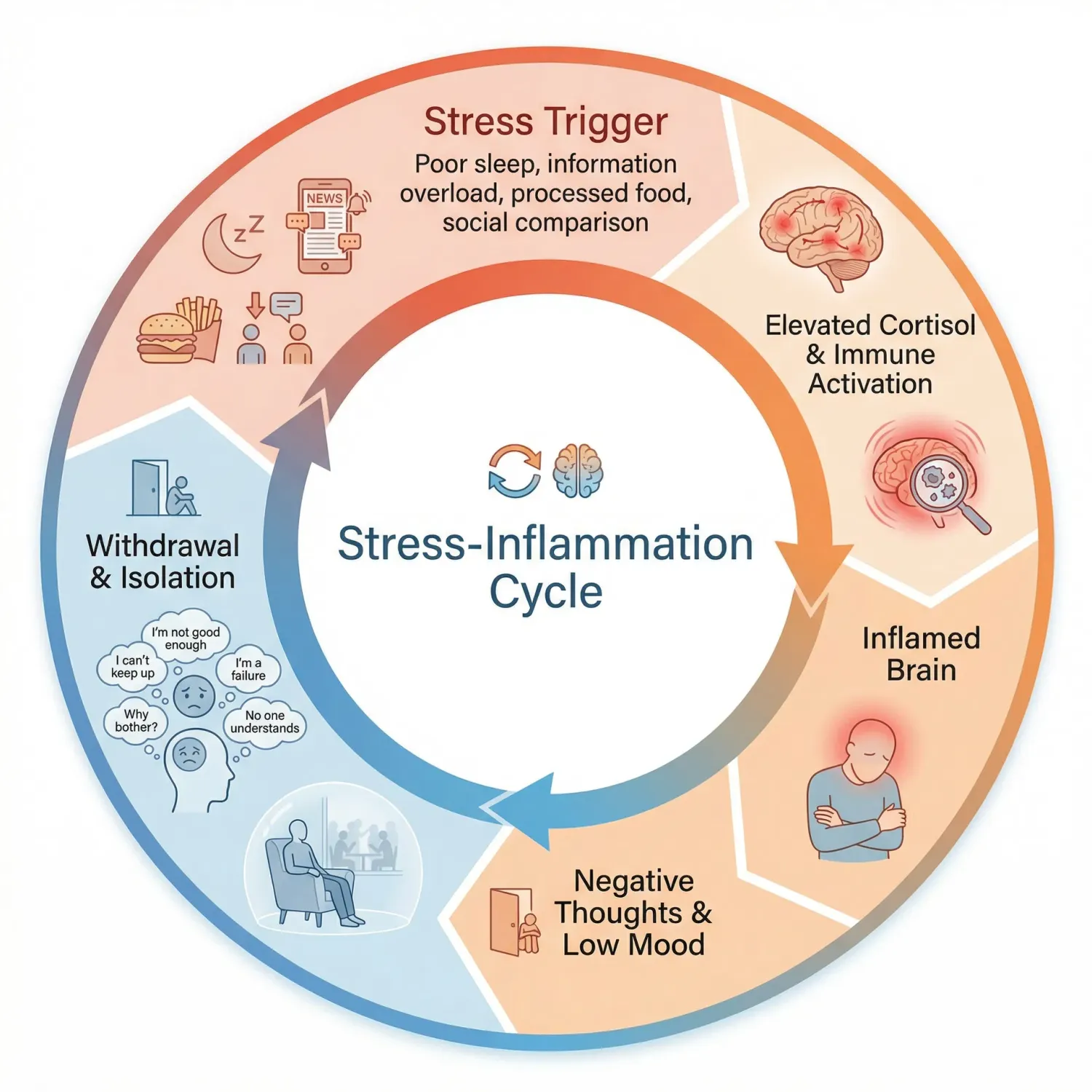
The Modern Inflammation Spiral:
Poor Sleep, then Your immune system can't repair itself. Inflammatory markers rise. Your brain becomes foggy.
Information Overload, then Constant notifications and context-switching keep your nervous system in high alert. Stress hormones remain elevated.
Processed Foods, then Sugar and refined carbs trigger an immune response. Your body thinks it's under attack.
Sedentary Behavior, then Movement is how your body processes stress. Without it, inflammation accumulates in your tissues and brain.
Social Comparison, then Seeing others' curated lives activates your threat-detection system. Your brain interprets it as social danger.
The Result, then Your brain, now inflamed and flooded with stress signals, interprets everything negatively. It's not pessimism, it's biology protecting you from what it perceives as danger.
The Mismatch Between Your Body's Needs and Society's Demands
Here's the cruel paradox: When your body is inflamed and your brain is in "depressed mode," society demands the opposite of what you need. You feel low mood and withdrawal, your body's way of saying "rest, recover, conserve energy." But your boss expects productivity. Your friends expect you to be social. Your culture celebrates those who "push through" and "grind harder." You might hear yourself thinking: "I should just get over this. Everyone else manages. Why can't I just push myself harder?"
This creates a secondary layer of suffering: shame. Not only are you experiencing the biological reality of inflammation and low mood, but you're also judging yourself for not meeting society's impossible demands. You internalize the message that something is wrong with you, when in fact, something is very right, your body is trying to protect you by forcing rest.
A Reflection for You
Think back to a period when you felt persistently sad, unmotivated, or "depressed." Can you trace it back to lifestyle factors? Perhaps you were sleeping poorly for weeks. Or you were in a period of intense stress, a demanding job, relationship conflict, or major life change. Maybe you were eating poorly, scrolling endlessly, or isolating yourself.
Now, think of a time when you felt lighter, more energized, and more optimistic. What was different? Were you sleeping well? Moving your body regularly? Spending time with people you care about? Eating nourishing food? These are not luxuries, they are the conditions your brain needs to function without depression.
Your low mood is not a character flaw. It's feedback. It's your body saying: "The current strategy isn't working. We need to change something."
In today's society, lifestyle factors such as prolonged inactivity, lack of sleep, exposure to toxins, obesity, and smoking can induce or worsen inflammation. This persistent inflammatory state can be misinterpreted by the body as an attack from viruses and bacteria, which can lead to mental standstill or depression as a result of the body's defense mechanism. The key insight is that low mood is not something to be ashamed of, it often makes sense as a response to real biological and life stress. That does not mean depression is only lifestyle. Depression is a real condition that can need treatment, and this work sits alongside that, not instead of it.
Sleep Deprivation & Biological Mood Changes
One of the most direct ways your brain becomes inflamed is through poor sleep. When you sleep poorly for even one night, your amygdala (the brain's alarm system) becomes hyperactive, and your prefrontal cortex (the rational thinking center) becomes less active.
This is not weakness or laziness, it's pure biology. You literally cannot think clearly or regulate your emotions when sleep-deprived because your brain is operating in survival mode.
If you've noticed that you feel sad, anxious, or hopeless after poor sleep, that's not a sign you're depressed, it's a sign your brain needs rest. Learn evidence-based sleep hygiene strategies and breathing exercises that can help you recover.
How Well Do You Understand the Stress-Inflammation Connection?
Take this brief quiz to assess your understanding of how lifestyle factors influence your mental health and mood. This is not a diagnostic tool, it's a reflection exercise to help you recognize patterns in your own life.
Question 1 of 5
You've been sleeping poorly for 2 weeks. How does this typically affect your mood?
Remember: There are no "wrong" answers. This quiz is meant to help you reflect on your understanding of how lifestyle factors influence your mental health.
Do You Recognize Yourself?
Below are common patterns people experience when their brain is inflamed. Check which ones resonate with you. This is not a diagnosis, it's recognition. And recognition is the first step toward change.
You felt sad or hopeless the next day, even though nothing bad happened. You couldn't shake negative thoughts.
You noticed your mood dropped significantly during demanding work projects, relationship conflicts, or major life changes.
You went through a period of inactivity (illness, busy schedule, depression itself), and your mood worsened progressively.
You felt sluggish, foggy, or emotionally flat after days of eating sugar-heavy or processed meals.
You spent prolonged time alone (working from home, social withdrawal), and your negative thoughts intensified.
You felt overwhelmed by constant notifications, news, and social media, and your anxiety or sadness increased.
Write about a time when you felt persistently low or sad. Looking back now, can you identify what was happening in your life? Was it sleep deprivation? Stress? Isolation? Poor nutrition? Or a combination?
Now, think of a contrasting period when you felt better. What was different? What were you doing that supported your well-being?
The goal is not to blame yourself for past struggles, but to recognize that your mood is not random, it's connected to real, changeable factors in your life.
The Art of Giving Up: The Berry Bush Metaphor
Imagine you are picking wild berries. When you find a new bush full of ripe fruit, you feel a thrill of enthusiasm. You pick quickly and happily. But as the bush gets depleted, the berries come slower and slower. Your enthusiasm wanes. Eventually, you are reaching through thorns just to get one last deformed berry. Your motivation is gone.
This loss of motivation is a good thing. It is senseless to try to get every single berry from every bush. Your fading enthusiasm is your brain's way of telling you: "It is time to move on to a new bush."
When is it best to give up on a major life goal?
We often pursue long-term goals, a career, a difficult relationship, trying to change someone. Progress speeds and slows, and mood rises and falls. Sometimes, low mood is not an emanation from a disordered brain; it is a normal, healthy response to pursuing an unreachable goal. It is your body telling you that the "berry bush" is empty, and it is time to redirect your energy toward something that will actually nourish you.
Summary: The Evolutionary Purpose of Sadness
Sadness is an evolutionary mechanism that regulates resource allocation, promotes social support, and initiates cognitive restructuring. It arises often as a response to loss, but can also be a predictive mechanism helping us avoid future misallocations of energy and resources.
In today's modern society, sadness can sometimes be activated by irrelevant or subtle triggers, social comparison, existential uncertainty, or the pressure to constantly achieve. By understanding sadness's function, we can use it as a tool for growth rather than viewing it as a system malfunction.
The key insight: When we feel sad, we can ask ourselves with curiosity rather than judgment:
What is this feeling trying to tell me?
Is there something I should change?
Do I need social support?
Or is this simply an old brain responding to a modern world?
This type of reflection helps us not only understand ourselves better, but also meet others' sadness with greater empathy and wisdom.
Reframing Emptiness: The Inner Child's Wisdom
Feeling sad because you have no concrete plans to execute might seem like a problem, your inner child might interpret it as sadness. But consider a different perspective: this could mean you are safe. You can take care of yourself. You don't have to go do something else. You can simply exist, just be, and enjoy this moment. Perhaps in the past this felt stressful, the pressure to always be productive, always be moving. But today, you understand that this is simply good. This is freedom. This is rest.
Maybe this feeling used to read as loneliness. It does not have to. Emptiness and calm can feel almost identical in the body, the difference is often what you tell yourself it means. The absence of external stimulation is not a problem to solve, it is an invitation to simply be.
Over-Identification with Thoughts: The Root of Suffering
When we over-identify with our thoughts, we create suffering, not from the actual situation, but from the pain we believe might come. Thinking is interpretation. Therefore, you are vulnerable to all the cognitive traps our minds create.
Common Thought Traps:
•"People like me less than I think": This is a common cognitive distortion. People often like you more than you believe. They are drawn to others' warmth and enthusiasm just as you are. They don't scrutinize you the way you scrutinize yourself.
•Negativity Bias: Your brain is wired to notice threats and problems more readily than positive things. This was useful for survival but creates suffering in a safe world.
•Confirmation Bias: Once you believe something negative about yourself or others, you unconsciously seek evidence that confirms it while ignoring contradictory evidence.
Creative Practices: Calming Anxiety Through Expression
There is a reciprocal relationship between creativity and anxiety: creativity dampens anxiety, while anxiety dampens creativity. When we feel anxious, our creative capacity shrinks. When we engage in creative expression, anxiety naturally subsides.
CALM Practice: Grounding Through Curiosity
When anxiety arises, try this grounding exercise:
1.Visualize an orange: Close your eyes and vividly imagine an orange. Feel its texture, see its color, imagine peeling it and smelling its scent.
2.Draw your name in reverse: With your eyes open, draw your name backwards on paper. This engages your cognitive resources and interrupts the anxiety loop.
3.Feel where it lives in your body: Notice where the anxiety lives in your body. Is it in your chest? Your stomach? Your shoulders? Observe it with curiosity rather than resistance.
4.Write it out: Write down what you're feeling, where you feel it, and what it's trying to tell you. Externalizing anxiety through writing creates distance and perspective.
Art: Making Things Tangible
Drawing, painting, creating podcasts, or making things with your hands are powerful anxiety regulators. Research shows that drawing after stress significantly reduces the risk of developing PTSD. Creative expression:
•Transforms internal emotional chaos into external, manageable form
•Engages the right hemisphere of the brain, which processes emotions and intuition
•Creates a sense of agency and control over your internal experience
•Provides a container for difficult emotions, allowing them to be held and processed
Visualization: Imagining Calm with All Your Senses
Imagine your future with all your senses engaged. Not just seeing it, but:
•See the colors, light, and details of a calm moment
•Hear the sounds, silence, nature, voices of loved ones
•Feel the physical sensations, warmth, comfort, safety
•Smell the scents associated with calm and safety
Approach this visualization with calm curiosity. What is behind this feeling of peace? What does it reveal about what you truly need? When you engage all your senses, the nervous system recognizes safety and begins to downregulate.
Instead of searching for what is "broken" in your brain when you feel anxious or sad, try asking: What is this feeling trying to protect me from? What is it telling me about where I am spending my energy? What lifestyle factors might be contributing to my current state?
Negative emotions motivate us to avoid threats or change failing strategies. Positive emotions encourage us to stay in situations that are good for us. By understanding the good reasons behind our bad feelings, we can stop fighting ourselves and start listening to what our biology is trying to tell us. Your body is not your enemy. It's trying to help you survive and thrive.
Rest is not laziness. Withdrawal when stressed is not weakness. Low mood during inflammation is not depression, it's your brain's way of forcing you to recover. And recovery is where healing begins.
Concepts inspired by evolutionary psychiatry, the book "Good Reasons for Bad Feelings" by Randolph M. Nesse, "Deppehjernen" by Anders Hansen, and contemporary research on inflammation and mental health.
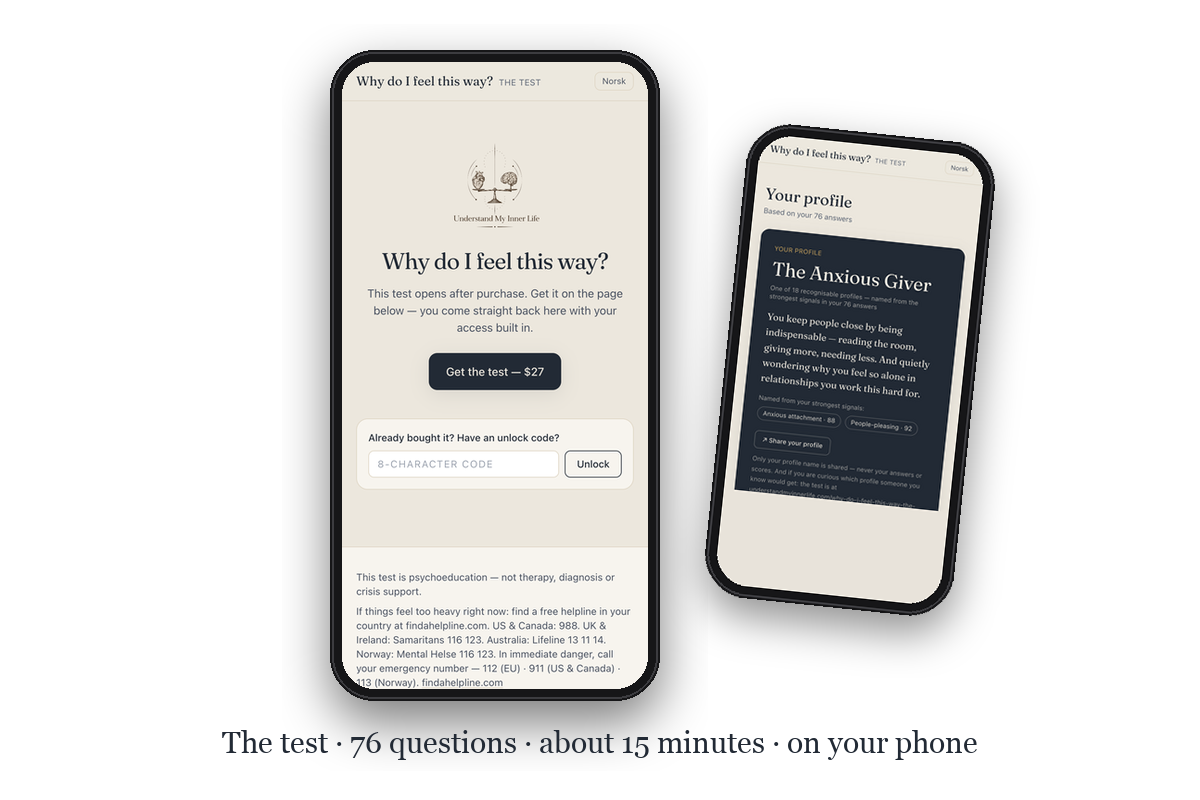
Want to understand more about why you feel this way?
The 15-minute assessment is $27, paid up front. It names your pattern and shows you exactly where to begin.
IF SIGNALS, NOT FAULTS, MADE SENSE TO YOU
Reading that a feeling is a signal helps. Knowing what to do while it fires is the next step.
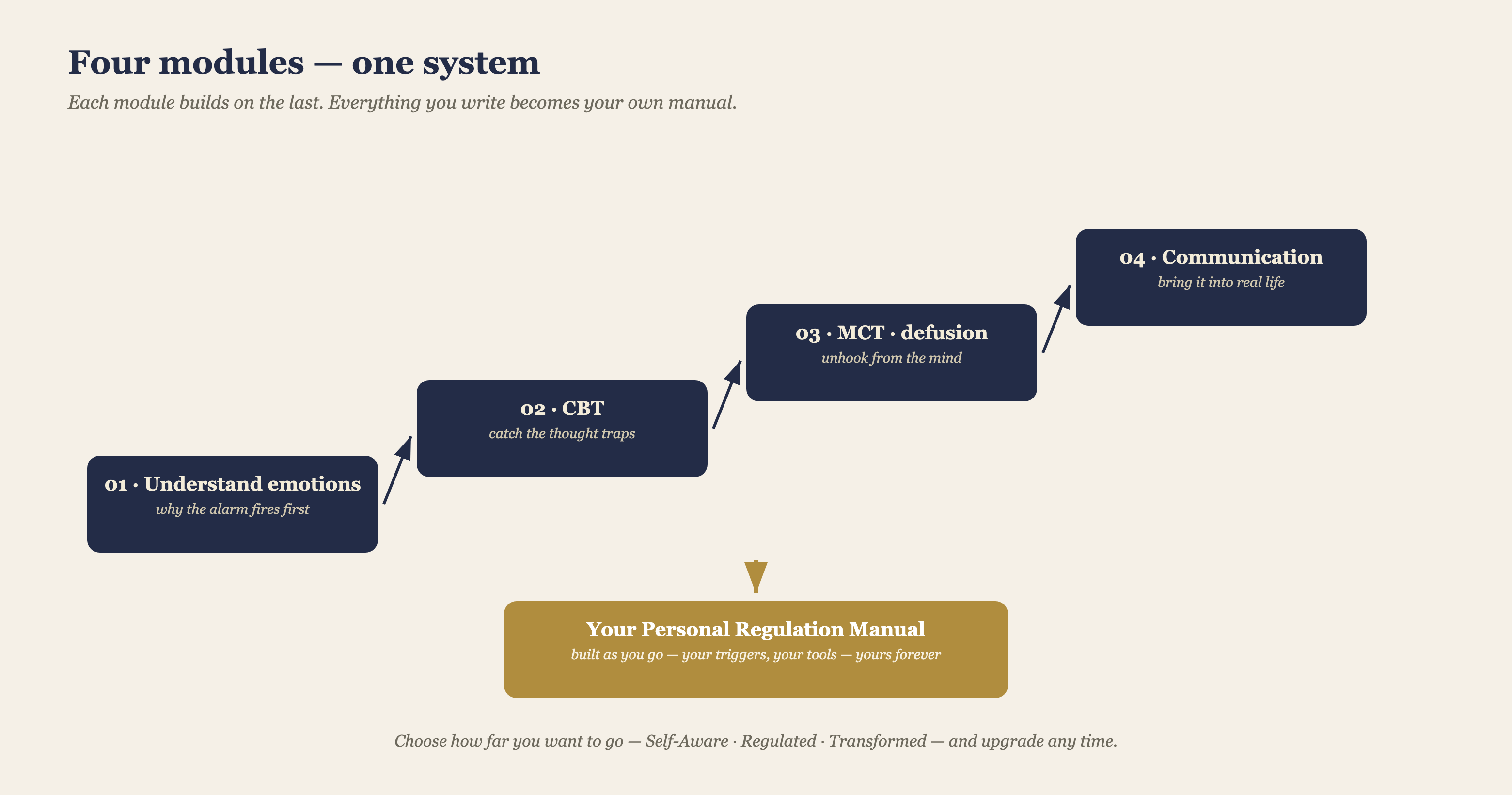
If emotions are signals rather than faults, the useful question becomes what each one is pointing at, and what to do while it is still loud. That is what the Emotion Regulation Course is built around: the mechanism first, then the steps, practised on real situations rather than only understood.
WHAT IS INSIDE
76 questions. About 15 minutes. Honest answers, no right ones.
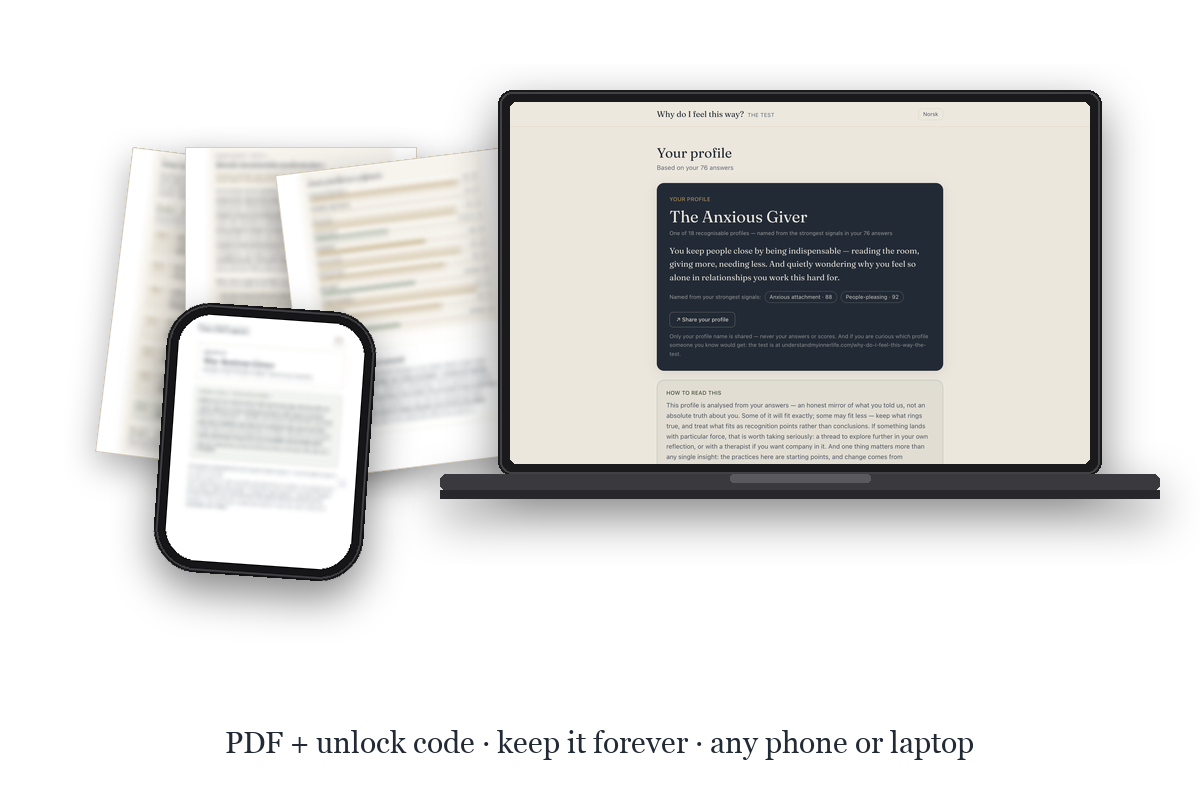
Your own report, written from your answers: the patterns that run your days, where each one started, and the one thing to work on first.
A 21-day plan to start. Yours to keep as a PDF.
23 sources. Every claim in your report points to published research.
From $297 · one-time payment · instant access.