
Anxiety & Practical Tools
A guide to understanding unexplainable feelings and concrete steps to regain your balance.
Step 1: The Physiological Checklist
Before you try to fix your thoughts or analyze your life, check your biological needs. Feelings are often signals of physical depletion.
- Have I eaten a proper meal today?
- Have I slept enough last night?
- Have I moved my body today?
- Have I spoken to someone I trust?
- Have I been alone for too long?
- Am I overstimulated (screens/noise)?
- Am I dehydrated?
- Have I been under prolonged stress?
If you answered "no" to any of these, address that physical need first. Your anxiety might simply be your body asking for care.
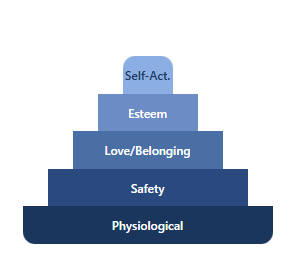
Why This Matters: Maslow's Hierarchy
Abraham Maslow's hierarchy of needs is a useful reminder that higher-level psychological needs, self-esteem, creativity, connection, are much harder to attend to while basic physical needs go unmet. It is a model rather than a law, but the everyday version of it holds up well.
When you are hungry, tired, or unsafe, your brain stays in survival mode. Trying to "think positive" or "analyze your trauma" while sleep-deprived is like trying to build a roof on a house with no foundation.
Foundation first. Psychology second.
Step 2: Understanding the Feeling
If your physical needs are met and the feeling persists, use this exercise to trace it back to its source. Ask "Why?" repeatedly until you reach the core belief.
Example: The "Why" Technique
Why do I feel this strange feeling?
Because I am in a new and unfamiliar situation.
Why does it feel strange to be in a new situation?
Because I do not yet know the rules here, what is expected of me, how people will react, or whether I will get it right.
Why does that make me anxious?
Because I am worried about making a mistake or looking foolish.
Why am I worried about making a mistake?
Because I value social acceptance and want to be liked.
Step 3: Strategies for False Alarms
The best thing you can do when there's no real danger is to recognize that the brain made a mistake. It thought you were in danger, but there's nothing harmful present. Remember that thoughts and feelings are temporary. They rise, peak and pass on their own. You do not have to make them go away, and trying to force them out is usually what keeps them around.
If you try to control your uncomfortable symptoms and make them go away, you may unintentionally keep them going through your thoughts. The brain then believes you still need help and releases more stress hormones into your body.
So remember: you do not have to fight the symptoms. When you stop struggling against them, they tend to settle on their own.
Stop & Notice
When you experience anxiety or physical discomfort because you're worrying or having distressing thoughts, stop and notice what's happening. 'My brain thinks I'm in danger because I started focusing on unpleasant thoughts.'
Shift Focus
Use your control over your attention and shift your focus from the internal to the external by concentrating on something outside of yourself. It could be observing what's actually around you, doing something that engages your thoughts, solving a task, having a conversation with a friend, or enjoying an activity you like.
Step 4: Concrete Regulation Tools
1. Stop and Register
Don't fight it. Just name it. "I feel a tightness in my chest." "I feel heat in my face." Naming the sensation activates the prefrontal cortex and begins to calm the amygdala.
2. Self-Compassion
Instead of "Stop being anxious," try: "It makes sense that I feel this way given the situation. It's uncomfortable, but I am safe." Treat yourself like a friend.
3. Sensory Grounding
Shock your senses gently. Splash cold water on your face. Hold an ice cube. Smell a lemon. Physical sensation overrides mental spiraling.
4. Guided Grounding
If you can't do it alone, let this voice guide you back to the present moment.
Step 5: A Holistic Approach to Wellness
Emotional regulation is not only a mental skill, it rests on four areas that support each other: physical health and sleep, thought patterns, social connection, and a sense of meaning. Neglect one for long enough and the others get harder. The following resource helps you integrate all these dimensions into your weekly routine.
Your Weekly Wellness Plan
This downloadable workbook is designed to help you structure your week across four key areas:
•Physical Brain Health & Sleep: Exercise, nutrition, sleep routines, and stress reduction
•Psychology & Mindset: Meditation, challenging negative thoughts, self-compassion practices
•Social Connection: Quality time with loved ones, community engagement, meaningful relationships
•Spiritual Meaning & Growth: Reflection, gratitude, purpose-driven activities, personal values
Keep it small. The plan works best when it is light enough that you actually do it.
How to Use This Resource:
1.Download the workbook below
2.Print it or fill it digitally, whichever works best for you
3.Spend 15-20 minutes at the start of each week planning one activity in each of the four areas
4.Use the reflection pages to track what worked, what didn't, and how you felt
5.Adjust based on your reality, start small and build momentum over time
Tips for Success:
•Start Small: You don't need to overhaul your life. Pick one small action in each area and build from there.
•Frame Positively: Instead of "I must stop eating junk food," ask "What nourishing foods do I want to add this week?"
•Be Flexible: Life happens. If you miss a planned activity, simply return to it the next day without judgment.
•Celebrate Progress: Notice small wins. Feeling slightly more energized after a walk? That counts.
•Reflect Regularly: Use the reflection prompts to understand what activities genuinely support your wellbeing.
PDF format • Editable • Print-friendly
"You don't have to fix everything right now. You just need to make the next five minutes bearable. Then the next five."
WHEN THE CHECKLIST IS NOT ENOUGH
A checklist helps in the moment. A method helps the next twenty.
Checking sleep, food, movement and contact will often take the edge off today. What it does not do is change how the next wave arrives. The Emotion Regulation Course takes the same ideas further and has you practise them on real situations, so they are available when you are actually activated.
WHAT IS INSIDE
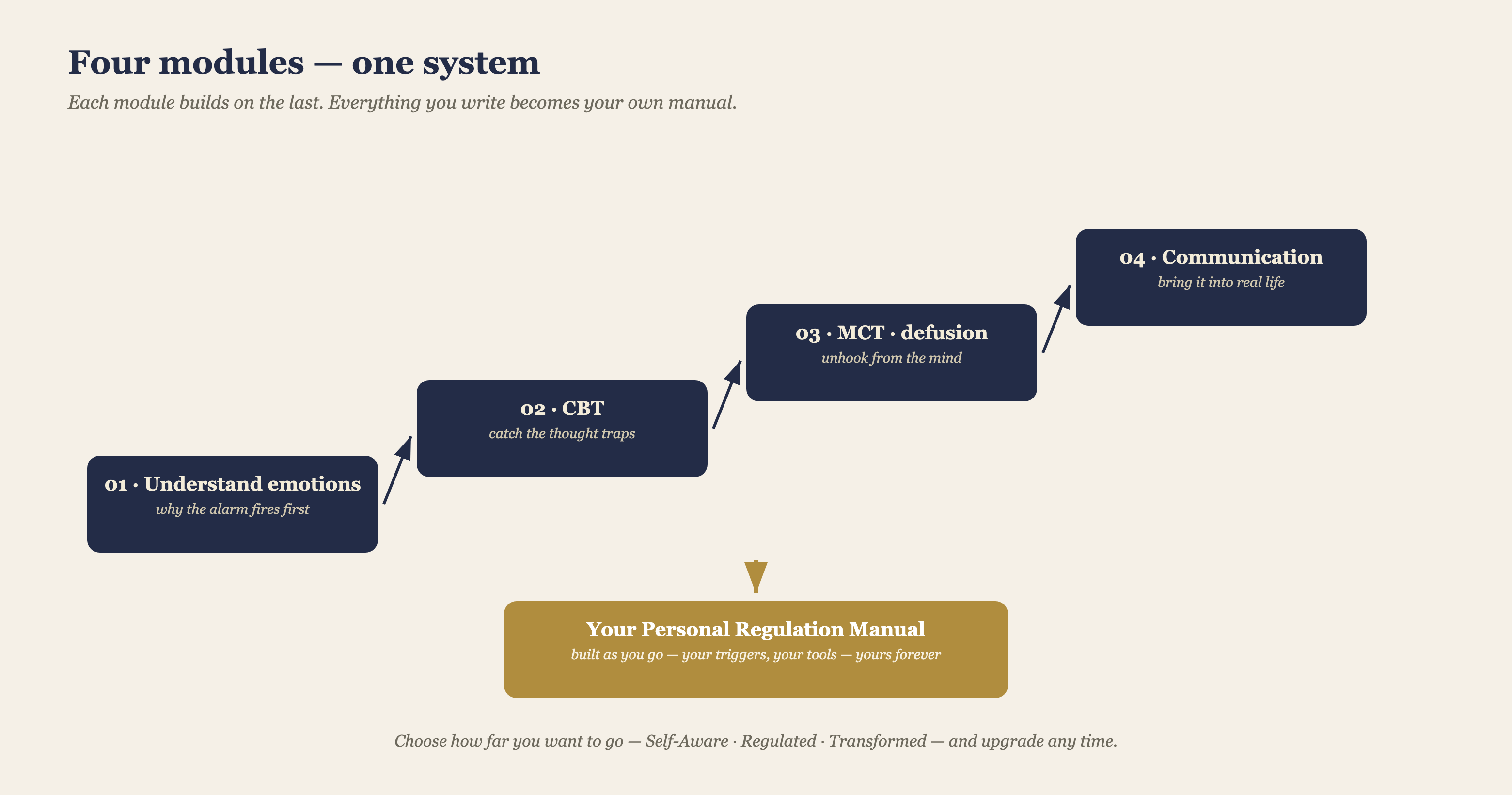
Module 1: Understanding Emotions, 59 lessons · 5 parts
Module 2: CBT Thought Patterns, 28 lessons
Module 3: MCT Thought Defusion Techniques, 32 lessons
Module 4: Communication in Real Life, 44 lessons
From $297 · one-time payment · instant access.