Healing what you think you deserve.
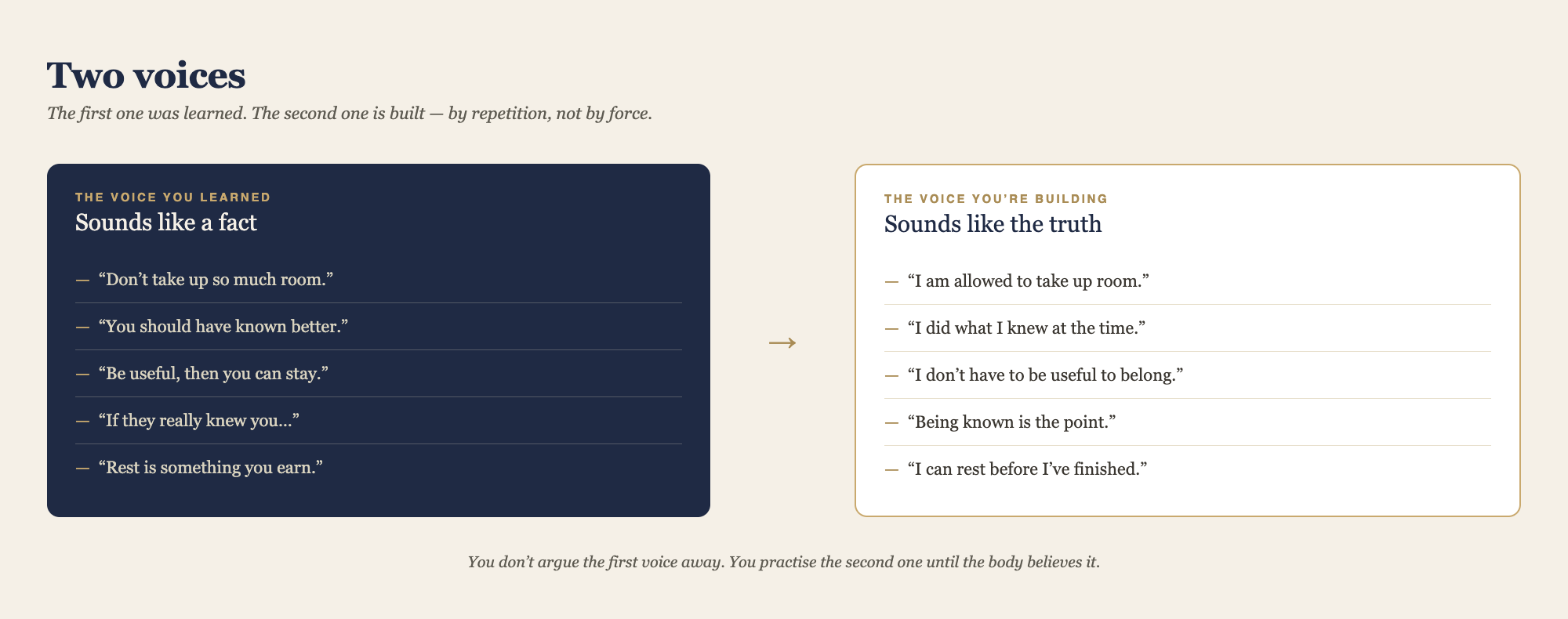
The voice that says you’re not enough is rarely loud. It sounds reasonable, like being realistic, like knowing your place. That is what makes it so hard to argue with: it doesn’t feel like a belief, it feels like a fact about you.
It isn’t. It was learned, built from things said to us and about us, again and again, until we quietly filed them away as facts about who we are. And it still runs today, mostly out of sight. We shrink. We over-prove. We get in our own way, or stop ourselves reaching for the thing we actually want.
Healing means seeing the belief for what it is, learned, not true, and then deliberately, repeatedly choosing a kinder truth, until the body starts to believe it too.
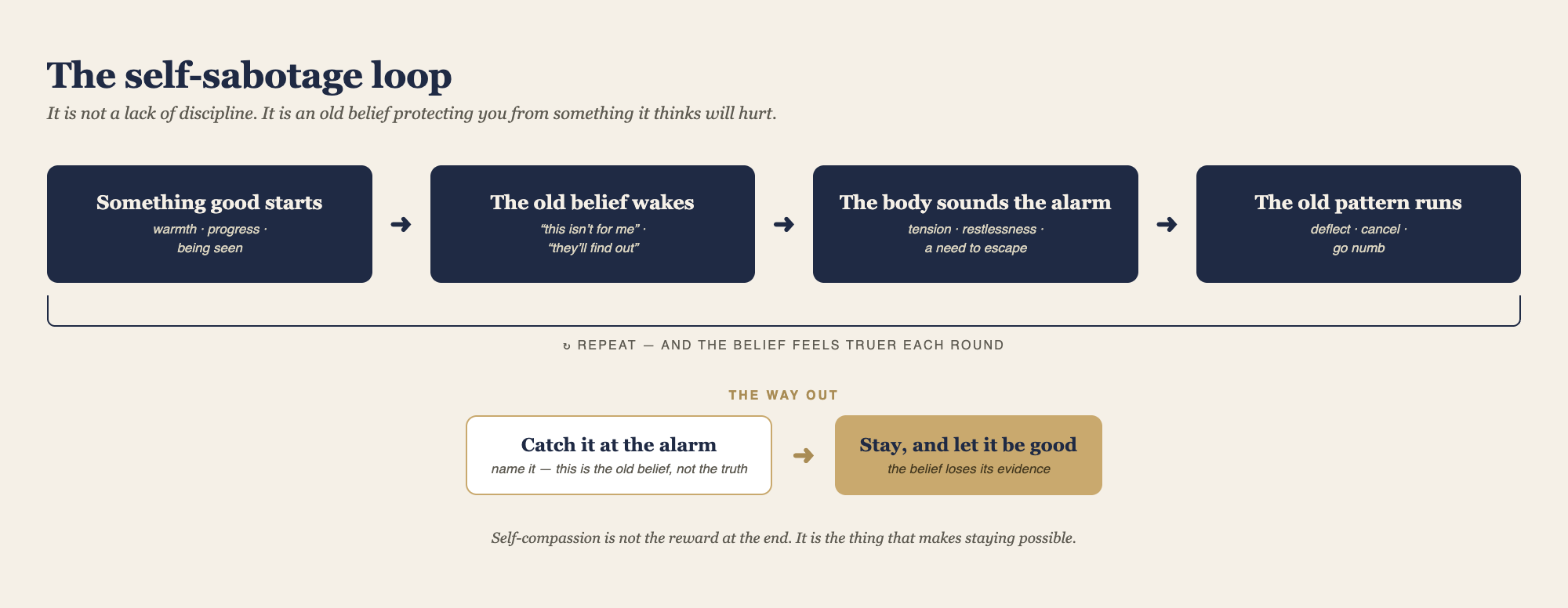
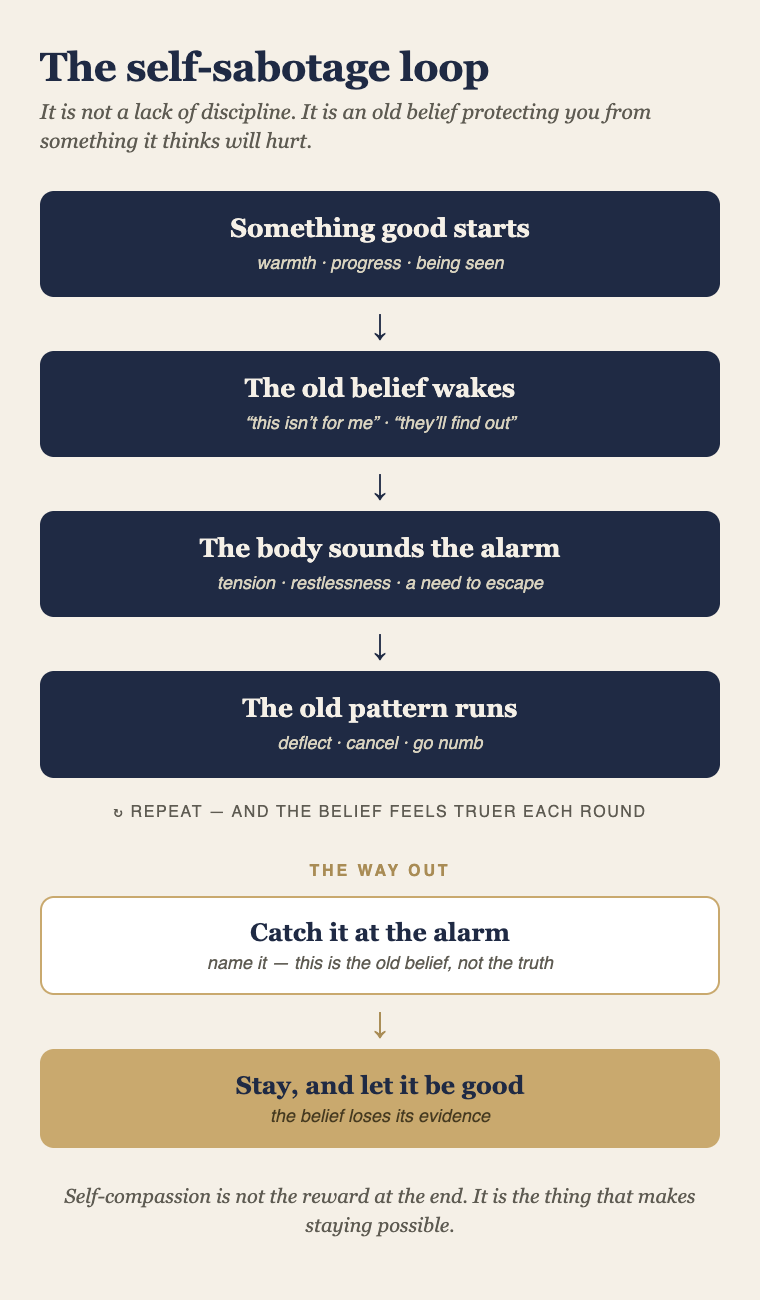
Low self-worth isn’t a feeling that visits. It’s a loop that keeps proving itself, the belief shapes what you do, what you do shapes what happens, and what happens is read back as evidence.
Where the belief was formed
Children rarely conclude that a situation was unfair. They conclude that something is wrong with them, because if they were the problem, there is at least something they felt they could fix.
What it protected you from
Shrinking, over-giving, achieving, staying useful, these kept you safe or connected once. The pattern isn’t weakness. It is a strategy that outlived the situation it was built for.
Why logic doesn’t shift it
You can know a belief is unfair and still feel it as true. Beliefs about worth were learned through repetition, and they loosen the same way, through lived evidence, not argument.
Does any of this sound relatable to you?
If it does, take heart: these are learned patterns, not character flaws, and what was learned can be unlearned.
Right now
Criticism goes straight in, while compliments slide off. That filter was learned, it is not a fact about you.
You apologise for things that were never yours to carry. Somewhere, keeping the peace became your job. It does not have to stay yours.
You are generous with everyone except yourself. The care is already in you, it has simply never been pointed your way.
Rest feels like something you have to earn. That is a rule you were taught, not a truth about what you deserve.
You replay conversations, searching for the moment you were “too much”. That is a mind that learned to stay safe by scanning, and minds can learn new ways.
You put yourself last, then feel unseen, then feel guilty for minding. A learned loop, and loops can be stepped out of.
You have achieved things that should have settled it. It didn’t settle. Worth was never going to arrive through the scoreboard, there is a kinder way to meet it.
After working through it
You can hear the critical voice without taking it as the truth about you.
You notice the moment you start shrinking, and you have something to do instead.
You can rest without negotiating for it first.
You can let people close without earning your place.
Your worth stops depending on how useful you were today.
Being on your own side is a skill. Most of us were never shown it, and skills can be learned.
If you recognised yourself here, let it land gently. Recognition is not a verdict, it is the first step. None of this is about becoming someone else; it is about ending the argument over whether you are worthy, and learning to stand on your own side.
Definition
Self-worth
The sense that you are worth care and consideration simply because you exist, not because of what you produce, how useful you are, or how well you manage other people’s feelings.
Psychology distinguishes this from self-esteem, which rises and falls with performance. Self-worth is steadier and less earned, which is why people who achieve a great deal can still feel fundamentally not enough. Work on core beliefs in cognitive therapy (Beck, 1976) and research on self-compassion (Neff, 2003) point the same way: what changes worth is not doing more, but changing how you treat yourself when you that you fall short.
Who is Kristina?

Kristina. 8 years in mental health care · 4,500+ clinical hours · MSc in clinical psychology (in progress)
How the change actually happens
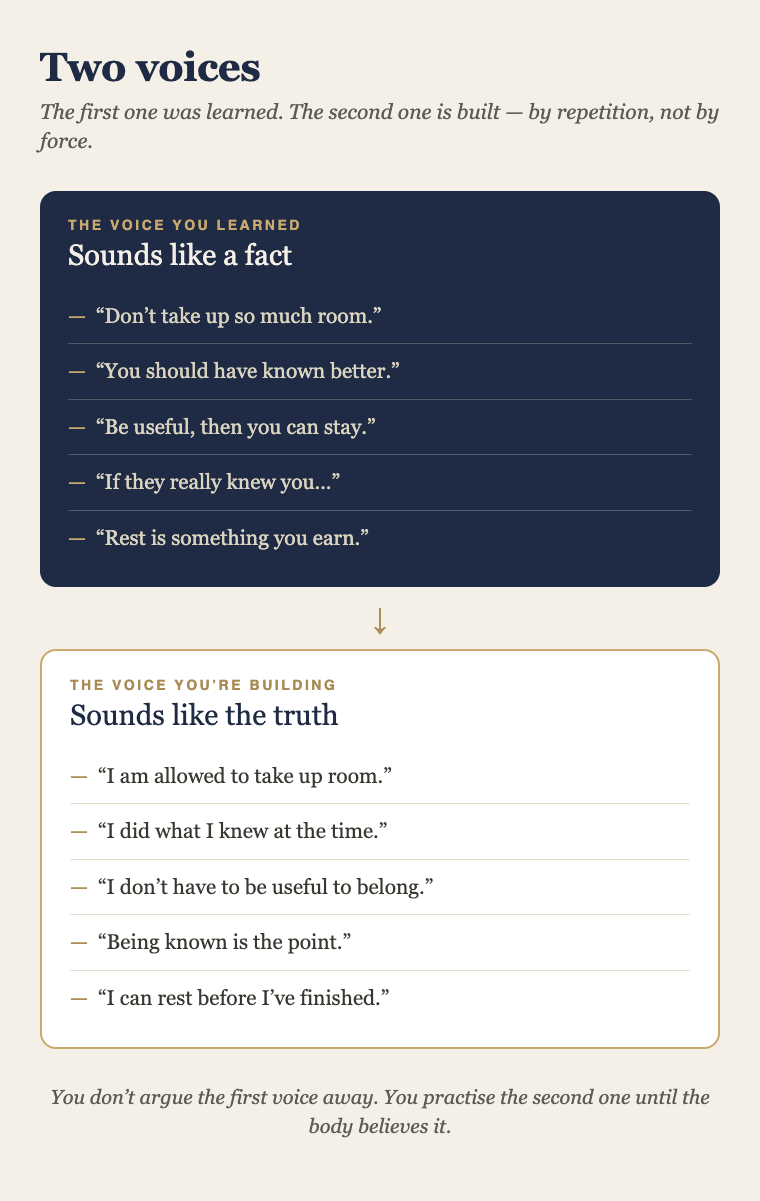
Not by winning an argument with the old voice. By practising a truer line, often enough, and gently enough, that your body stops flinching at it.
The Self-Worth Reset
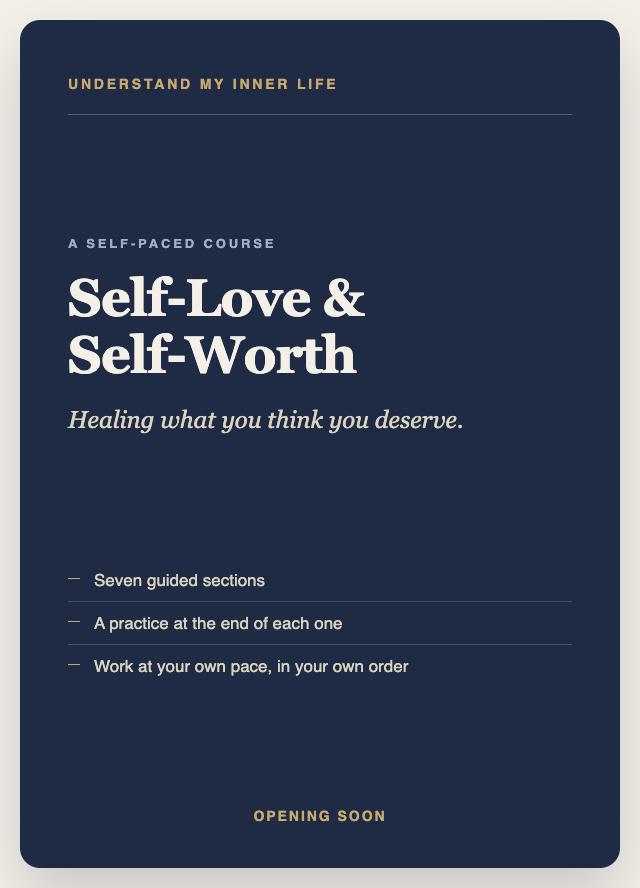
Seven guided sections that move from where “not enough” was learned, to the loop that keeps it alive, to a kinder truth practised often enough that it holds. Written to be worked through slowly, a little at a time.
Seven guided sections
One small practice in each
Work at your own pace
Leave your email and you’ll hear first when it opens. One message, nothing else, and you can leave the list at any point.
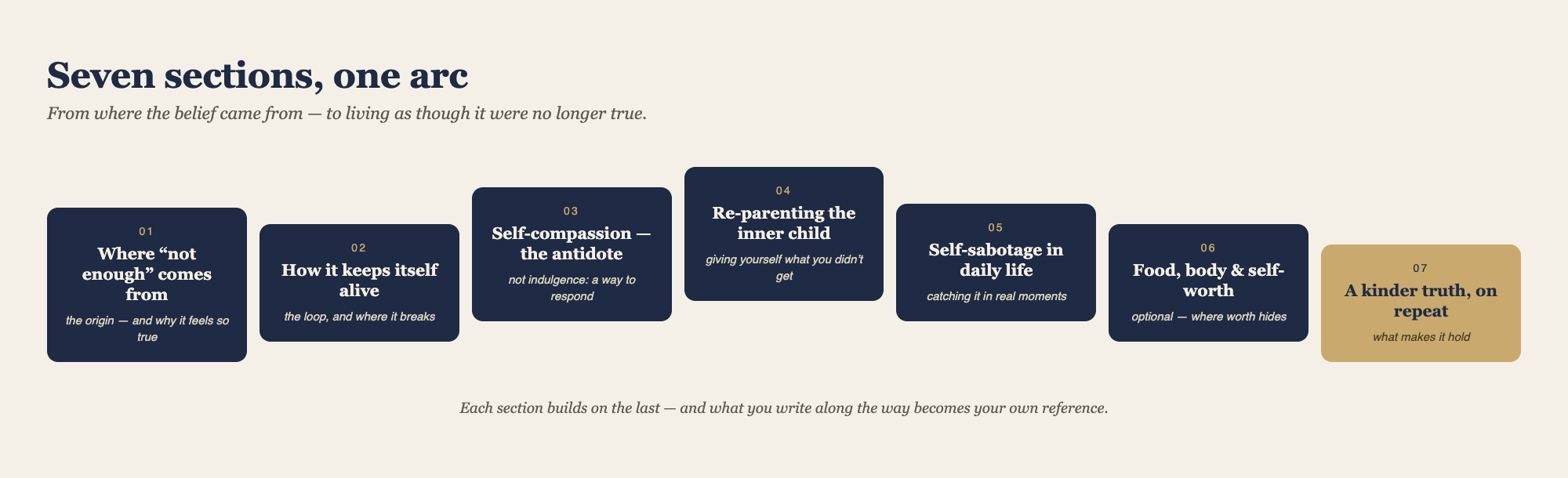
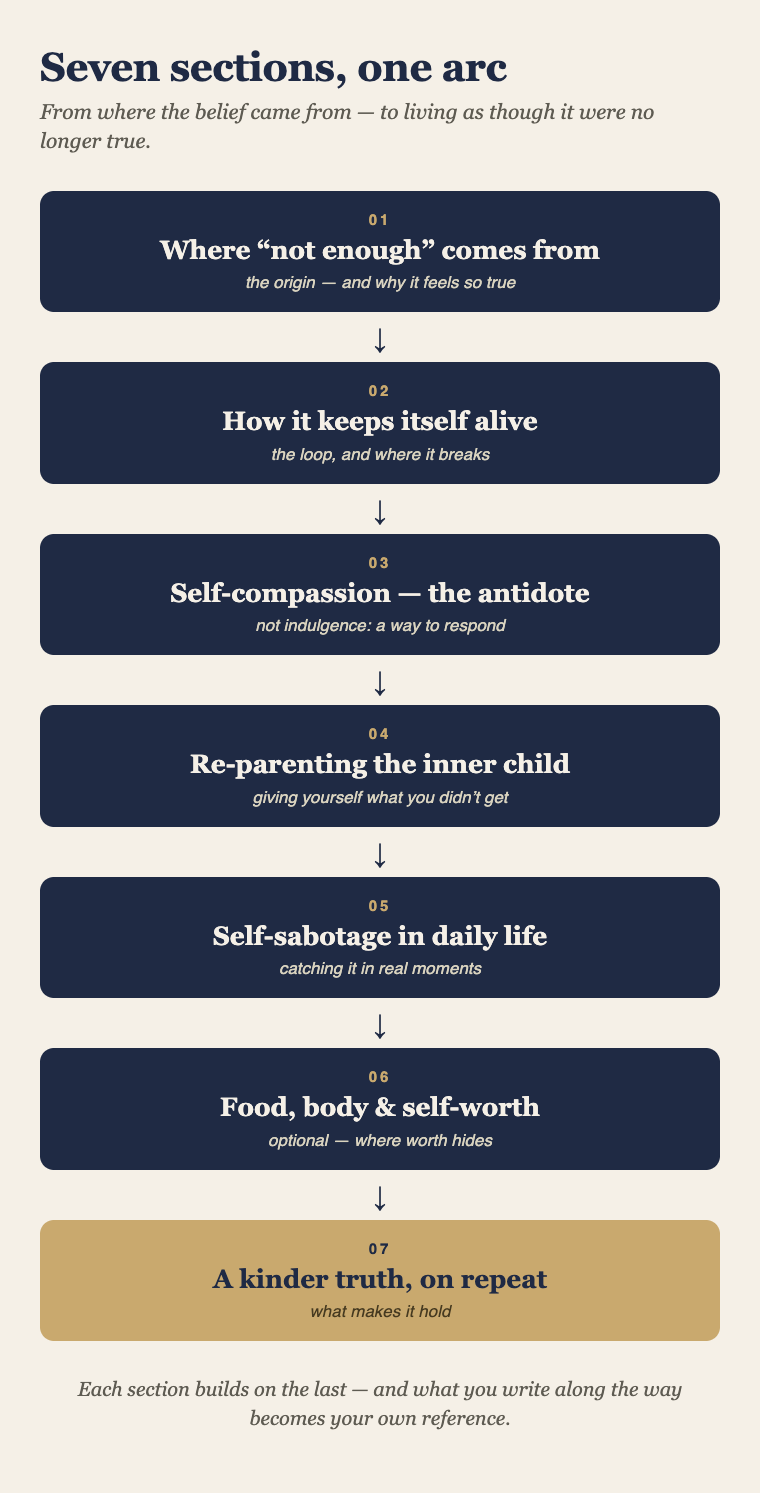
Seven sections, one arc
From where “not enough” began, to a kinder truth on repeat.
Each section builds on the one before, first understanding, then the loop that keeps it alive, then the practice. Every section ends with one small, doable thing, because the practice is the point, not the reading. One section at a time is plenty. Coming back tomorrow is not falling behind, and you can stop anywhere. Nothing here is a test.
01
Where “not enough” comes from
How core beliefs about worth get built young, from repetition, tone, comparison, and the voices we take inside.
02
How it keeps itself alive
The self-sabotage loop, step by step, and the one place in the chain where it can actually be broken.
03
Self-compassion, the antidote
The three parts of self-compassion, what it definitely is not, and the one question that does most of the work.
04
Re-parenting the inner child
The child who believed the criticism, and how today’s you can go back, defend them, and give them what they needed.
05
Self-sabotage in daily life
Procrastination, people-pleasing, playing small, perfectionism, and how to test a feared belief in real life.
06
Food, body & self-worth
How low self-worth shows up in a painful relationship with food and the body. Optional, with a clear heads-up first.
07
A kinder truth, on repeat
How beliefs actually change, repetition, not force. A short daily practice, and your plan for the hard days.
The belief
Where “not enough” was learned.
The loop
How the pattern keeps proving itself.
The practice
Self-compassion, done not felt.
The repair
Meeting the child who believed it.
Common questions
It is not open yet. Join the waitlist and you get one message when it opens. Nothing else.
Grounded in research, not opinion
Core beliefs in cognitive therapy
Beck (1976), J. Beck (1995), the downward arrow
Self-compassion
Neff (2003), kindness, common humanity, mindfulness
Compassion-focused therapy
Gilbert (2009), the shame and criticism cycle
Attachment theory
Bowlby (1969), Ainsworth (1978)
Schema therapy
Young (1990), early maladaptive schemas
Acceptance & commitment therapy
Hayes et al. (1999), psychological flexibility
This course is education and guided self-reflection, not therapy, diagnosis, or treatment, and it cannot be. Nothing here promises an outcome. If you are struggling, it is not a substitute for professional support, and reaching for that support is not an overreaction. If you need help right now, findahelpline.com offers free, confidential support in over 175 countries.
You don’t have to do this perfectly. Doing a little, badly, still counts.
You can know a belief is unfair and still feel it as true. That is not failure, it is how beliefs work. They were learned through repetition, and they loosen the same way: not by force, and not all at once, but by choosing a kinder truth often enough that the body starts to believe it too.
One section at a time is plenty. Coming back tomorrow is not falling behind.