What are Eating Disorders?
Understanding the different types, recognizing the signs, and finding the path to recovery.
Many people worry about food, weight or how they look, and that on its own is not an eating disorder. It is more a question of how much room it takes up. When eating, and the thinking around eating, starts to crowd out the life someone wants to live, that is when clinicians begin to talk about an eating disorder.
It does not have to start with wanting to lose weight. For many people, controlling or worrying about food becomes a way to manage feelings that are hard to be with. That is an understandable thing to reach for, even when it stops helping.
Anxiety and low mood often travel alongside an eating disorder. Sometimes they come first, sometimes they follow. Either way they are worth taking seriously.
Types and Symptoms
Reading a list of symptoms can be uncomfortable, and it is not a way to diagnose yourself or anyone else. It is here so the patterns have names. If something on this page feels close, that is worth talking to a doctor or a therapist about, not worth deciding on your own.
Anorexia
Anorexia usually involves eating much less than the body needs, often alongside a lot of exercise, and a body weight a health professional would consider too low for that person. It can come on slowly, which is part of why it is easy to miss, from the outside and from the inside.
It can be hard to see from the inside that anything is wrong
Periods becoming irregular or stopping
Feeling weak or dizzy, or noticing your heart beating oddly
Bulimia
Bulimia usually involves eating much more than intended in one go, and then trying to undo it afterwards. The cycle tends to happen in private and often carries a great deal of shame, which is one reason it can go on for a long time without anyone knowing.
Body weight often stays within a usual range, which is one reason it can go unnoticed
A great deal of attention on the body and on appearance
Eating tends to happen alone, and is often planned around not being seen
Binge Eating Disorder
Binge eating disorder shares much with bulimia, but without the attempts to undo the food afterwards. There is usually a sense of losing control during it, eating well past comfortable fullness, and a heavy wave of shame after. The shame is part of the problem, not evidence of a flaw in the person.
Orthorexia & Megarexia
Orthorexia: when healthy eating and training stop being one part of life and start organising all of it, including turning down things that matter in order to keep control.
Megarexia: a preoccupation with building the body to be as large and muscular as possible, to the point where it takes over.
Neither is a formal diagnosis in the current diagnostic manuals, but both describe patterns clinicians do see, and both can cause real distress.
Are you worried about someone?
If someone you care about has an eating disorder, it can be hard to know what to say or how to help. A few things tend to help:
- Be clear that you are worried. Tell them what you see/notice.
Stay calm and show respect and compassion, even if your concern is not well received.
Repeat your message gently, and be ready to say it more than once.
Be careful with advice drawn from your own experience, and try not to ask them to pull themselves together.
Help with practical things. Book a doctor's appointment, offer to join them for treatment.
Take care of yourself. Contact a doctor or talk to someone else about your concerns.
Treatment and Recovery
There are several forms of treatment for eating disorders, and talking therapy is the most common. For children and young people, family therapy should be offered to them and to the people around them. When anorexia is severe, part of the treatment sometimes needs to happen in hospital, so the body can be supported while it recovers.
Recovering from an eating disorder often takes time, and progress is rarely a straight line. Having people around you who know what is going on, and who stay, makes a real difference. Recovery is possible, and many people do recover.
STILL BEING WRITTEN
If any of this is close to home, there is a course being written about the relationship between eating, the body and the mind. No diets, no plans, no numbers. It is not open yet. Joining the list is free, and you get one email when it opens, nothing else.
Further Resources (Norwegian)
In the documentary series "Helene sjekker inn", host Helene Sandvig moves into a specialist eating disorders unit in Norwegian public health care. There, those most severely affected by anorexia and bulimia are treated. Helene follows the daily lives of the patients, trying to understand how this illness is treated and why it is so difficult to recover.
Among those who have received the online Body Project, up to 77% fewer develop an eating disorder within 2 years compared to a control group (Danish program).
Organizations & Resources (Norway)
INTERNATIONAL RESOURCES
Beat (UK), helplines, one-to-one support and guidance for families.
NEDA (US), screening, treatment directories and support options.
Butterfly Foundation (Australia), a national helpline and support for people and their families.
NHS (UK), a plain-language overview of eating disorders and how to ask for help.
findahelpline.com, free, confidential helplines listed by country, if you need to talk to someone today.
FURTHER RESOURCES
For further clinical reading:
Eating Disorders Meal Support: Helpful Approaches for Families (Full Video) https://www.youtube.com/watch?v=pPSLdUUlTWE
Opens in new tab.
If you are in Norway:
Norwegian Psychological Association: npf.no
Helsenorge: helsenorge.no
Crisis line: Mental Helse 116 123 (free, 24/7) · Kirkens SOS 22 40 00 40
If you are in Denmark:
If you are in the UK:
Mind: mind.org.uk | 0300 123 3393
Samaritans (crisis): samaritans.org | 116 123
If you are in the US:
NAMI: nami.org | Helpline: 1-800-950-6264
Crisis text line: text HOME to 741741
If you are in Australia:
Beyond Blue: beyondblue.org.au | 1300 22 4636
Lifeline (crisis): lifeline.org.au | 13 11 14
International crisis resources:
findahelpline.com, database of crisis lines by country
iasp.info/resources/Crisis_Centres/, IASP crisis centre directory
The information on this page is intended for educational purposes and general understanding. It does not constitute clinical advice, a diagnosis, or a recommendation for treatment. If you have concerns about your own mental health or that of someone close to you, please consult a qualified healthcare professional.
If you are in crisis or require immediate support, please contact emergency services or a crisis line in your region.
Norway: Mental Helse 116 123 (free, 24/7) · Kirkens SOS 22 40 00 40
International directory: findahelpline.com
WHEN IT HAS TAKEN UP TOO MUCH ROOM
Understanding it is one thing. Knowing what to do while you feel it is another.
An eating disorder needs proper assessment and treatment, and reading is not a substitute for either. But if what sits underneath it is feelings you have never quite had anywhere to put, that part can be learned. The Emotion Regulation Course teaches those skills step by step, in your own time.
WHAT IS INSIDE
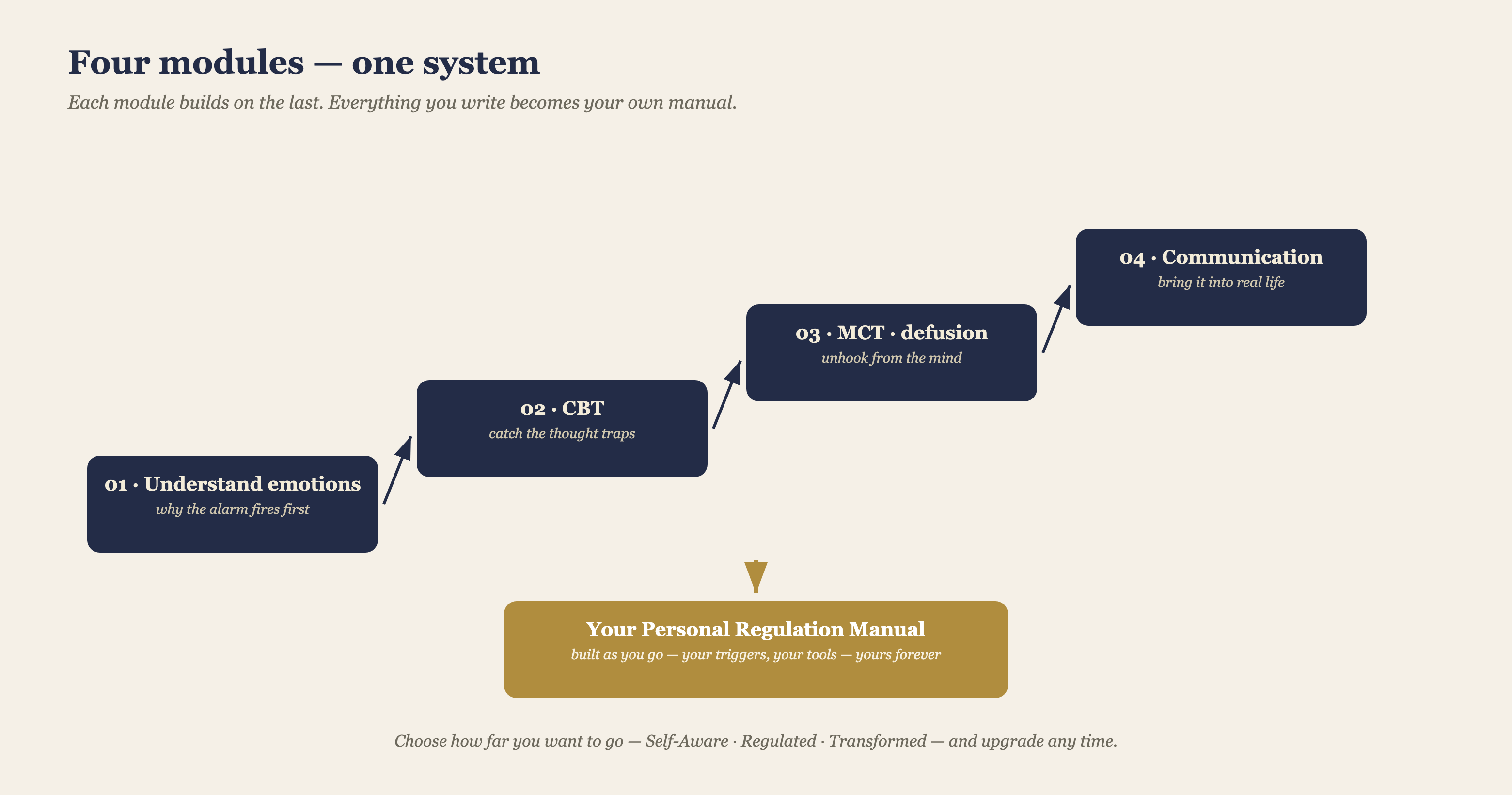
Module 1: Understanding Emotions, 59 lessons · 5 parts
Module 2: CBT Thought Patterns, 28 lessons
Module 3: MCT Thought Defusion Techniques, 32 lessons
Module 4: Communication in Real Life, 44 lessons
Four modules. 164 lessons. Guided teaching, written exercises and knowledge checks throughout.
Looking for something closer to this page? A course on the relationship between eating, the body and the mind is being written. Join the waitlist
From the same foundation