The full guide
Everything inside the Emotion Regulation Course
For you who want to read it all before you choose. The short version is on the course page. Here is the rest: why it exists, what every module trains, and what you get at each level.
The course at a glance
165 lessons. One way of working.
Introduction: 1 lesson
Module 1, Understanding Emotions: 59 lessons in 5 parts
Module 2, CBT: From Thought to Body: 28 lessons
Module 3, Thought Defusion (ACT and MCT): 32 lessons in 5 parts
Module 4, Communication in Real Life: 45 lessons in 5 parts
Two voices follow you through all four modules. Scar is the critical, unsure voice. Sun is the part of you that wants what is best for you.
You learn to hear which one is speaking. That small distance is often where the choice starts.
Why I made this
Nobody should have to understand their feelings alone.
I work in public mental health care. Eight years so far.
Someone would finally ask for help and be sent home without an answer, or put on a list months long. Many had tried once before and come away feeling misunderstood, and after that most people stop asking.
Most of us were never taught what a feeling is, or what to do with it. Watching a lesson changes what you know. The body only changes through repetition.
So every lesson ends with something you do, not something you read, small enough to practise on an ordinary Tuesday, until it is there without you having to reach for it.
I made it the way I wish someone had explained it to me. I read widely across psychology and neuroscience, spent eight years in mental health care, went back to study clinical psychology, and listened to hundreds of people tell me what actually helped them. Only what worked made it into the course.
Kristina · 8 years in mental health care · 4,500+ clinical hours · MSc in clinical psychology (in progress)
What it is built on
Well researched tools, explained in plain words.
Eight years in mental health care: nursing homes, home care, supported housing, a voluntary inpatient ward and, for most of those years, acute psychiatry. More than 4,500 clinical hours with people on their hardest days.
A master’s in clinical psychology, in progress. Top grade in personality psychology on my bachelor’s, and research work screening more than 3,500 studies for a clinical review.
The tools come from emotion science, CBT, Acceptance and Commitment Therapy (ACT), metacognitive therapy (MCT), and the communication skills from attachment and mentalization based work.
How every lesson works
Not a course you watch. A course you do.
1. Understand. Why the reaction fires. The mechanism, named, in plain words.
2. Practise. The tool, rehearsed while you are calm, so you can use it when you are not.
3. Apply. The tools, used in the real moment. Your own situations, not random examples.
Every module follows the same three steps. One lesson takes a few minutes. Most people do two or three a week.
Module 1 · 59 lessons · in every level
Understanding Emotions
Know what your body is doing, and why, while it happens.
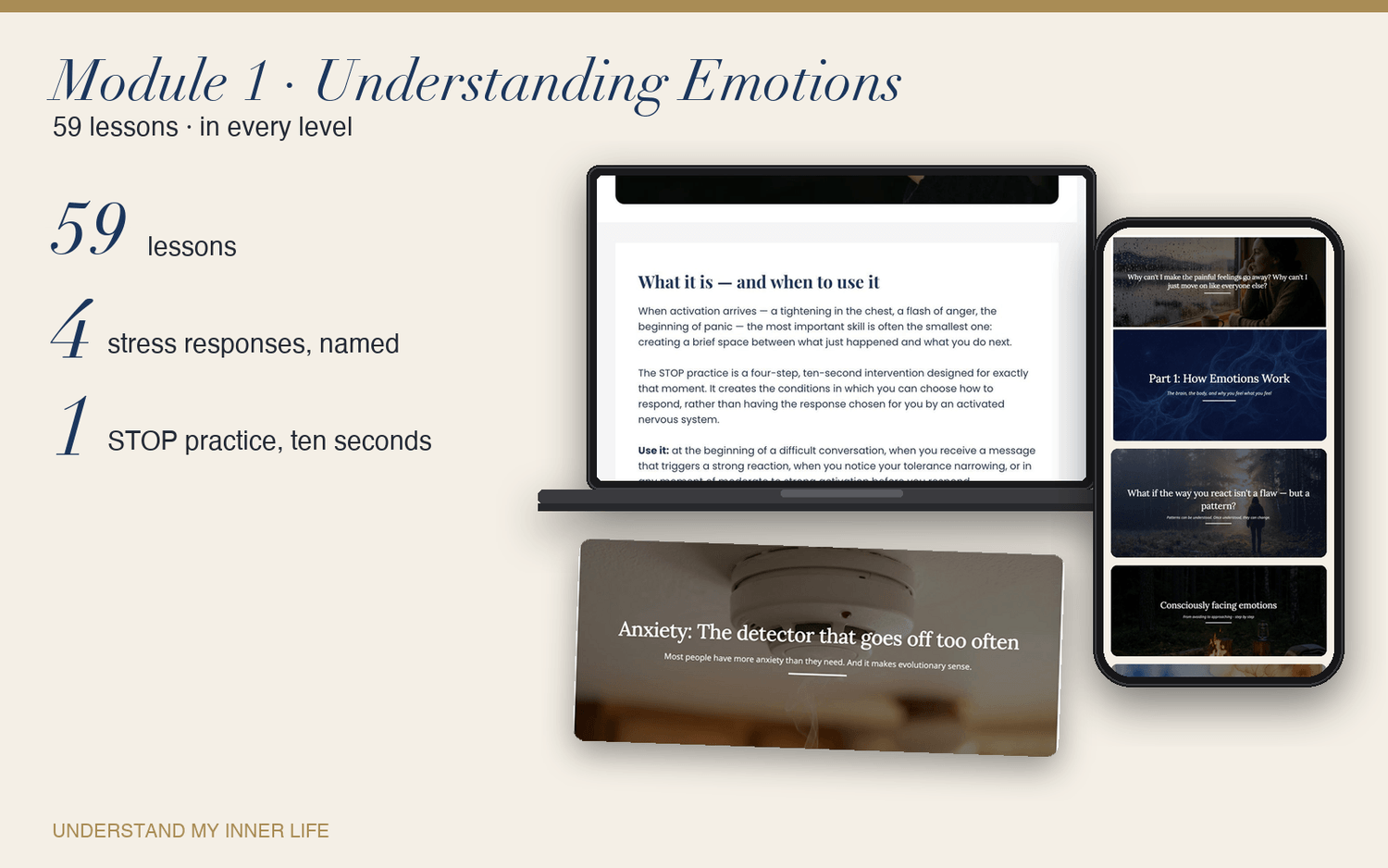
After this module: you can name what is happening in your body before it takes over.
✓ Why the reaction starts before you have time to think
✓ Your own stress response: fight, flight, freeze or fawn
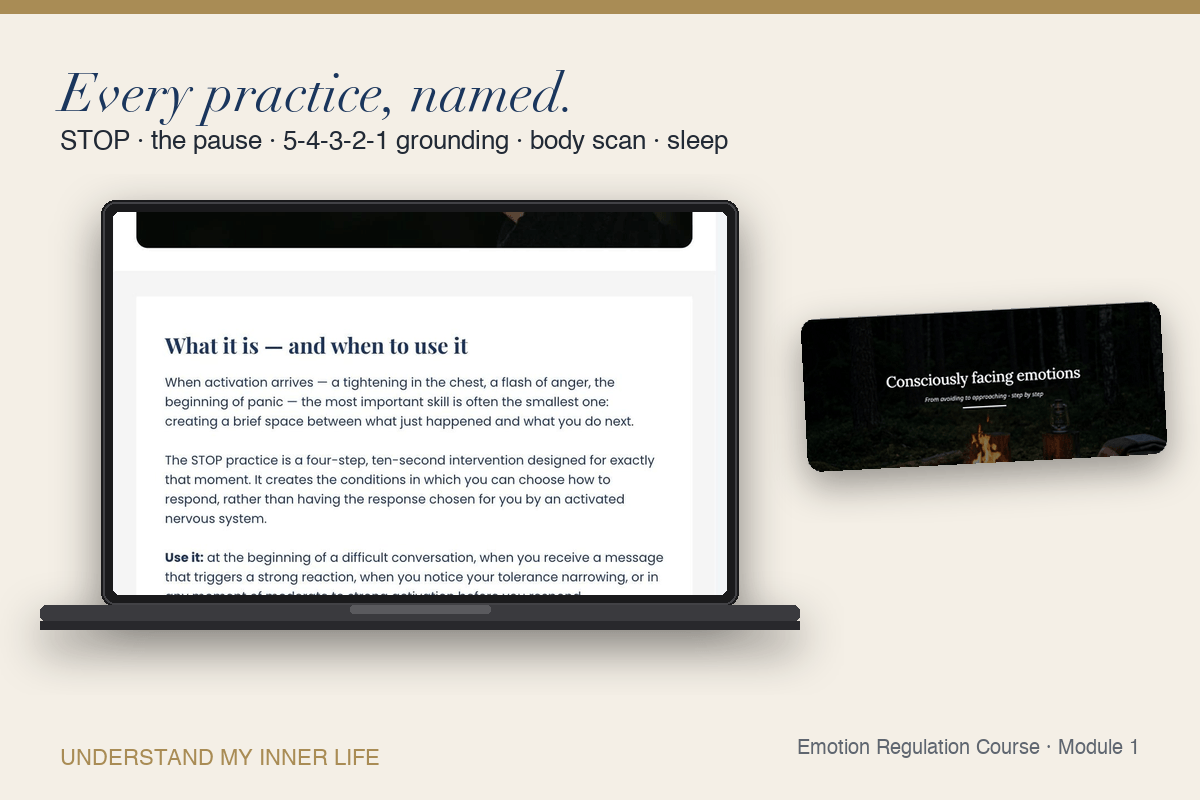
✓ The STOP practice and the Breathing Anchor, for the second it hits
✓ 5-4-3-2-1 grounding
✓ Which tool to reach for, and when
Questions this module answers
→ Why does the reaction start before I have time to think?
→ Why can’t I just move on, like everyone else seems to?
→ What is my body doing when I fight, flee, freeze or try to please?
→ What is sadness for, and what happens in the body when I am anxious?
→ What do I do when there is nothing left, and I feel flat?
From inside the module
Falling out of your window of tolerance is not a sign of weakness. Everyone does it, however much work they have done on themselves.
The aim is not to never fall out. It is to notice it earlier, and find your way back faster.
What you keep
My Personal Regulation Manual. You write down what sets you off, what brings you down from too much, and what brings you back up from nothing left. In your own words, so you have it the next time.
Look inside Module 1, part by part
How to use the course, and why the way you react is a pattern, not a flaw.
· How to get the most from this course
· Welcome: what if the way you react is not a flaw, but a pattern?
The brain, the body, and why you feel what you feel.
· Scar and Sun: the two voices of the brain
· Your Scar and Sun
· Why can't I just move on?
· Your emotions are not a design flaw
· Understand your physical response
· Emotions communicate, and what that means for you
· How the parts of the brain work together
· The four stress responses
· Recognise your response
· The window of tolerance
· Triggers: the body remembers what the mind wants to forget
· You are not yourself when you are triggered
Ways to meet a feeling instead of pushing it away.
· Eight emotion myths
· Primary and secondary emotions
· Consciously facing your emotions
· Self-compassion: meet yourself where you are
· Self-compassion in practice
· A guided emotion meditation for the inner child
· Calm the feeling through the body
· Calm the feeling through words
· Naming what you feel: tools, maps and practice
· Interoception: reading the signals in your body
· Meeting your feelings
· What is behind our emotions?
· The inflamed brain
One feeling at a time, and what it is for.
· Overwhelm and emotional flatness, when there is nothing left
· What sadness is for
· Anxiety: what happens in the body
· Anxiety: the spotlight effect and social anxiety
· Anxiety: exposure and practice
· Shame, the one nobody talks about
· Understanding anger
The practices, one by one, and when to use which.
· Regulation strategies: the foundations
· Distress tolerance: bearing what is difficult
· Exercises: face your emotions
· The pause between trigger and response
· The Breathing Anchor
· Body scan
· Sleep: the brain's most important maintenance
· The STOP practice
· 5-4-3-2-1 grounding through the senses
· Completing the stress cycle
· Knowing when to use what
From knowing it to doing it on an ordinary day.
· Two things can be true at the same time
· The three core insights
· From knowledge to practice: emotions in everyday life
· My Personal Regulation Manual
· Closing Module 1: insights, plans and next steps
Module 2 · 28 lessons · in every level
CBT: From Thought to Body
Catch the thought that runs the evening. Test it instead of obeying it.
After this module: you can tell a fact from an interpretation, in the moment it matters.
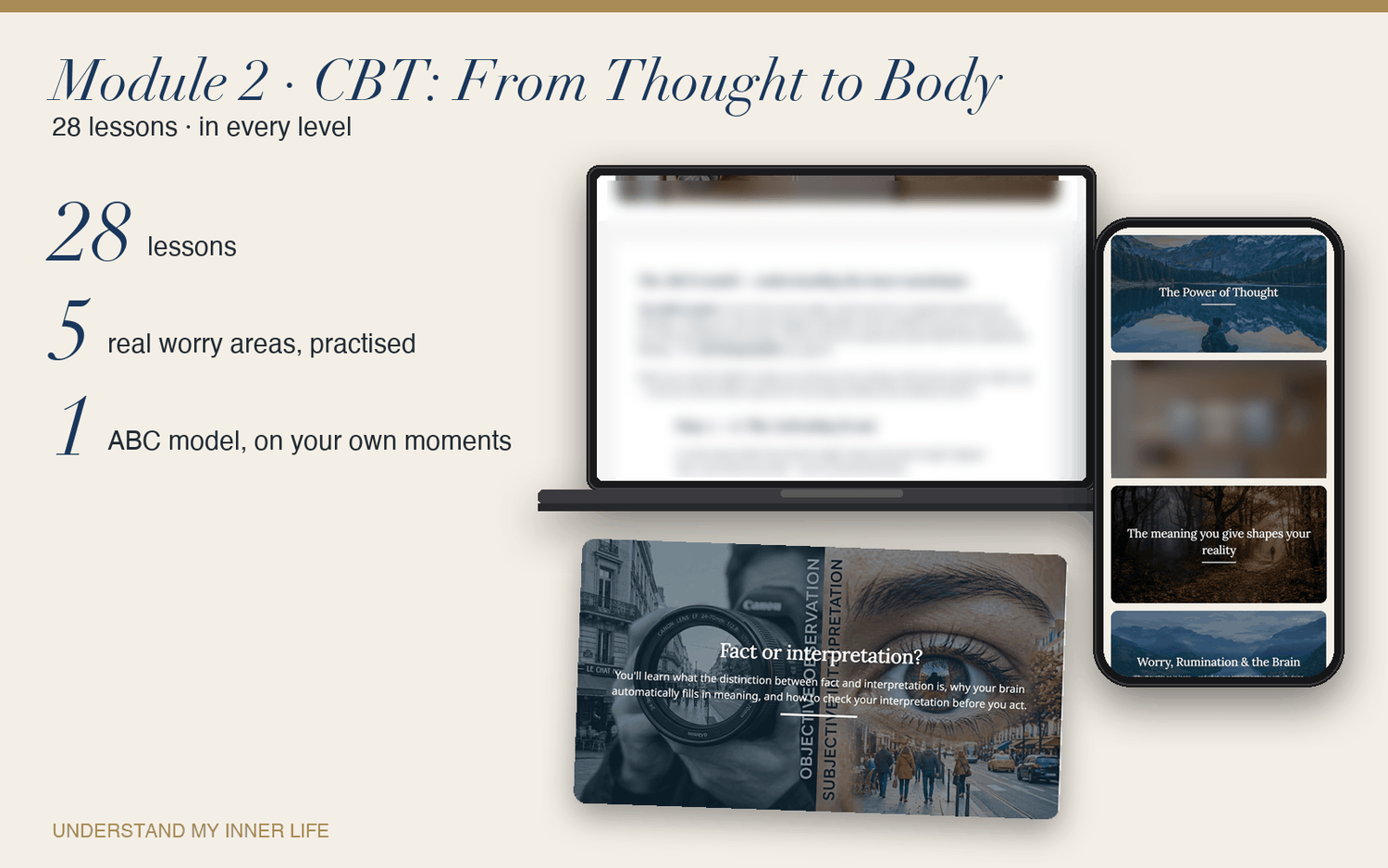
✓ What happened, and the story your mind added, kept apart
✓ The ABC model, on any moment that sets you off
✓ The Evidence Model: your thought against what is true
✓ Behavioural experiments and the 5-column form
✓ STOP and Think, practised on real worries: money, health, work, mental health and self-compassion
Questions this module answers
→ What did my mind decide this moment means?
→ Is this rumination, or a worry I can actually do something about?
→ How do I check a thought against what is true?
→ How do I use the tools on real worries like money, health and work?
From inside the module
When something happens, we rarely react to the event itself. We react to the story we tell ourselves about it.
Seeing that difference clearly is the first step. The rest of the module trains it.
What you keep
Two forms you can use again and again: the 5-column form and STOP and Think. Two knowledge checks, and your Personal Manual for this module.
Look inside Module 2, lesson by lesson
Why the meaning you give a moment decides how it feels.
· What your mind decides events mean
· Before we begin: there is nothing wrong with you
· What a thought can do
· CBT in clinical practice
· When the brain goes into danger mode
· Worry, rumination and the brain
· Is this rumination, or is your body missing something right now?
· The meaning you give shapes your reality
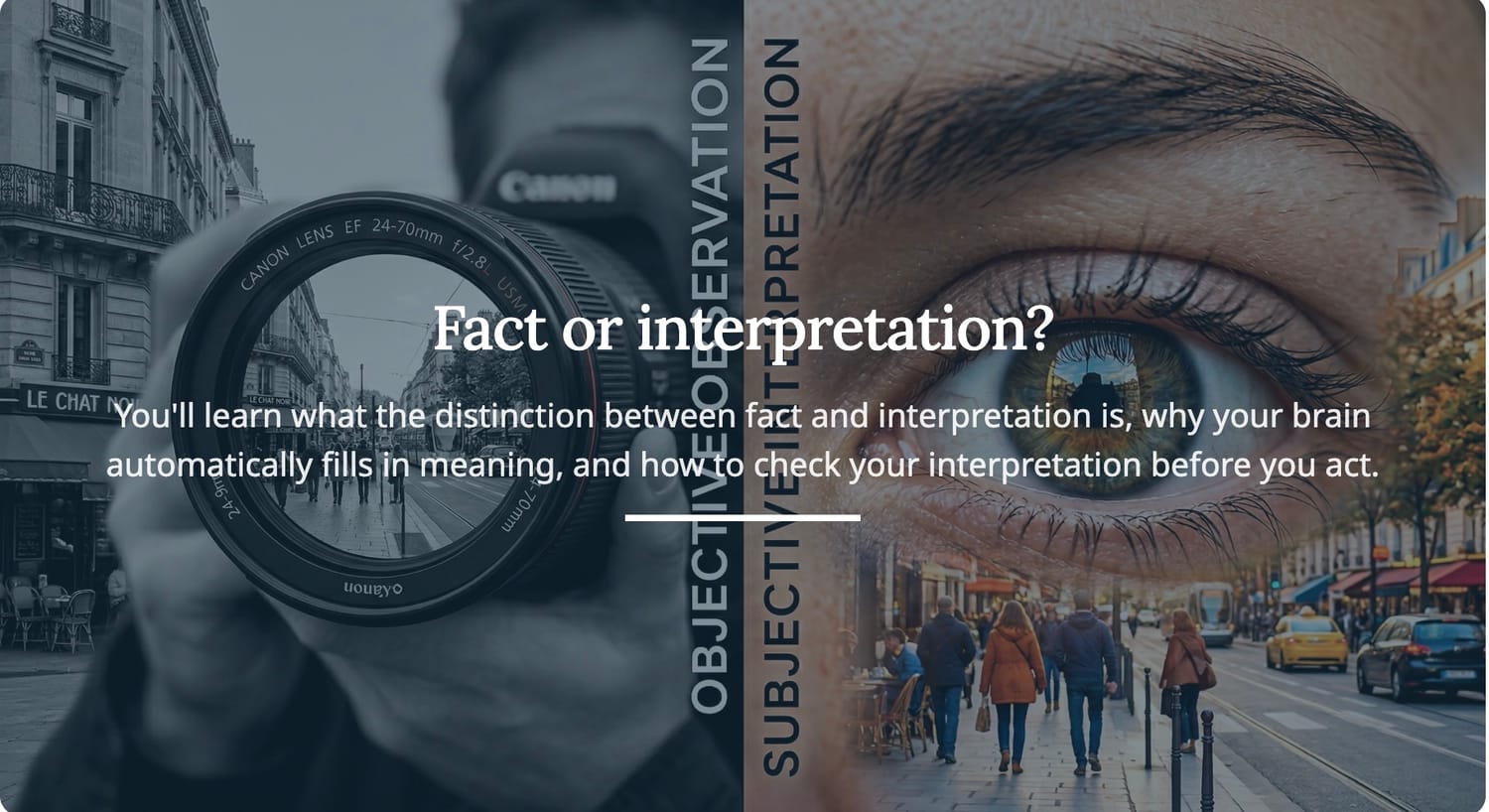
· Fact or interpretation: how the brain adds the story
· The past shapes the interpretation
· Knowledge check: fact or interpretation
The models and forms you use on your own moments.
· The ABC model: events, thoughts and feelings
· Sun and Scar, day B
· How the brain changes
· The Evidence Model: checking thoughts against reality
· Behavioural experiments
· Form 2: the 5-column form
· Form 3: STOP and Think
The tools, practised on the worries people actually have.
· Money and rising prices
· Health and healthcare
· Work and balance, with applied tools
· Mental health
· Self-compassion: meeting yourself with kindness
What you take with you.
· Knowledge check: eight questions
· Your Personal Manual
· A note on memory
Module 3 · 32 lessons · Regulated and Transformed
Thought Defusion (ACT and MCT)
You cannot always change a thought. You can change your grip on it.
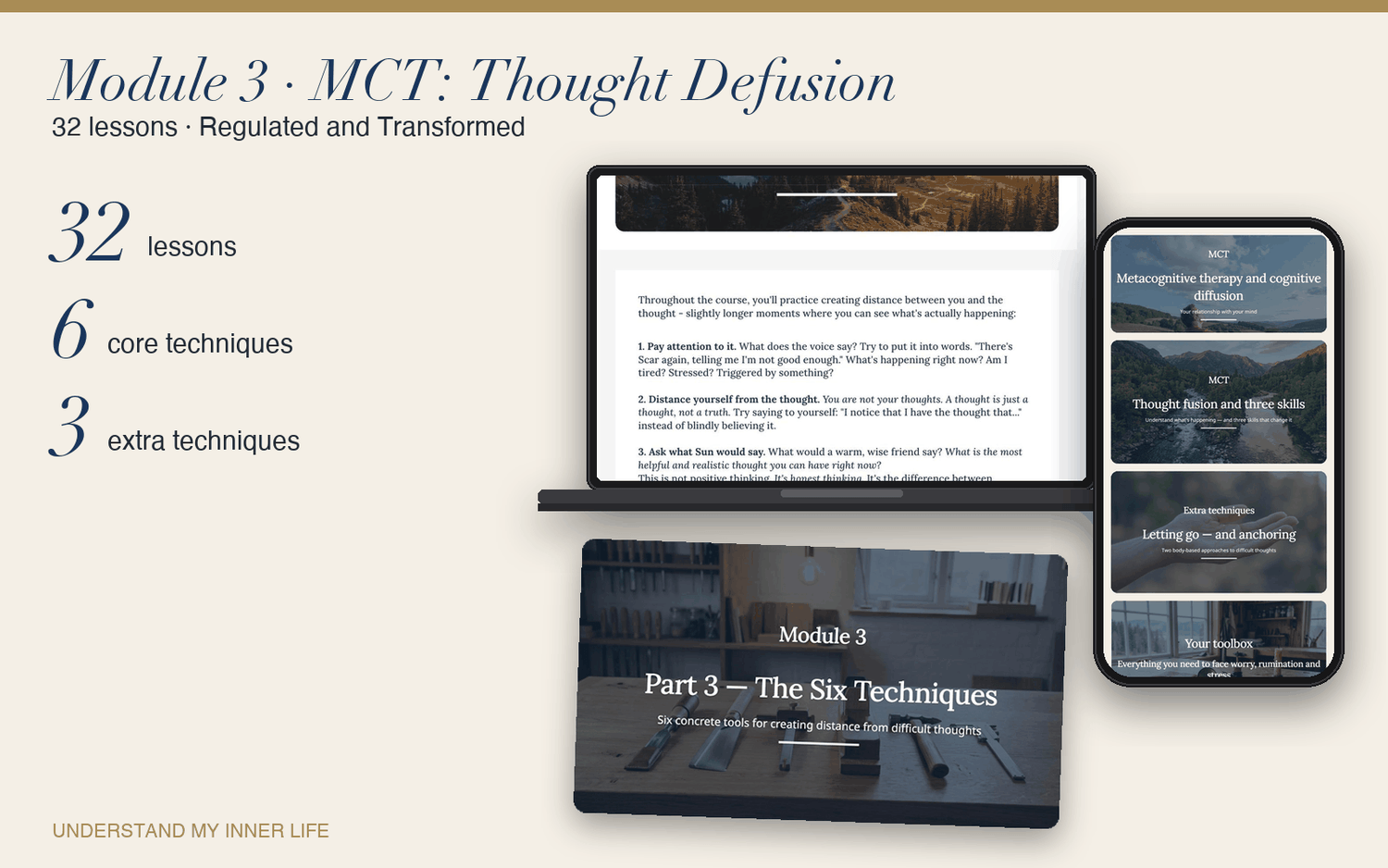
After this module: you can watch a thought go by without being pulled along by it.
✓ Spot a worry loop while you are still in it
✓ Six core techniques, plus three more
✓ Monkey Mind training
✓ Name the inner voice that runs the moment
✓ Leave with your own practice plan
Questions this module answers
→ What can I do when I cannot change the thought?
→ Is this rumination, or problem solving?
→ What do I do when the inner voice talks about who I am?
→ How do I keep practising, so the techniques are there when I need them?
From inside the module
Before the techniques, one question. Is there a feeling under this thought that I have not named yet?
Rumination often follows a feeling nobody has made room for. Naming it, the way you learned in Module 1, can settle the loop faster than any technique.
What you keep
Your toolbox against worry, and your own personal plan.
Look inside Module 3, part by part
Change your relationship with your thoughts, not what they say.
Thought defusion, in plain words.
· What defusion is, and where ACT and MCT come in
· Thought fusion and three skills
· Exercises and reflection
The restless mind, and how to practise with it.
· The restless monkey of the mind
· Exercises and practice
· A conversation with Sun
· Self-compassion: what would you say to a friend?
Six concrete ways to get distance from a hard thought.
· Rumination or problem solving: the core distinction
· Is this rumination, or is your body missing something?
· 1. Thank your brain
· 2. The parts of me
· 3. Label your thought
· 4. Schedule a worry time
· 5. Thoughts on clouds
· 6. The wise observer
· Choose your technique and get started
When the thought is about who you are.
· When the voice speaks about who you are
· Defusion for thoughts about who you are
Three extra techniques, and your own plan.
· From technique to life
· Extra technique: treating a thought as an object
· Extra technique: letting go and anchoring
· Playful techniques, and how to build a habit
· Summary: your toolbox against worry
· Your personal plan
· Closing the module
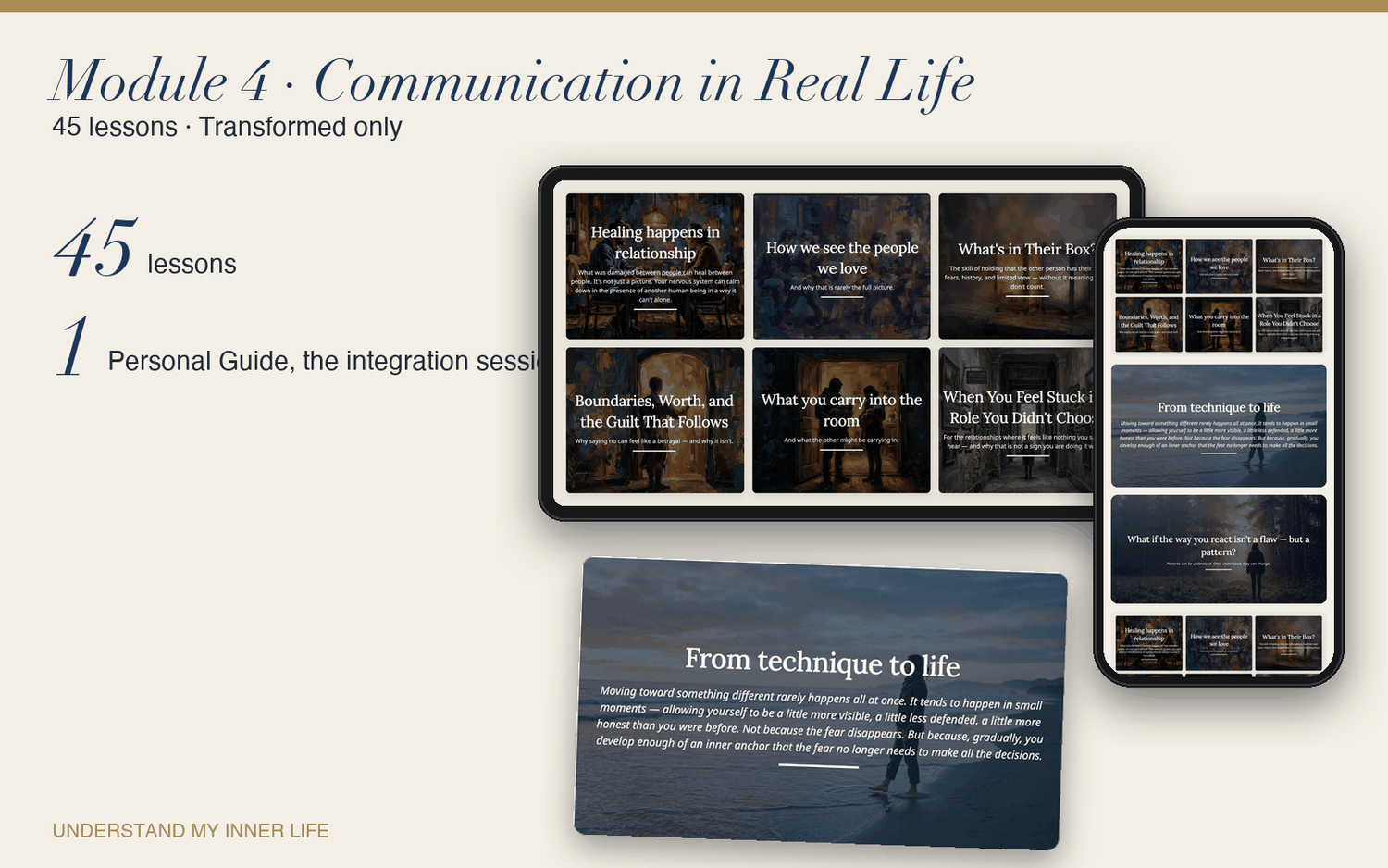
Module 4 · 45 lessons · Transformed
Communication in Real Life
Calm yourself first. Then say the hard thing, clearly.
After this module: you can calm yourself first, then say the hard thing clearly.
✓ Set a boundary without feeling like a bad person
✓ See what is going on in the other person before you answer
✓ Ask for what you need, as a request, not a demand
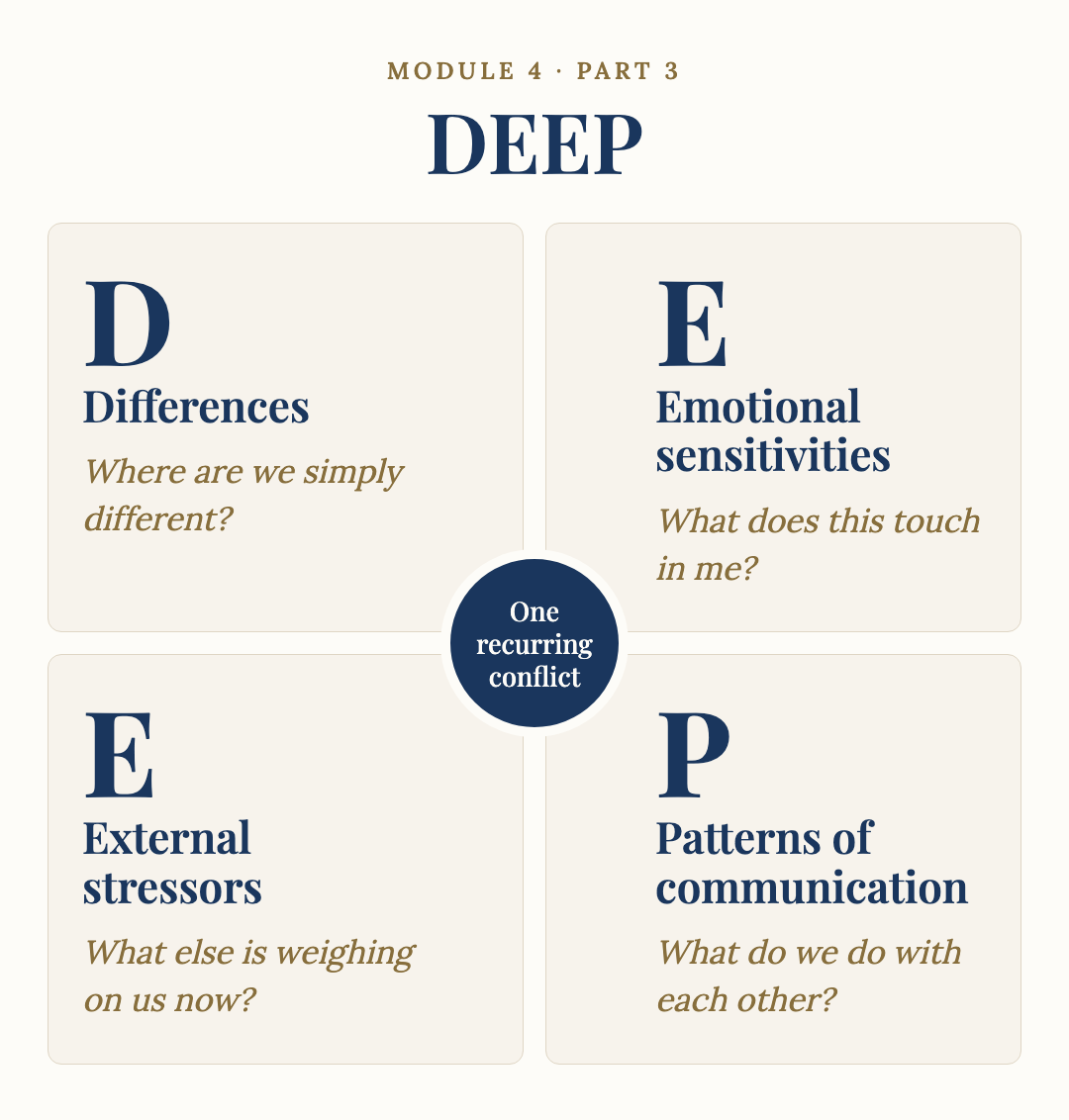
✓ Map a conflict that keeps coming back, with the four DEEP lenses
✓ Repair after it went wrong, in one honest sentence
✓ Your Personal Guide: the session that ties it all together
Questions this module answers
→ Why am I not myself when I am triggered?
→ How do I set a boundary without feeling like a bad person?
→ How do I ask for what I need, as a request and not a demand?
→ Why does the same conflict keep coming back?
→ How do I come back after it went wrong?
New in Part 3: DEEP
A conflict that keeps coming back is rarely about one thing. DEEP gives you four lenses to look through, one at a time: Differences, Emotional sensitivities, External stressors and Patterns of communication.
It is built on Integrative Behavioral Couple Therapy (Christensen, Doss and Jacobson, 2020). You map one recurring conflict of your own, and write one sentence about your reaction, not the other person’s fault.
From inside the module
Your partner says: “You’ve been really distant lately.” One answer closes the conversation: “That’s not fair, I’ve had a lot going on.”
Another opens it: “I hear that something feels off between us. I’ve noticed it too. Can we talk about it?” Same moment, same feeling. The module trains the second answer.
What you keep
Your Personal Guide, written on day 21: what sets you off, what calms you, your shortest way back to yourself, and your shortest way back to the other person.
Look inside Module 4, part by part
How we see the people we love.
· Welcome to Module 4
· How we see the people we love
What you bring into the room, and what happens when it takes over.
· Meeting your feelings
· What you carry into the room
· You are not yourself when you are triggered
· When the activation takes over
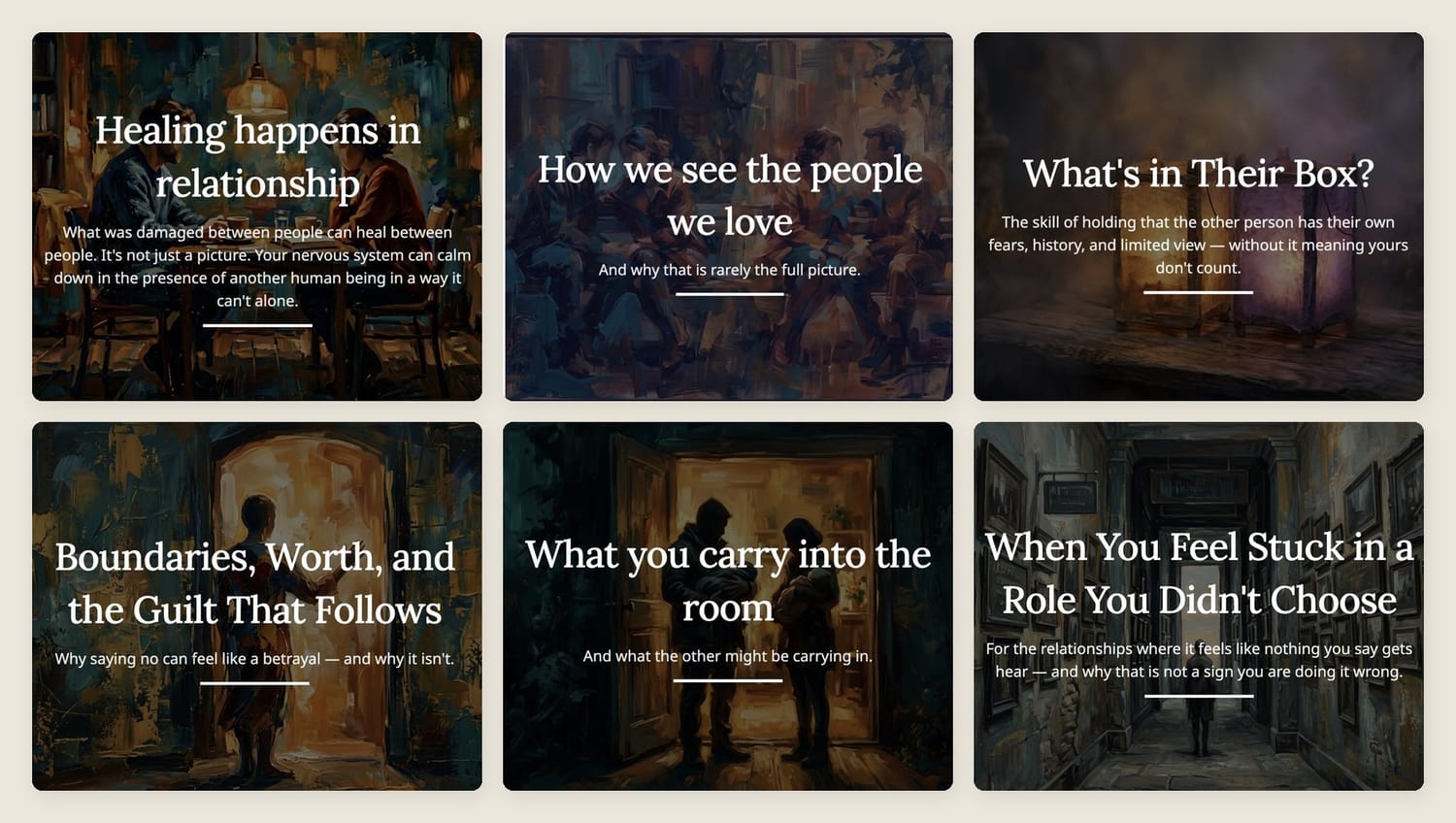
· Healing happens in relationships
· Patterns you recognise
· Standing up for yourself
· Boundaries, worth and the guilt that follows
· Closeness that carries you
· What is in their box?
· From yourself to you and the other
· Knowledge check: closeness
Saying what you need, as a request.
· Needs and requests: saying it directly
· The request
· The request in everyday life
· The full communication model
· Communication as a skill
· Model 1 and Model 2
· The five communication skills
· Practise your communication
The feeling under the argument.
· Before the conflict: the feeling underneath
· How old patterns colour a conflict
· DEEP: four lenses on a recurring conflict
· When you feel stuck in a role you didn't choose
· Whose task is this?
· Communication in the moment
Coming back after it went wrong.
· When you want to come back
· Role play: repair
· Releasing the grip
Putting it together.
· Your Personal Guide, day 21
· Why repetition matters
· Module 4 quiz
· Closing
MODULE 4 · A MINUTE FROM THE VIDEO
Two people, two boxes, the same feeling
“The other person can’t see inside our box. So the closeness, the connection, depends on how well we try to understand each other’s boxes.”
KRISTINA, FROM MODULE 4
What you get
Everything you get
✓ 4 modules and the intro, 165 lessons in all
✓ Your Personal Manual, built from your own answers as you go
✓ Written exercises and knowledge checks in every module
✓ Lifetime access on phone or computer: one payment, nothing recurring
✓ Every future update, free
✓ Move up a level later and pay only the difference
IN THEIR OWN WORDS
What people say about Kristina
✶
“What made the biggest impression on me is how much she actually cares about the person behind the goals. She has been good at seeing the whole picture, and at motivating me to believe in myself. She makes me feel I am not standing alone, and that there is always a way forward.”
JON
✶
“She doesn’t let anything out of her hands before it feels right to her. I think this can mean a lot to anyone who struggles to put words to their own feelings.”
INGRID
✶
“She guided me through some of the most uncertain periods of my academic life, not by doing the thinking for me, but by consistently reflecting my own abilities back to me. I often left our conversations feeling more capable than when I arrived.”
STUDENT
✶
“Kristina is fearless in the face of strong emotions. She dares to stand in it together with you. That creates a safety that is rare to see.”
COLLEAGUE
✶
“She doesn’t just offer comfort, she helps you understand why you feel what you feel. She puts words to things I hadn’t been able to express myself.”
NIKA
The three levels
Three levels. One payment. Yours for life.
START HERE
Self-Aware
$297 · one payment · lifetime access
For you if this is your first time working with your feelings in a structured way.
✓ Module 1: Understanding Emotions (59 lessons)
✓ Module 2: CBT (28 lessons)
✓ All exercises for Modules 1 and 2
MODULES 1 TO 3
Regulated
$597 · one payment · lifetime access
For you if your thoughts keep going round, and you want a way to step back from them.
Everything in Self-Aware, plus:
✓ Module 3: Thought Defusion from ACT and MCT (32 lessons)
✓ 6 core techniques plus 3 more, practised
✓ Step out of a worry loop while you are in it
THE WHOLE COURSE
Transformed
$997 · one payment · lifetime access
For you if you’re ready to change how you show up with the people who matter most.
Everything in Regulated, plus:
✓ Module 4: Communication in Real Life (45 lessons)
✓ Boundaries, conflict and repair, trained in practice
✓ Needs and requests. Mentalizing. Attachment patterns.
Not sure? Start with Self-Aware. You can move up any time and pay only the difference.
Is it for you?
Who this is for, and who it is not for
This is for you if you feel a lot and want to understand what is actually going on inside you, you want to understand yourself and not just cope, you want tools you can reach at 11 pm on a Tuesday without a waitlist, and you are ready to practise.
This is not for you if you want individual therapy with a therapist, or you are looking for a quick fix.
If you are in crisis right now, please reach out first: findahelpline.com. The course is teaching and practice. It is not therapy, and it does not diagnose.
Want to hear from people who know how I work? Read the reflections and reference letters: In their own words.
Before you choose
Questions people ask
A few minutes. Most people do two or three a week. There is no wrong pace.
No. Every lesson explains one thing in plain words, before you practise it.
Your Personal Manual in Module 1 and 2, your personal plan in Module 3, and your Personal Guide in Module 4. They are yours to keep.
Not sure? Start with Self-Aware. You can move up any time and pay only the difference.
No. It is teaching and practice, and it does not diagnose. Many people use it next to therapy.
After payment you get an email. You sign in with the email you paid with, on your phone or computer. Nothing to install.
Ready when you are.
Four modules and the intro. 165 lessons, practised until they are there when it counts.
Not ready to buy? Try the free preview: real course content, no card.